
Industrial Robot Arms
High-End Mechanical Arm Machining
CNCPioneer is an AS9100D and IATF 16949 certified China high-end mechanical arm machining factory delivering professional mechanical arm machining services — 78+ Swiss CNC lathes and 66+ MAZAK mill-turn centers for plate mechanical arm machining, plate sliding rail mechanical arm machining, end of arm tooling machining, machining robot arm connector parts, and complete supply mechanical arm machining programs for robot OEMs, integrators, and distribution partners worldwide since 2011.
What Is Industrial
Robot Arms Machining?
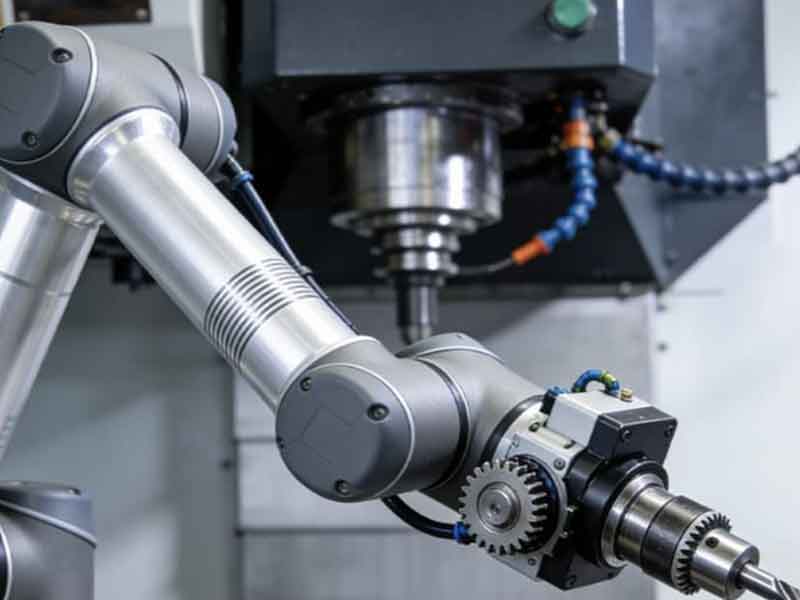
Industrial robot arms machining is the precision CNC manufacturing of mechanical arm structural components, joint drive elements, end-effector hardware, linear motion system parts, and electrical interface components for serial chain industrial robots, collaborative robot arm systems, SCARA robot arms, delta robot arms, cartesian gantry arms, and specialized robotic manipulator assemblies through Swiss turning, mill-turn machining, multi-axis milling, precision boring, and specialized secondary operations.
The mechanical arm is the defining mechanical subsystem of every industrial robot — the kinematic chain of structural links, rotary joints, linear axes, and end-effector interfaces that positions the robot's tool center point with the accuracy, repeatability, and speed that defines robot system performance. Every dimension of every machined component in the mechanical arm directly influences robot performance: arm link dimensional accuracy governs kinematic model calibration; joint bearing housing concentricity governs positioning repeatability; plate structural component flatness governs arm stiffness; sliding rail component geometry governs linear axis accuracy; and robot arm connector parts dimensional compliance governs wiring harness reliability across millions of robot operational cycles.
-
High-end mechanical arm machining precision capability CNCPioneer's high-end mechanical arm machining achieves bearing journal roundness ±0.002mm, shaft concentricity ±0.002mm, plate face flatness 0.005mm, and sliding rail mounting surface straightness 0.010mm per 500mm — the dimensional standards that define high-end mechanical arm machining quality and distinguish premium robot arm performance from commodity robot arm products. 100% roundness tester verification at 0.0001mm resolution on all harmonic drive components.
-
Complete supply mechanical arm machining factory single-source capability CNCPioneer's supply mechanical arm machining factory covers joint drive components, plate structural elements, plate sliding rail components, end of arm tooling parts, and robot arm connector hardware in a single supply relationship — eliminating the multi-supplier coordination that conventional industrial robot arms machining supply chains require. Plate mechanical arm machining, EOAT machining, and robot arm connector parts from one AS9100D certified source.
-
Profitable supply mechanical arm machining factory programs for distributors CNCPioneer's China high-end mechanical arm machining factory creates the margin structure that makes supply mechanical arm machining programs profitable for robot component distributors and integrators — 40–60% below European and Japanese industrial robot arms machining pricing at equivalent dimensional accuracy (plate flatness 0.005mm, bearing journal roundness ±0.002mm) and AS9100D/IATF 16949 documentation quality that robot OEM customers require.
-
24-hour professional mechanical arm machining DFM review Every industrial robot arms machining inquiry receives comprehensive DFM review within 24 hours — dimensional feasibility against Swiss CNC (±0.002mm) and MAZAK mill-turn (±0.003mm) capability envelopes; tolerance stack-up assessment for robot arm assembly accuracy; mass optimization through pocket geometry analysis; and material selection guidance. Professional mechanical arm machining engineering support at no cost for every program inquiry.

Why CNCPioneer — High-End
Mechanical Arm Machining Factory
CNCPioneer's China high-end mechanical arm machining factory combines Swiss CNC precision for critical joint drive components, MAZAK mill-turn capability for complex plate structural and connector parts, dual AS9100D and IATF 16949 quality certification, and China manufacturing economics — creating the profitable supply mechanical arm machining economics for robot OEMs, integrators, and distribution partners globally.
Plate Flatness 0.005mm — Precise Robot Arm Assembly
CNCPioneer's plate mechanical arm machining achieves motor mounting plate flatness 0.005mm, joint flange plate flatness 0.005mm, and ISO 9283 end-effector mounting flange face runout ≤ 0.010mm — the dimensional standards governing subsystem mounting accuracy, joint assembly seating, and TCP calibration reliability. Plate hole pattern accuracy ±0.020mm for simultaneous 4/6-bolt engagement across joint assembly, motor mounting, and ISO 9283 tool flange bolt circles.
Rail Mounting Straightness 0.010mm/500mm
CNCPioneer's plate sliding rail mechanical arm machining achieves rail mounting surface straightness of 0.010mm per 500mm — five times more accurate than standard plate machining — governing the geometric accuracy of SCARA robot Z-axes, cartesian robot arm linear drives, 7th-axis track systems, and telescoping arm extensions. A 0.050mm/500mm straightness error produces 0.050mm systematic tool center point positioning error that no robot controller calibration can compensate. Verified by Mitutoyo CMM straightness measurement on every first article.
EOAT Machining — ISO 9283 TCP Compliance
CNCPioneer's end of arm tooling machining achieves ISO 9283 register spigot h6 ±0.008mm and mounting bolt circle ±0.020mm — the critical EOAT machining dimensions determining how accurately and repeatably the EOAT positions its functional tool tip relative to the robot arm wrist flange. Quick-change master-to-tool-plate cone seat ±0.003mm produces TCP repeatability ≤ 0.010mm across tool change cycles, enabling automatic tool change without TCP recalibration between tool exchanges.
IP67 Robot Arm Connector Parts Machining
CNCPioneer's machining robot arm connector parts achieves O-ring groove width ±0.020mm and depth ±0.020mm for the 20–25% O-ring compression ratio required for IP67 water ingress protection at robot arm connector penetration points. Mating face flatness 0.010mm ensures uniform O-ring compression around the complete sealing circumference. Cable entry thread pitch diameter ±0.005mm (NPT, BSP, PG) governs cable gland watertight seal engagement — verified by 100% CMM O-ring groove verification on all IP67 connector programs.
Profitable Supply Mechanical Arm Machining Economics
CNCPioneer's China high-end mechanical arm machining pricing is 40–60% below European and Japanese robot arm machining suppliers at equivalent dimensional accuracy (bearing journal roundness ±0.002mm, plate flatness 0.005mm) and documentation quality (FAIR/PPAP). At 500–2,000 piece production quantities, distributors purchasing from CNCPioneer's supply mechanical arm machining factory can resell at Western-equivalent quality standards with 30–50% gross margin. AS9100D + IATF 16949 dual certification provides the robot OEM qualification documentation eliminating China-sourced supply risk.
Volume Scalability — Prototype to Production
CNCPioneer's supply mechanical arm machining factory scales from 10-piece prototype orders in 5–7 business days through 100,000-piece annual production for high-volume industrial robot arms machining programs — allowing distribution partners to start small, validate supply mechanical arm machining quality, and scale volume as their customer base grows without supplier transition costs. Blanket order programs with dedicated capacity reservation and committed 2–3 week monthly delivery release lead times.
Industrial Robot Arms Machining
— Complete Component Range
CNCPioneer's industrial robot arms machining factory covers the complete mechanical arm component spectrum — from Ø0.5mm Swiss-CNC-machined robot arm connector pin components through 600mm×400mm MAZAK-machined plate mechanical arm structural body panels — providing single-source supply mechanical arm machining for joint drive hardware, structural plates, sliding rail systems, end of arm tooling, electrical connector interface hardware, and arm link structural fittings.

Plate Mechanical Arm Machining
Robot arm central hub plates, joint flange plates, motor mounting plates (flatness 0.005mm for motor-to-harmonic-drive shaft alignment), end-effector mounting plates (ISO 9283 flange face runout ≤0.010mm), electronics mounting plates, and cable management body panels. Hole pattern accuracy ±0.020mm for simultaneous 4/6-bolt engagement. Bore accuracy: dowel pin H7 ±0.005mm; bearing press-fit ±0.003mm roundness. Mass optimization: 30–50% material removal through rib-and-pocket geometry; minimum pocket floor 2.0mm. Six-axis robot arm plate machining (FANUC/KUKA/ABB/Yaskawa compatible) in 7075-T6 with hard anodize Type III; cobot arm plates (1.5–2.0mm wall for ISO/TS 15066 inertia compliance); SCARA arm structural panels; gantry crossbeam mounting plates. High-volume professional plate mechanical arm machining up to 50,000 plates annually.

Plate Sliding Rail Mechanical Arm Machining
Linear rail mounting plates (rail mounting surface straightness 0.010mm/500mm — the most critical specification in plate sliding rail mechanical arm machining; rail bolt hole pitch ±0.020mm; dual-rail parallelism 0.020mm/500mm; perpendicularity 0.010mm/100mm; 6061-T6 standard). Linear carriage body plates (linear guide block mounting surface flatness 0.005mm; block hole pattern ±0.020mm; payload mounting surface flatness 0.010mm; mass ±5g; 7075-T6 for minimum carriage mass). Ball screw and linear actuator mounting plates (fixed-end bearing bore ±0.005mm diameter/±0.003mm roundness; float-end bore ±0.010mm; centerline height ±0.020mm). 7th-axis robot arm track system plates (straightness 0.010mm/1,000mm; anchor bolt ±0.020mm; dual-rail parallelism 0.030mm/1,000mm). Telescoping arm slide components (inner tube OD h6 ±0.008mm; outer guide H7 ±0.010mm; Ra 0.4μm sliding surface).

End of Arm Tooling Machining
EOAT mounting plates and adapters (ISO 9283 flange bolt circle ±0.020mm; register spigot h6 ±0.008mm; tool-side flatness 0.005mm; mass ±5g within robot arm rated payload; 7075-T6). Parallel gripper jaw and body machining (jaw guide bore ±0.005mm; contact surface ±0.050mm; pneumatic port G1/8-G1/4 BSPP ±0.005mm; 6061-T6 standard, 316L for food/washdown). Three-finger adaptive gripper palm and finger base (finger pivot bore ±0.003mm; palm central actuator mounting accuracy). Vacuum cup mounting structure machining (array position ±0.200mm; manifold port thread ±0.005mm; flow restriction orifice ±0.020mm). Force-controlled compliant tool machining (guide bore ±0.005mm; spring seat ±0.020mm depth). Welding torch bracket machining (torch axis angular accuracy ±0.05°; wire conduit routing ±0.300mm). Dispensing head body machining (nozzle thread ±0.005mm; metering orifice ±0.010mm). Quick-change tool plate master-to-tool cone seat ±0.003mm for TCP repeatability ≤0.010mm.

Machining Robot Arm Connector Parts
Robot arm section coupling connectors (mating face flatness 0.005mm; register pilot h6/H7 ±0.008mm; bolt circle ±0.020mm; cable pass-through bore ±0.200mm; TCP repeatability ≤0.020mm across reassembly cycles; 7075-T6 or Ti-6Al-4V). Joint flange connectors (output face runout ≤0.010mm; ISO 9283 bolt circle ±0.020mm; 17-4PH H900 for max joint output connector strength). Robot arm base mounting connectors (bolt circle ±0.020mm; contact face flatness 0.005mm; zero-point clamping geometry ±0.010mm). Wiring harness pass-through connector bodies (housing OD ±0.010mm; contact retention bore ±0.003mm; IP67 O-ring groove ±0.020mm; M16×1.5/PG16 cable entry ±0.005mm; Alodine Class 3 EMC shielding). Circular connector shells (MIL-DTL-38999/MIL-DTL-26482 series; coupling nut thread ±0.005mm; contact insert retention ±0.003mm). Slip ring structural components (contact ring OD concentricity ±0.003mm; housing bore ±0.003mm; 303 stainless rotor; copper alloy contact rings; PEEK brush holders). Robot arm power terminal machining (pin diameter ±0.003mm; Ra 0.2μm for gold plating; gold MIL-G-45204 over nickel). Miniature signal connector bodies (M8/M12 sensor bodies per IEC 61076-2-101; contact bore array ±0.002mm at 0.5–1.0mm pitch).

Robot Arm Joint Drive Components
Harmonic drive wave generator shaft machining (bearing journal roundness ±0.002mm standard/±0.001mm high-precision; 100% roundness tester 0.0001mm resolution; 17-4PH H900; Ra 0.4μm/Ra 0.2μm). Flexspline thin-wall cup machining (wall thickness ±0.020mm; cylindricity ±0.003mm; minimum wall 0.4mm; 17-4PH H900 or Inconel 718). Circular spline ring gear (pitch diameter ±0.005mm; housing bore ±0.003mm). Joint main bearing housing bodies (bearing bore ±0.003mm; roundness ±0.002mm; input-to-output concentricity ±0.003mm; 7075-T6 or Ti-6Al-4V). Joint torque sensor structural bodies (elastic beam thickness ±0.010mm governing sensor sensitivity accuracy). Motor mounting hardware (motor bore concentricity ±0.005mm; encoder mounting runout ≤0.003mm). Robot arm structural links: CFRP interface end fittings in Ti-6Al-4V (CFRP bore ±0.050mm; joint bore ±0.005mm); intermediate link structural elements (angular accuracy ±0.050°; wall 1.5–3.0mm; pocket mass optimization); robot base flange (mounting bolt pattern ±0.020mm; slewing race seat ±0.003mm).

Supply Mechanical Arm Machining Distribution
CNCPioneer's supply mechanical arm machining factory distribution programs provide robot component distributors, robot system integrators, and industrial automation resellers with tiered pricing from prototype through high-volume production (15–25% at 50–199 pcs; 25–40% at 200–999 pcs; 40–55% at 1,000–4,999 pcs; up to maximum discount at 5,000+ pcs and annual blanket orders). Dedicated mechanical arm machining production capacity reservation for blanket order distribution partners. Inventory stocking programs for fastest-moving mechanical arm machining part numbers. Priority scheduling for urgent supply mechanical arm machining orders. Complete documentation package (CMM report, material certifications, surface treatment certifications, FAIR/PPAP) with every supply mechanical arm machining shipment. Volume scalability from 10-piece robot development prototype orders through 100,000-piece annual production in a single supply mechanical arm machining factory relationship.
Industries & Applications
CNCPioneer's industrial robot arms machining factory serves automotive robot OEMs, collaborative robot manufacturers, electronics/semiconductor automation producers, medical and surgical robotics developers, warehouse logistics robot makers, aerospace and defense robotics contractors, food and pharmaceutical processing robot builders, and supply mechanical arm machining distribution partners worldwide.

Automotive Manufacturing
Industrial robot arms machining for automotive welding robot arm joint components, automotive assembly robot arm plate structural panels, paint shop robot arm slide rail components, and press tending robot EOAT mounting plates — IATF 16949 certified supply mechanical arm machining factory with PPAP Level 3 documentation for automotive robot OEM supply chains serving FANUC, KUKA, ABB, and Yaskawa Motoman robot programs at BMW, Volkswagen, Toyota, and global automotive OEM facilities.
Collaborative Robot Manufacturing
China plate mechanical arm machining for cobot arm structural panel components, cobot joint housing plates, cobot torque sensor bodies, and cobot EOAT mounting plates — lightweight thin-wall plate mechanical arm machining (1.5–2.0mm wall) for cobot ISO/TS 15066 safety compliance. Professional plate mechanical arm machining supply for UR, Fanuc CRX, ABB GoFa, and KUKA LBR iisy compatible collaborative robot arm assemblies.

Electronics & Semiconductor Manufacturing
Professional plate mechanical arm machining for SCARA robot arm structural components, delta robot arm plate elements, and electronics assembly robot EOAT vacuum gripper mounting plates. ESD-compatible material options (PEEK, Delrin gripper jaw components) and cleanroom-compatible surface treatments. Precision plate sliding rail mechanical arm machining for semiconductor wafer handling robot arm linear axis systems.

Medical & Surgical Robotics
High-end mechanical arm machining for surgical robot arm instrument housing components, medical robot arm structural fittings, rehabilitation robot arm exoskeleton joint elements, and medical EOAT instrument bodies in biocompatible titanium and 316L stainless steel. Electropolished Ra ≤ 0.4μm surfaces and ISO 13485 compatible quality documentation with FAIR per AS9102 for all medical industrial robot arms machining programs.

Warehouse Logistics & AMR
Supply mechanical arm machining for AMR robot arm pickup mechanism plate structural components, gantry robot arm linear rail mounting plates (straightness 0.010mm/500mm), and logistics robot EOAT container gripping structural hardware for warehouse automation applications. Plate sliding rail mechanical arm machining for 7th-axis robot arm track systems and automated storage and retrieval linear robot arm assemblies.

Food, Pharma, Aerospace & Defense
Professional plate mechanical arm machining in 316L stainless steel with electropolished surfaces for food processing robot arm EOAT, pharmaceutical robot arm washdown-rated structural components, and food-safe robot arm connector parts. AS9100D certified industrial robot arms machining for aerospace manufacturing robot arm joint components, defense robot arm structural hardware, and space robot arm structural elements with FAIR documentation per AS9102.
Industrial Robot Arms Machining
Factory Capabilities
CNCPioneer's China high-end mechanical arm machining factory combines Swiss CNC precision for critical joint drive and connector components, MAZAK mill-turn capability for complex plate structural bodies and EOAT hardware, dedicated CMM straightness measurement for plate sliding rail components, and roundness tester verification for harmonic drive components — delivering professional mechanical arm machining quality at China supply manufacturing economics.
Swiss CNC — Joint Drive & Connector Miniature Parts
78+ Swiss CNC lathes (Star SR-32J, Citizen A20/A16, Tsugami B206) · Ø0.5–Ø32mm robot arm component diameter range · Guide bushing support for L/D up to 20:1 — essential for slender robot arm shaft and connector pin components · Positional accuracy ±0.002mm; repeatability ±0.001mm · Harmonic drive wave generator bearing journal ±0.001mm roundness high-precision; slip ring contact ring concentricity ±0.003mm; signal connector contact bore array ±0.002mm at 0.5–1.0mm pitch; power terminal pin diameter ±0.003mm
MAZAK Mill-Turn — Plate, EOAT & Connector Bodies
66+ MAZAK mill-turn centers for plate structural arm components, EOAT mounting hardware, and robot arm connector bodies · Ø10–Ø300mm; plate dimensions to 600mm×400mm · 5-axis simultaneous for complex pocket geometry, multi-directional bore arrays, compound-angle interface features in single setups · Positional accuracy ±0.003mm · Single-setup machining preserving critical geometric relationships — plate flatness relative to bore axes, O-ring groove position relative to mating face, bolt circle concentricity relative to register pilot · EOAT cone seat ±0.003mm in single-setup for TCP repeatability ≤0.010mm
Plate Mechanical Arm Machining Precision
Plate face flatness: 0.005mm motor mounting / joint flange plates; 0.010mm ISO 9283 end-effector face · Face parallelism: 0.010mm–0.020mm per program · Hole pattern position: ±0.020mm for joint assembly bolt circles, motor mounting patterns, ISO 9283 tool flange bolt circles · Bore diameter: ±0.005mm standard / ±0.003mm high-precision · Pocket geometry: 30–50% mass reduction; minimum pocket floor 2.0mm; rib-and-pocket for stiffness at minimum mass · Wall thickness: 1.5–2.0mm cobot arm plates; 2.0–3.0mm industrial arm plates · High-volume plate mechanical arm machining: up to 50,000 plates/year in 7075-T6 with hard anodize
Plate Sliding Rail Arm Machining Precision
Rail mounting surface straightness: 0.010mm/500mm standard / 0.005mm/500mm high-precision — verified by Mitutoyo CMM straightness measurement on every plate sliding rail mechanical arm machining first article · Dual-rail parallelism: 0.020mm/500mm for equal carriage load distribution · Ball screw fixed-end bearing bore roundness: ±0.002mm verified by roundness tester · Carriage body guide block mounting surface flatness: 0.005mm · 7th-axis track plate straightness: 0.010mm/1,000mm · Telescoping arm sliding surface: Ra 0.4μm for smooth extension · Ball screw centerline height: ±0.020mm for correct nut-to-carriage geometric alignment
Industrial Robot Arms Machining Materials
Al 7075-T6 (503 MPa; dominant robot arm structural fitting and plate material) · Al 6061-T6 (excellent machinability; EOAT structural plates; sensor mounts; chassis) · 17-4PH H900 (1,310 MPa yield; AMS 5643; dominant harmonic drive and joint shaft material; soft-state machining ±0.002mm roundness then H900 aging with minimal distortion) · 316L stainless (food robot EOAT; surgical arm; washdown connector parts) · 303 stainless (general robot arm mechanism components; connector bodies) · Ti-6Al-4V Grade 5 (CFRP-interface arm fittings; surgical arm; exoskeleton) · Ti Grade 23 ELI (surgical robot instruments; ISO 10993 biocompatible) · Inconel 718 (high-payload harmonic drive flexspline; high-temp industrial arm joints) · Brass C3604 (connector bodies; signal connector hardware) · Beryllium Copper C17200 (robot arm power connector contacts) · PEEK (ESD-sensitive EOAT; medical arm; food arm) · Invar 36 (robot arm calibration reference; CTE 1.3 ppm/°C)
AS9100D / IATF 16949 Documentation
FAIR per AS9102 for aerospace and medical industrial robot arms machining programs · PPAP Level 3 with Cpk ≥ 1.67 on critical bearing journal, plate flatness, O-ring groove, and rail straightness dimensions; MSA Gage R&R for CMM, roundness tester, and straightness measurement systems; FMEA; control plan · 100% CMM + roundness tester for all harmonic drive and bearing robot arm joint components · 100% CMM O-ring groove verification on all IP67 robot arm connector programs · 17-4PH H900 hardness 388–444 HBW per AMS 5643 verified every lot · Mass measurement ±0.1g on mass-specified EOAT and cobot arm components · Records: 10 years industrial; 20 years aerospace/medical
Materials for Industrial
Robot Arms Machining
Industrial robot arms machining material selection is governed by specific strength for robot arm mass minimization, machinability for high-end mechanical arm machining precision, tribological performance for joint drive component lubrication compatibility, biocompatibility for medical robot arm applications, and food-contact compliance for food/pharmaceutical robot arm EOAT. 17-4PH H900 dominates joint drive and connector contact parts; 7075-T6 dominates plate and structural arm components; Ti-6Al-4V serves CFRP-interface fittings and surgical arm hardware.
7075-T6
503 MPa yield strength · Density 2.80 g/cm³ · Dominant robot arm structural fitting and plate mechanical arm machining material — highest-strength aluminum alloy for robot arm structural plates, joint casings, EOAT mounting plates, motor mounting plates, and end-effector adapter plates. 30–50% mass reduction through rib-and-pocket geometry at equivalent stiffness. Hard anodize Type III standard surface treatment for wear resistance at robot arm assembly contact interfaces. Wholesale supply mechanical arm machining programs in standard 7075-T6 plate configurations.
6061-T6
Excellent machinability · Weldable · Density 2.70 g/cm³ · EOAT structural plates, robot arm chassis structural plates, sensor mounting hardware, linear rail mounting plates for robot arm slide rail systems, and electronics mounting plates. Standard plate mechanical arm machining material for applications where 7075-T6's additional yield strength is not required. Chemical film (Alodine) surface treatment for robot arm connector body components requiring EMC shielding continuity. Rapid prototype plate mechanical arm machining: 5–7 business days first article.
2024-T351
High fatigue strength · Density 2.78 g/cm³ · High-cycle robot arm mechanism components and rotating robot arm parts subject to millions of load cycles across robot operational lifetime. Robot arm EOAT mechanism link components, robot arm joint cam follower elements, and robot arm structural fittings where 2024-T351's superior fatigue resistance versus 7075-T6 governs component service life under cyclic operational loading in industrial robot arm production environments.
Ti-6Al-4V Grade 5
Specific strength 199 MPa·cm³/g · CTE 8.6 ppm/°C (CFRP-compatible) · AMS 4928 · Premium industrial robot arms machining structural material for CFRP-interface robot arm end fittings (titanium CTE 8.6 vs. CFRP 0–2 ppm/°C preventing thermal fatigue at bonded robot arm structural interfaces), surgical robot arm structural hardware, exoskeleton robot arm joint components, and weight-critical advanced robot arm programs where titanium's specific strength enables minimum cross-section at required structural loading. Non-magnetic for magnetically sensitive robot arm sensor applications.
Ti Grade 23 ELI
ISO 10993 biocompatible · Superior fracture toughness · Surgical robot arm instrument housing components, medical robot arm structural fittings in direct human-contact or implantable-adjacent configurations, and rehabilitation robot arm exoskeleton joint elements where biocompatibility in addition to structural performance governs material selection. Enables surgical robot arm joint compactness within instrument shaft diameter constraints that steel robot arm structural components at equivalent strength cannot achieve. Electropolished Ra ≤ 0.4μm for surgical compliance.
Inconel 718
High fatigue strength at elevated temperature · Age-hardenable · AMS 5663 · High-payload industrial robot arms machining harmonic drive flexspline components where 17-4PH H900 fatigue strength is insufficient at the same flexspline wall thickness, and high-temperature industrial robot arm joint applications where robot arm joint drive components operate in elevated-temperature environments exceeding 17-4PH H900's temperature service range. Flexspline thin-wall 0.4mm minimum achievable in Inconel 718. 10–14 business day prototype industrial robot arms machining.
17-4PH H900
Yield strength 1,310 MPa · Dominant robot arm joint drive component material · Non-magnetic · AMS 5643 · Hardness 388–444 HBW governs harmonic drive fatigue life. Critical industrial robot arms machining manufacturing advantage: soft-state machining (H1150-M annealed) achieves ±0.002mm bearing journal roundness before H900 precipitation hardening aging produces 1,310 MPa yield strength with minimal dimensional distortion. Robot arm joint flange connectors (17-4PH H900 for maximum joint output connector strength), harmonic drive wave generator and circular spline, joint torque sensor elastic beam elements.
316L & 303
316L: Non-magnetic · Biocompatible · Food handling robot arm EOAT gripper jaws (FDA food contact compliant), pharmaceutical robot arm structural elements, washdown-rated robot arm connector parts, and surgical robot arm instrument housing bodies. Electropolished Ra ≤ 0.4μm for surgical robot arm regulatory clearance. Passivation ASTM A967 standard for all stainless steel industrial robot arms machining programs. 303: Good machinability for general robot arm mechanism components, robot arm pivot pins, and standard connector body hardware where 316L's molybdenum content is not required.
Steel 4140 / Cast Iron
High stiffness · High mass · Steel 4140 for heavy-duty robot arm EOAT welding torch brackets (black oxide finish), quick-change master plate bodies (hard chrome or DLC for wear resistance at high-cycle ATC applications), and robot arm base mounting connectors in heavy-duty industrial applications. Cast iron for 7th-axis robot arm track system base plates and linear rail mounting structures for heavy-payload robot arm linear axis systems requiring maximum rail mounting surface stiffness at minimum cost.
Brass C3604 & Beryllium Copper
Brass C3604: Excellent machinability · Standard robot arm connector body CNC machining material for signal connector shells, robot arm wiring harness pass-through connector housings, and M8/M12 sensor connector bodies (IEC 61076-2-101 standard). Nickel plated for corrosion resistance. Beryllium Copper C17200: Highest strength copper alloy · Non-sparking · Robot arm high-current power connector terminal pins and socket contacts (48V–400V, 10A–100A servo drive power). Gold MIL-G-45204 plated over nickel for stable low contact resistance across robot arm service lifetime.
PEEK & Delrin
PEEK: Chemical resistant · Biocompatible · Low density (1.32 g/cm³) · ESD-sensitive electronics assembly robot arm EOAT gripper jaw components, MRI-guided medical robot arm structural elements where metallic components create imaging artifacts, and slip ring brush holder body components (non-conducting isolation of brush elements from robot arm slip ring housing). Delrin: Low friction · Good machinability · Robot arm EOAT slide mechanism components, robot arm cable management guide elements, and food-grade robot arm EOAT parts in direct food contact.
Invar 36
CTE 1.3 ppm/°C · Ultra-low thermal expansion · Robot arm calibration reference components — robot base calibration fixture plates, laser tracker target nest mounting bases, and robot arm accuracy verification reference structures where dimensional change across robot arm operating temperature range would introduce systematic positioning error into robot arm calibration measurements. Thermally stable robot arm structural elements for precision assembly robot arm applications requiring sub-0.010mm dimensional stability across the robot arm's operating temperature range.
Surface Treatments for Industrial
Robot Arms Machining
Industrial robot arms machining surface treatment selection is governed by wear resistance at robot arm assembly contact interfaces, biocompatibility and sterilization compatibility for medical robot arm EOAT, corrosion resistance for food processing and washdown robot arm applications, EMC shielding conductivity for robot arm connector and housing components, low-reflectance for machine vision guided robot arm applications, and food-contact compliance for food processing robot arm end-effector components.
Hard Anodize — MIL-A-8625 Type III (Aluminum Robot Arm Parts)
Standard surface treatment for aluminum industrial robot arms machining structural, plate, and EOAT components. HV 400+ hardness for wear resistance at robot arm assembly contact surfaces. Type III (15–50μm) for industrial robot arm joint mounting interfaces, EOAT adapter plates, plate mechanical arm machining structural components. Type II (5–15μm) for components where minimal coating thickness impact on precision plate flatness and bore tolerances is required. Custom color anodize for cobot safety color coding. Clear, black, and custom RAL color options for robot arm brand identification.
Chemical Film — MIL-DTL-5541 (Robot Arm EMC Shielding)
Alodine chromate conversion coating for aluminum robot arm connector parts and electronic housing components requiring EMC shielding conductivity. Class 3 for minimum-resistance EMC bonding at robot arm connector penetrations and servo drive enclosure interfaces — ensuring reliable electromagnetic shielding continuity at robot arm wiring harness pass-through points. Class 1A for maximum corrosion protection on agricultural and outdoor robot arm structural aluminum components where hard anodize dimensional buildup would compromise precision robot arm plate or connector bore fits.
Passivation — ASTM A967 (Food & Surgical Robot Arm Parts)
Mandatory for all stainless steel industrial robot arms machining components — food processing robot arm EOAT gripper jaws, surgical robot arm instrument housing bodies, pharmaceutical robot arm structural elements, and washdown cobot robot arm connector parts. Removes free iron from machined stainless surfaces, enhances chromium oxide passive layer for food contact safety compliance, autoclave sterilization compatibility, and pharmaceutical cleanroom environmental compliance. Standard on all 316L and 17-4PH stainless steel robot arm mechanical arm machining programs.
Gold Plating — MIL-G-45204 (Robot Arm Connector Contacts)
Hard gold plating per MIL-G-45204 for robot arm electrical connector contact components — robot arm slip ring contact rings, circular connector contact surfaces, power terminal contact bodies, and signal connector contact pin elements. Gold's stable low contact resistance across robot arm joint slip ring service lifetimes, circular connector mating cycles, and power distribution contact surfaces governs robot arm control signal reliability and servo drive power delivery integrity across industrial robot arm operational service life. XRF thickness verification on every production lot of machining robot arm connector parts electrical contact programs.
Black Anodize & PTFE Coating
Black anodize for industrial robot arms machining structural components in machine vision guided robot arm applications — low-reflectance surface preventing specular reflections corrupting robot arm vision system object detection and pose estimation accuracy. Black anodize also provides high solar absorptivity for thermal management of outdoor robot arm structural plate components. PTFE / dry lube coating for robot arm sliding plate rail components and EOAT mechanism sliding surfaces — low friction coefficient below 0.05 for lubrication-free operation in cleanroom robot arm environments and food processing robot arm applications where liquid lubricants are prohibited.
Zinc, Nickel Plating & Electropolishing
Electroless nickel plating for robot arm wear-surface connector parts requiring wear resistance at repeated contact interfaces — robot arm quick-change tool changer locking mechanism contact surfaces, robot arm guide rail slider interfaces, and robot arm linear stage carriage contact wear points. Zinc plating for cost-effective corrosion protection of robot arm steel structural hardware, robot arm welding torch bracket components, and robot arm linear motion system steel elements. Electropolishing for surgical robot arm and medical robot arm stainless steel components requiring Ra ≤ 0.4μm biocompatible surface finish for regulatory clearance and autoclave sterilization cycle resistance.
All industrial robot arms machining surface treatments — hard anodize MIL-A-8625 Type III, chemical film MIL-DTL-5541, passivation ASTM A967, gold plating MIL-G-45204, electropolishing, black anodize, PTFE dry lube coating, electroless nickel, and zinc plating — are selected per robot arm application environment, regulatory requirements (food contact, biocompatibility, EMC), and supply mechanical arm machining program economics. Surface treatment certifications are included in every industrial robot arms machining shipment documentation package. Surface treatment recommendation is included in CNCPioneer's 24-hour industrial robot arms machining DFM review service.
Quality Assurance for Industrial
Robot Arms Machining
CNCPioneer's industrial robot arms machining quality system applies AS9100D and IATF 16949 protocols across all robot arm component programs — plate flatness verification, rail mounting straightness measurement, harmonic drive roundness tester verification, O-ring groove CMM verification for IP67 connector compliance, and 17-4PH H900 hardness testing, from prototype plate mechanical arm machining through high-volume supply mechanical arm machining factory production.
Contract & Drawing Review
Engineering review of industrial robot arms machining drawing requirements, applicable ISO 9283, AS9100D, IATF 16949, ISO 13485 (medical robot arm), ISO 9283 EOAT flange standards, IP rating compliance for robot arm connector parts, and customer robot OEM specifications. Plate mechanical arm machining flatness feasibility, plate sliding rail arm machining straightness specifications, EOAT machining ISO 9283 compliance, and machining robot arm connector parts IP67 sealing geometry reviewed before order acceptance.
Material Incoming Inspection
SII XRF composition verification confirms alloy grade compliance for every industrial robot arms machining material lot. 17-4PH H900 hardness verification (388–444 HBW per AMS 5643) — H900 hardness directly governs harmonic drive wave generator and circular spline fatigue life, the defining material property for robot arm joint service life under rated cyclic loading. Full lot traceability from mill certificate through finished robot arm component. Counterfeit material prevention for all OEM supply mechanical arm machining programs.
First Article Inspection (FAIR) per AS9102
FAIR per AS9102 for aerospace and medical industrial robot arms machining programs. PPAP Level 3 with Cpk ≥ 1.67 on plate flatness, rail mounting straightness, harmonic drive bearing journal roundness, and O-ring groove dimensions; MSA Gage R&R for CMM, roundness tester, and straightness measurement systems; FMEA; control plan for automotive supply mechanical arm machining programs. Complete CMM dimensional verification with balloon drawing, roundness tester records, surface treatment certifications, and mass measurement results. Customer approval required before production quantity release.
In-Process Statistical Control
100% CCD automatic sorting for critical robot arm joint bearing bore diameters and plate flatness on high-volume supply mechanical arm machining production programs. Real-time harmonic drive journal monitoring by air gauge at defined production intervals. SPC Cpk ≥ 1.33 for all critical robot arm dimensions; Cpk ≥ 1.67 for IATF 16949 special characteristics on automotive industrial robot arms machining supply chains. 100% roundness tester verification on all harmonic drive wave generator and joint bearing seat components.
Final Inspection & Cleanliness Verification
Mitutoyo CMM (±0.001mm) full dimensional report covering plate flatness, hole pattern position, bore geometry, O-ring groove dimensions, rail mounting straightness, EOAT flange bolt circle, thread pitch diameter, wall thickness, and overall dimensions. Roundness tester measurement at 0.0001mm resolution for all harmonic drive and bearing robot arm joint components. Surface roughness on robot arm bearing and sealing surfaces. Thread gauge verification for all robot arm connector threaded features. Mass measurement on precision balance (±0.1g) for mass-specified EOAT and cobot arm components. Visual inspection for burrs on robot arm assembly interfaces.
Shipment Documentation
Certificate of Conformance, CMM dimensional report, roundness tester records, material certifications with full lot traceability, surface treatment certifications, mass records, FAIR per AS9102 or PPAP Level 3 package. Supply mechanical arm machining distribution programs: CoC and CMM sampling inspection per established control plan. Records retained 10 years for industrial robot arm programs; 20 years for aerospace and medical robot arm programs.
AS9100D & IATF 16949 Quality System for
Industrial Robot Arms Machining
CNCPioneer holds AS9100D certification for aerospace and medical robot arm programs and IATF 16949 certification for automotive industrial robot arms machining supply chains — providing the independently audited quality framework demanded by robot arm OEMs, supply mechanical arm machining distribution partners, and robot system integrators procuring high-end mechanical arm machining components globally.
FAIR per AS9102 (Aerospace & Medical Robot Arm Programs)
Complete FAIR documentation per AS9102 for every new aerospace and medical industrial robot arms machining program part number — AS9102 balloon drawing format with all drawing dimensions ballooned, measured, and recorded, with roundness tester records, plate flatness CMM results, material certifications, surface treatment certifications, and mass measurement results. Customer approval required before production quantity release. Records retained 20 years for aerospace and medical robot arm programs.
- FAIR per AS9102 for aerospace/medical robot arm P/Ns
- Customer approval before production release
- Records retained 20 years aerospace/medical
17-4PH H900 Hardness Verification (AMS 5643)
SII XRF PMI composition verification on every industrial robot arms machining material lot confirms alloy grade compliance. Hardness testing on every 17-4PH H900 robot arm joint drive component lot — H900 hardness 388–444 HBW per AMS 5643 directly governs harmonic drive wave generator and circular spline fatigue life. Full lot traceability from mill certificate heat number through finished robot arm component shipment. Counterfeit material prevention through approved supplier management for all OEM supply mechanical arm machining programs.
- XRF PMI on every robot arms machining material lot
- 17-4PH H900: 388–444 HBW per AMS 5643
- Full traceability mill cert → finished robot arm component
Plate Flatness & Rail Straightness Verification
100% CMM plate flatness verification (0.005mm target, standard 0.010mm) on all robot arm motor mounting plates, joint flange plates, and EOAT mounting plate mechanical arm machining first articles. Mitutoyo CMM straightness measurement on every plate sliding rail mechanical arm machining first article confirming 0.010mm/500mm rail mounting surface straightness. Production sampling per established control plan. Ball screw fixed-end bearing bore roundness ±0.002mm verified by roundness tester. 100% CMM O-ring groove verification (±0.020mm width and depth) on all IP67 machining robot arm connector parts programs.
- Plate flatness: 0.005mm motor mounting / joint flange plates
- Rail straightness: 0.010mm/500mm CMM verified
- 100% CMM O-ring groove on all IP67 connector programs
Cpk ≥ 1.67 / IATF 16949 PPAP Level 3
IATF 16949 PPAP Level 3 for automotive industrial robot arms machining supply chains — process capability study confirming Cpk ≥ 1.67 on plate flatness, harmonic drive bearing journal roundness, O-ring groove dimensions, rail mounting straightness, and bearing housing concentricity special characteristics; MSA Gage R&R for CMM, roundness tester, and straightness measurement systems; FMEA with critical mechanical arm machining process risk identification; control plan with 100% CCD sorting for safety-critical robot arm joint bearing diameters. Cpk ≥ 1.33 for all other critical industrial robot arms machining dimensions across all programs.
- Cpk ≥ 1.67 on IATF automotive robot arm special characteristics
- MSA Gage R&R for CMM, roundness tester, straightness gauges
- 100% CCD sorting on robot arm joint bearing bores
Industrial Robot Arms Machining FAQ
Common questions from robot OEMs, robot system integrators, mechanical arm machining distributors, and automation equipment manufacturers about CNCPioneer's China high-end mechanical arm machining factory capabilities, plate flatness, rail straightness, EOAT TCP compliance, robot arm connector IP67 specifications, distributor pricing economics, and supply mechanical arm machining factory lead times.
High-end mechanical arm machining is distinguished by four simultaneous performance dimensions. First, dimensional accuracy at bearing interfaces — achieving harmonic drive bearing journal roundness ±0.002mm and bearing housing bore concentricity ±0.003mm, versus standard robot arm machining at ±0.005–0.010mm, because robot positioning repeatability is directly traceable to these bearing interface dimensional parameters. Second, plate structural flatness — achieving plate face flatness of 0.005mm for joint mounting surfaces and sliding rail mounting surfaces of 0.010mm per 500mm, versus standard machining at 0.020–0.050mm. Third, material certification depth — full material lot traceability from mill certificate, XRF composition verification on every lot, and hardness verification for 17-4PH H900 (388–444 HBW per AMS 5643). Fourth, quality documentation completeness — FAIR per AS9102 or PPAP Level 3 with process capability data (Cpk ≥ 1.67). CNCPioneer's China high-end mechanical arm machining factory delivers all four dimensions at China manufacturing cost — creating the profitable supply economics for distributors that make China high-end mechanical arm machining competitively superior to both China standard-quality and Western high-end alternatives.
Plate sliding rail mechanical arm machining produces the structural plate components to which linear guide rails attach in robot arm linear axis systems — SCARA robot Z-axes, cartesian robot arm linear drives, 7th-axis robot track systems, and telescoping robot arm extension mechanisms. Rail mounting surface straightness governs the geometric accuracy of the linear axis the robot arm performs along that rail. A rail mounting surface with 0.050mm per 500mm straightness error produces a robot arm tool center point position deviation of 0.050mm along the linear axis stroke — a systematic positioning error that cannot be compensated by robot controller calibration because it is a spatial error varying with carriage position rather than a constant offset. For high-precision robot arm applications (semiconductor handling, precision assembly, metrology), CNCPioneer achieves rail mounting surface straightness of 0.010mm per 500mm — five times more accurate than standard plate machining. Verified by Mitutoyo CMM straightness measurement on every plate sliding rail mechanical arm machining first article, with production samples verified at defined intervals per the established SPC control plan.
The most critical EOAT machining tolerance for reliable robot TCP calibration is the ISO 9283 robot flange interface geometry — specifically the register spigot diameter (h6 tolerance, typically ±0.008mm) and the mounting bolt circle (±0.020mm). An EOAT with register spigot diameter outside h6 tolerance produces random radial offset between the robot arm flange and the EOAT body that varies with installation orientation — preventing consistent TCP calibration and introducing unpredictable robot path error. An EOAT quick-change master-to-tool-plate cone seat machined to ±0.003mm accuracy produces TCP repeatability of ≤ 0.010mm across tool change cycles — enabling automatic tool change without TCP recalibration between tool exchanges. CNCPioneer's end of arm tooling machining achieves ISO 9283 register spigot diameter h6 ±0.008mm, bolt circle ±0.020mm, and quick-change cone seat ±0.003mm as standard EOAT machining specifications, verified by CMM on every first article with production lot sampling inspection per the established control plan.
IP67 robot arm connector sealing compliance requires simultaneous achievement of three machining specifications. First, connector housing O-ring groove dimensional accuracy — groove width ±0.020mm and groove depth ±0.020mm ensure 20–25% O-ring compression ratio for IP67 water ingress protection; groove dimensions outside this tolerance produce insufficient compression (below 20%, risking IP67 failure) or excessive compression (above 30%, causing permanent O-ring deformation reducing seal life). Second, connector shell mating face flatness — mating face flatness of 0.010mm ensures uniform O-ring compression around the complete sealing circumference, preventing localized low-compression zones creating water ingress paths. Third, cable entry thread form accuracy — NPT, BSP, or PG cable gland thread pitch diameter ±0.005mm governs cable gland sealing engagement depth producing watertight seal compression at the cable-to-connector-shell interface. CNCPioneer's machining robot arm connector parts achieves all three specifications through MAZAK mill-turn single-setup machining of all connector sealing features, with 100% CMM O-ring groove verification on all robot arm connector IP67 programs.
CNCPioneer's China high-end mechanical arm machining pricing creates distributor margins through the combination of China manufacturing economics and premium quality positioning. At 500–2,000 piece production quantities — typical for robot component distributors serving multiple robot OEM customers — China high-end mechanical arm machining pricing from CNCPioneer is 40–60% below equivalent European and Japanese robot arm machining supplier pricing at equivalent dimensional accuracy (bearing journal roundness ±0.002mm, plate flatness 0.005mm) and quality documentation (FAIR/PPAP). This pricing gap creates the foundation for profitable mechanical arm machining distribution margins: distributors purchasing from CNCPioneer's China high-end mechanical arm machining factory at competitive supply pricing can resell to robot OEM customers at Western-equivalent quality standards with 30–50% gross margin. The AS9100D and IATF 16949 dual certification provides the qualification documentation that robot OEM customers require when accepting China-sourced high-end mechanical arm machining components — eliminating the quality acceptance risk that would otherwise discount the profitability of China mechanical arm machining distribution programs.
CNCPioneer's supply mechanical arm machining factory lead times for production quantity programs: aluminum 7075-T6 plate mechanical arm machining components — 3–4 weeks standard; plate sliding rail mechanical arm machining components — 3–4 weeks; stainless steel 17-4PH robot arm joint components — 4–5 weeks; titanium robot arm structural fittings — 4–5 weeks; EOAT machining standard configurations — 3–4 weeks; machining robot arm connector parts standard configurations — 3–5 weeks. Rapid prototype supply mechanical arm machining: aluminum components 5–7 business days; titanium 7–12 business days. For blanket order supply mechanical arm machining factory programs with annual volume commitments, CNCPioneer reserves dedicated production capacity and commits to monthly delivery release lead times of 2–3 weeks for standard configurations within the agreed blanket order schedule. Emergency expedite supply mechanical arm machining for production line critical needs: aluminum components from material in stock 24–48 hours machining plus 3–5 days international express shipping.
Get a Quote for Industrial Robot Arms Machining
Upload your robot arm component drawing or CAD file and receive a free DFM review and competitive industrial robot arms machining quotation within 24 hours. CNCPioneer's engineering team will review your plate mechanical arm machining design for flatness and hole pattern feasibility, confirm plate sliding rail mechanical arm machining straightness specifications for linear axis accuracy, assess end of arm tooling machining compliance with ISO 9283 tool flange standards, verify machining robot arm connector parts sealing geometry for IP67 compliance, identify critical robot arm component dimensions requiring special process controls, and provide complete quotation options covering prototype, OEM supply mechanical arm machining, and wholesale distribution programs.