
EV Battery Connectors
Precision CNC Machining
CNCPioneer is a precision EV battery connectors machining specialist and certified automotive EV battery connector CNC turning parts manufacturer delivering custom machined EV battery connector components — high-voltage power contact pin bodies, high-current terminal socket machining, MSD contact assemblies, HVIL connector pin bodies, BMS signal contact pins, DC fast-charge inlet contacts, CCS1/CCS2 charging contact bodies, and megawatt charging system terminal bodies.
What Is EV Battery Connectors
Precision Machining?
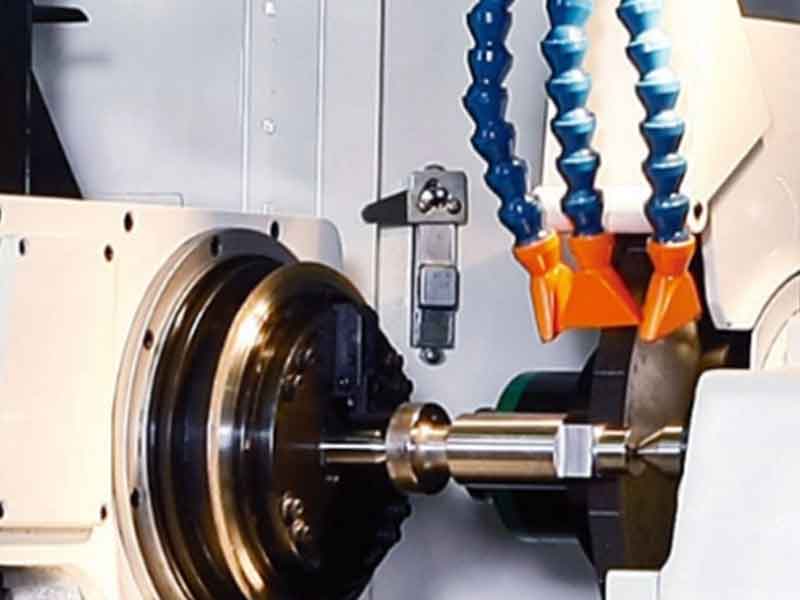
EV battery connectors machining is the precision CNC manufacturing process — executed on Swiss CNC turning platforms, MAZAK mill-turn centers, 5-axis simultaneous machining systems, and wire EDM — that produces the metallic contact pins, terminal socket bodies, connector housing elements, shielding ring assemblies, locking mechanism components, and sealing interface structures that constitute the high-voltage and signal-level electrical connectors in battery electric vehicle powertrain systems.
Every EV battery connector assembly — whether a 1,000A direct-current fast-charge inlet contact or a 0.8mm BMS cell voltage signal pin — contains precision-machined metallic elements whose dimensional accuracy directly determines the connector's current-carrying capacity, contact resistance, arc resistance, vibration retention force, and IP sealing performance. Manufacturing these components to automotive-grade dimensional accuracy is the specialty manufacturing challenge that EV battery connectors machining addresses.
-
Swiss CNC guide bushing micro machining foundation Swiss CNC guide bushing positions workpiece support 0.5–2.0mm from the cutting point, reducing deflection by 1/1,000–1/15,000× versus conventional turning — enabling ±0.002mm contact OD and ±0.001mm roundness on EV battery connector signal pins as production standard across 78+ Swiss CNC platforms.
-
Plating-allowance-corrected contact dimensions Without plating allowance, a 10μm silver plating on a Ø8.000mm contact pin produces a Ø8.020mm plated OD — oversized for mating socket engagement. CNCPioneer incorporates plating allowance in every machined contact dimension as standard, verified by 100% air gauge pre- and post-plate.
-
IATF 16949 automotive production quality Automotive OEM and Tier 1 supplier quality programs require PPAP Level 3 submission, Cpk ≥1.67 on contact OD and sealing groove dimensions, 100% contact resistance measurement, and DFMEA-traceable control plans — all standard scope for CNCPioneer EV battery connector programs.
-
40–60% China CNC machining cost advantage 40–60% below equivalent EV battery connector CNC turning parts from US, European, and Japanese automotive connector machining facilities at identical dimensional accuracy, plating documentation, and IATF 16949 quality — enabling competitive automotive connector supply chain economics.

Why CNCPioneer for EV Battery
Connectors Machining?
Among EV battery connectors machining factories globally, CNCPioneer's Swiss CNC micro machining precision, plating-allowance discipline, connector-type engineering fluency, IATF 16949 automotive quality, 5-axis housing capability, and China cost advantage establish our factory as the preferred EV battery connector CNC turning parts partner.
Swiss CNC Guide Bushing Micro Machining
BMS cell voltage monitoring pins, HVIL interlock pins, and CAN bus signal connector pins range from Ø0.8mm to Ø4mm at length-to-diameter ratios of 5:1 to 15:1 — dimensions where conventional turning deflects the workpiece by 0.020–0.080mm. Swiss CNC guide bushing support reduces unsupported length by 10–25×, enabling ±0.002mm contact OD and ±0.001mm roundness on EV battery connector signal pins as production standard.
Plating-Allowance-Corrected Dimensions
Silver plating (5–50μm), gold plating (0.3–1.5μm), and tin plating (3–10μm) after machining change contact OD dimensions. Without plating allowance, the plated contact exits oversize. CNCPioneer's programs incorporate plating allowance in every machined contact dimension as standard — the Ø8.000mm target plated OD is machined to Ø7.980mm pre-plate, verified by air gauge before plating, and re-verified post-plate by 100% air gauge.
Connector-Type Engineering DFM Competency
The diversity of EV battery connector types — CCS1, CCS2, CHAdeMO, GB/T 20234.3, MCS, MSD, HVIL, BMS — each with specific contact geometry standards, current ratings, and plating specifications, creates a DFM landscape requiring connector-type-specific knowledge. CNCPioneer's DFM review applies dimensional tables and plating requirements from SAE J1772, IEC 62196, GB/T 20234, and SAE J3400 before manufacturing commitment.
IATF 16949 Automotive Production Quality
EV battery connectors are safety-critical high-voltage components where contact resistance exceedance or sealing failure produces fire risk from arcing. Automotive quality programs require PPAP Level 3, Cpk ≥1.67, 100% contact resistance measurement, and DFMEA-traceable control plans. CNCPioneer's programs operate under the same IATF 16949 production infrastructure from first article through production volume.
5-Axis CNC Turning Housing Machining
Junction box connector housings, multi-directional port manifold bodies, and integrated HV connector-and-busbar bodies require 5-axis simultaneous machining for compound-angle port bores, non-orthogonal terminal cavities, and freeform exterior geometry. CNCPioneer's MAZAK VARIAXIS 5-axis programs machine compound port angles within ±0.020° and all terminal cavity bores from one datum reference.
40–60% China CNC Machining Cost Advantage
CNCPioneer delivers EV battery connector CNC turning parts at 40–60% below US, European, and Japanese automotive connector machining facilities at identical dimensional accuracy, plating documentation, and IATF 16949 quality. Engineering DFM, plating allowance specification, and PPAP documentation are included in program pricing without surcharges.
EV Battery Connector CNC Turning
Parts We Manufacture
CNCPioneer's EV battery connectors machining programs cover the complete machined metallic connector component architecture — from micro-machined BMS signal pins through megawatt charging system high-current terminals and 5-axis compound housing bodies.

MSD, HVIL & HV Power Connectors
Manual Service Disconnect contact blades (CuCrZr C18150; blade width ±0.020mm; thickness ±0.010mm; contact face Ra 0.4μm; silver plating 15–30μm). MSD socket bodies (barrel socket bore ±0.005mm; spring deflection features ±0.010mm). HVIL signal pins (Ø0.8–2.0mm; Swiss CNC; OD ±0.002mm; gold plating 0.5–1.0μm). HV junction box terminal lugs (C11000 or C18150; bolt hole ±0.020mm; face flatness 0.010mm; silver plating 8–15μm).

DC Fast-Charging Inlet Contacts
CCS1 DC pins Ø9.6mm nominal; CCS2 DC pins Ø6.4mm nominal; GB/T 20234.3 DC pins Ø8.0mm nominal; all ±0.020mm for correct socket engagement force at 200+ charge cycles. Contact face Ra 0.2μm; silver plating 10–20μm standard per IEC 62196-3. CHAdeMO socket bore Ø16.0mm ±0.020mm internal bore for plug contact engagement. AC pilot and signal pins Ø2.5mm; Swiss CNC; OD ±0.002mm; gold plating 0.3–0.5μm.

Megawatt Charging System (MCS) Terminals
Ultra-high-current contacts for commercial EV and heavy-duty truck charging at 1–3.75 MW. Contact OD 25–50mm diameter range; ±0.020mm; machined on MAZAK mill-turn heavy-duty program. Current rating: 3,000A peak; silver plating 40–80μm for thermal mass. Contact face Ra 0.1μm; face flatness 0.005mm — ultra-flat for maximum true contact area at 3,000A. Material: C18150 CuCrZr mandatory for high-temperature softening resistance.

BMS & Battery Monitoring Signal Connectors
Cell voltage monitoring pins (Ø0.8–1.5mm ±0.001mm — the tightest tolerance in EV battery connector CNC turning parts; exclusively Swiss CNC with guide bushing). Temperature sensor connector pins (Ø1.5–2.5mm ±0.002mm; 316L stainless option for electrolyte vapor exposure). CAN/LIN bus connector pins (Ø1.5–2.0mm ±0.002mm; shielded co-axial variants with ±0.003mm concentricity). Gold plating 0.3–0.5μm over Ni 1.5μm standard.

Motor Phase, OBC & Inter-Module Connectors
Three-phase motor connector contact pins (Ø8–25mm ±0.010mm; C18150 CuCrZr; silver plating 15–30μm; retaining ring groove ±0.015mm). OBC AC inlet contact pins — J1772 Type 1 (L1+N: Ø6.3mm; CP: Ø2.5mm) and IEC 62196-2 Type 2 (L1-3: Ø6.0mm; CP: Ø4.0mm). Inter-module busbar terminal lugs (bore ±0.020mm for M6/M8 bolt; face flatness 0.005mm; tin or silver plating).

5-Axis Housing & Structural Components
Junction connector manifold bodies with multi-port HV distribution; integrated charging inlet housings (CCS2 or GB/T 20234) positioning DC, AC, and signal contacts in standard geometric relationship. MSD housing lock assemblies with blade guide bores ±0.010mm and lock ring thread ±0.005mm pitch diameter. Shielding ring machined elements, locking sleeve bodies, and secondary lock machined components in 6061-T6 aluminum or PEEK.
Industries & Applications
CNCPioneer's EV battery connectors machining serves every industry consuming precision machined connector contacts at automotive-grade tolerances — from EV battery connector OEMs to charging equipment manufacturers and EV powertrain Tier 1 suppliers.

EV Battery
Complete contact pin sets for CCS1, CCS2, GB/T 20234.3, CHAdeMO, and MCS charging connector OEM production — CuCrZr power contact pins with silver plating in matched production lots; signal pin arrays gold-plated to PPAP Level 3; and complete multi-standard contact kit programs for connector OEMs supplying multiple vehicle manufacturer customers.

EV Charging Equipment
DC fast-charging station inlet contact machining programs — CCS2 contact sets for 150kW–350kW DCFC stations; MCS contact programs for 1MW+ heavy-duty charging; CHAdeMO socket body machining; and charging station HV junction connector terminal bodies with full plating documentation.
EV Powertrain
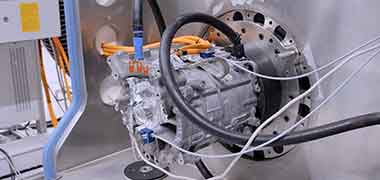
High-volume EV battery connector automotive contact programs for powertrain Tier 1 suppliers — motor phase connector machined contact bodies; inverter HV connector contacts; OBC AC inlet contact sets; and 5-axis junction connector housing machining for integrated e-axle HV connection bodies.
BMS System
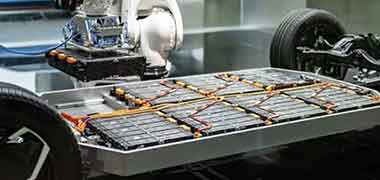
Micro machining CNC turning EV battery connector BMS signal pin arrays — Ø0.8–2.5mm cell voltage monitoring pins; temperature sensor connector pins; CAN bus shield contact assemblies; and complete BMS connector contact sets for 400V and 800V battery pack architectures with 100% air gauge verification.
HV Harness Assemblers
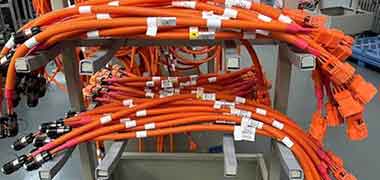
MSD contact blade and socket machining programs; HVIL shorting bridge and signal pin programs; HV connector terminal body machining for wire-to-connector assembly; and sealing groove verification per IP67 automotive connector seal specification with 100% CMM groove documentation.
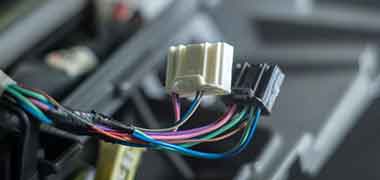
Automotive Connector System
5-axis CNC turning EV battery connector housing body machining for complex junction connector assemblies; multi-port HV distribution connector bodies; integrated connector-busbar structural bodies; and IATF 16949 production for automotive Tier 2 connector component supply with PPAP Level 3 documentation.
EV Battery Connector Machining
Process & Capabilities
CNCPioneer's EV battery connectors machining process runs on 78+ Swiss CNC lathes, 66+ MAZAK Integrex and Quick Turn mill-turn centers, and MAZAK VARIAXIS 5-axis platforms — delivering complete EV battery connector machined parts from single prototype first articles through 500,000+ annual unit volumes.
24-Hour EV Connector DFM & Engineering Review
Single-setup concentricity feasibility for every contact and housing · Connector standard verification (SAE J1772, IEC 62196, GB/T 20234, SAE J3400) · Plating allowance specification for silver/gold/tin target thickness and contact OD · Sealing groove geometry for wire seal catalog number · Micro machining feasibility for signal pin OD and L/D ratio · 5-axis routing assessment for compound port geometry · Material recommendation (CuCrZr vs. brass vs. BeCu) per current rating · Cost-driver identification specific to EV connector geometry.
Swiss CNC Micro Machining — Signal Pins
Ø0.5–8mm Swiss CNC programs with guide bushing support — the only process achieving ±0.002mm contact OD and ±0.003mm bore concentricity at these diameters and length-to-diameter ratios. PCD micro-tooling at v_c = 300 m/min achieves Ra 0.1μm contact face finish from single-pass cutting. Thermal stabilization at 20°C ±0.3°C mandatory for Ø1.2mm pins where CTE produces 0.0003mm per °C diameter variation. Deburring under 20× magnification; ultrasonic DI water + IPA cleaning.
MAZAK Mill-Turn — Power Contacts & Sockets
Main power contact pins and socket bodies from Ø5mm through Ø30mm machined on MAZAK mill-turn centers — accommodating current density, sealing groove, and locking feature geometry of standard high-voltage EV power connector standards. CuCrZr C18150 incoming composition verified by SII XRF (Cr 0.6–0.9%; Zr 0.08–0.15%); conductivity 83–87% IACS confirmed. PCD finish OD and contact face; groove tools for wire seal and retention grooves; C-axis milling for anti-rotation flats.
5-Axis CNC Turning — Compound Housing Bodies
Complex connector housing bodies, multi-port junction connector structures, and integrated shield-and-terminal assemblies requiring compound-angle features, non-orthogonal port arrays, and freeform exterior geometry machined on MAZAK VARIAXIS 5-axis platforms. All port bores from one datum reference maintaining port-to-port angular relationships within ±0.020°. IP67 O-ring grooves machined in plane perpendicular to each port bore axis at compound angles.
Plating Allowance Management & Verification
Every machined contact dimension incorporates plating allowance as standard: machined pre-plate OD = finished OD − 2× plating thickness. 100% air gauge verification before plating confirms correct allowance. Post-plate 100% air gauge confirms plated OD within specification. XRF plating thickness: 3 positions per pin, 5 pins per lot; mean within target ±2μm. Adhesion per IPC-TM-650 Method 2.4.1 tape test. Micro-section on PPAP initial lots confirming layer uniformity.
IATF 16949 / AS9100D Documentation
Certificate of Conformance · CMM dimensional report (100-piece initial sample) · Material and performance test results · Initial process capability (Cpk per characteristic) · Measurement system analysis (Gage R&R per gauging) · PFMEA and linked Control Plan · Process Flow Diagram · PSW · 100% contact OD air gauge records · 100% plating XRF on precious metal programs · 100% contact resistance 4-wire milliohmmeter on signal and HVIL programs · IMDS material declaration · Records retained 20 years.
Materials for EV Battery Connector
CNC Turning Parts
EV battery connector CNC turning parts material selection is governed by electrical conductivity, yield strength for insertion/extraction forces, softening temperature for high-current thermal management, corrosion resistance, and machinability. CuCrZr C18150 dominates high-voltage power contact applications.
CuCrZr C18150
85% IACS · 550 MPa yield (H900) · The standard high-performance EV power contact material combining adequate electrical conductivity with high yield strength and 300°C softening temperature. Dominates all HV power contact pins: CCS, CHAdeMO, GB/T, MCS, MSD, and motor phase connectors. SII XRF composition verified every lot; eddy-current conductivity 83–87% IACS confirmed before machining.
ETP Copper C11000
100% IACS · 220 MPa yield · Maximum conductivity; lower strength. Used for busbar terminal lugs and low-current power contacts where conductivity is paramount and mechanical loading is moderate. Not suitable for high-insertion-force HV connector contacts where 220 MPa yield risks permanent deformation.
Cartridge Brass C26000
28% IACS · 200 MPa yield · Excellent machinability; tin-plate compatible. Cost-effective BMS signal pin bodies and low-current connector elements where high conductivity is not required. 70/30 Cu-Zn composition machines cleanly on Swiss CNC platforms for Ø0.8–2.5mm pin programs.
Beryllium Copper CDA 172
22% IACS · 1,100 MPa yield (H900) · Spring contact force; high-cycle retention. Used for spring socket contacts and high-insertion-force connector pins requiring retention spring characteristics. Not for main current-path pins due to lower conductivity, but essential for socket spring fingers and retention clips.
Phosphor Bronze CDA 510
15% IACS · 510 MPa yield · Spring contact properties with excellent corrosion resistance. Socket spring fingers and connector retention clips in environments where corrosion resistance is as important as mechanical spring force. Standard material for connector retention features.
316L Stainless Steel
Non-magnetic · Biocompatible · Superior corrosion resistance for BMS temperature sensor connector pins exposed to battery electrolyte vapor. 316L provides corrosion resistance without galvanic incompatibility risk of copper alloy in electrolyte environments. Passivation ASTM A967 mandatory post-machining.
Aluminum 6061-T6
42% IACS · 276 MPa yield · Lightweight HV housing and EMC shielding body material. Used for metallic connector housing bodies and shielding ring bodies. Type II clear anodize MIL-A-8625 for exterior corrosion protection; Alodine Class 3 at EMC seam interfaces for electrically conductive finish ≤5 mΩ/cm².
PEEK Victrex 450G
Insulating · 100 MPa yield · Non-conductive housing and insulator elements for isolated connector housing bodies. CNCPioneer machines PEEK housing bodies with PCD tooling at reduced cutting speeds for Ra 0.4μm bore finish. Chemical resistance and dimensional stability at elevated temperatures.
Titanium Grade 5
2% IACS · 950 MPa yield · Non-magnetic; lightweight; non-sparking. Special EV battery connector fastener elements where magnetic interference must be avoided and strength-to-weight ratio is critical. Used for specialized fastening and locking components in high-reliability connector assemblies.
Surface Treatments for
EV Battery Connector CNC Turning Parts
EV battery connector surface treatment selection addresses minimum contact resistance for HV power (silver), dry-circuit signal reliability (gold), medium-current cost optimization (tin), corrosion protection for stainless pins (passivation), and EMC conductivity for aluminum housings (Alodine).
Silver Plating — HV Power Contacts
The standard surface treatment for EV battery connector power contacts. Silver provides minimum contact resistance (Ag bulk resistivity 1.59×10⁻⁸ Ω·m), arc resistance through surface diffusion self-repair, and fretting corrosion resistance. Thickness by current rating: 5–8μm (0–50A), 8–15μm (50–200A), 15–25μm (200–500A), 25–40μm (500–1,000A), 40–80μm (MCS 1,000–3,000A). Ni undercoat 3–12μm. Tarnish mitigated by minimum 15μm Ag thickness for 10-year automotive service.
Gold Plating — Signal & Low-Current Contacts
Hard gold (Au-Co 0.1–0.3%): 0.3–0.8μm on Ni 1.5μm undercoat per IEC 60512-11-1 Class G3 or G6. Soft gold: 0.5–1.5μm for maximum conductivity BMS pin programs. Flash gold: 0.05–0.15μm for cost-sensitive HVIL programs. At 0.3μm hard gold: 50,000 cycle life. At 0.8μm: 200,000 cycles. Gold provides stable contact resistance with no oxide growth over 10-year service life in battery environments — essential for BMS cell voltage monitoring pins where 5mΩ variation produces 5mV SOC error.
Tin & Tin-Silver — Medium-Current Contacts
Matte tin (Sn): 5–10μm on Ni or Cu undercoat for OBC AC inlet contacts, temperature sensor pins, and cost-sensitive BMS configurations above 100mA where tin oxide film is broken by contact force. Tin-silver (SnAg 3.5%): SAC305 equivalent with better creep resistance above 85°C. Tin plating is the cost-optimized alternative to gold for medium-current EV battery connector contacts where dry-circuit conditions do not apply.
Passivation — Stainless Steel Pins
ASTM A967 passivation mandatory for all 316L and 17-4PH stainless EV battery connector signal pins — restores passive oxide layer at machined surfaces and prevents free iron spots that initiate corrosion in battery vapor environment. Applied after all machining is complete; passivation liquid penetrates cross-holes, grooves, threads, and bores uniformly. Zero dimensional change. Passivation certificates included in standard shipment documentation.
Anodize & Alodine — Aluminum Housings
Type II clear anodize MIL-A-8625 for aluminum EV battery connector housing bodies — corrosion protection at exterior surfaces. Alodine Class 3 at EMC seam interfaces (electrically conductive, not anodize which is insulating) achieving ≤5 mΩ/cm² for effective electromagnetic shielding continuity. Type III hard anodize (HV 400+) available on aluminum bearing sleeves for wear resistance at housing-to-outer-race interface.
Plating Allowance Management Protocol
The distinguishing production discipline at CNCPioneer: every CuCrZr contact pin is machined to finished diameter minus silver plating allowance (2 × target Ag thickness per side). For a CCS2 DC contact at Ø6.400mm with 15μm Ag: machined pre-plate OD = 6.370mm ±0.002mm, 100% air-gauged before plating. Post-plate OD 6.400mm ±0.005mm is 100% air-gauged after plating. XRF confirms actual thickness = (post-plate OD − pre-plate OD)/2 within ±2μm — the complete plating quality chain.
All surface treatments on EV battery connector CNC turning parts programs — silver plating (5–80μm), gold plating (0.3–1.5μm), tin/SnAg, passivation ASTM A967, and Alodine Class 3 — are documented with treatment certifications and post-treatment dimensional verification. Plating and coating allowances are machined-in to contact dimensions at the CNC stage and confirmed post-treatment by air gauge or XRF. Treatment selection guidance and dimensional allowance calculation are included in CNCPioneer's 24-hour DFM review at no additional cost.
Quality Assurance for
EV Battery Connector Machining
EV battery connector machining quality assurance addresses bearing-quality contacts and housings with laser micrometer (0.1μm resolution) OD verification, air gauge ID verification, roundness tester form verification, and CMM concentricity measurement resolving the sub-3μm tolerances that automotive connector specifications demand.
Engineering Contract Review & DFM
24-hour DFM review covering: connector standard verification (SAE J1772, IEC 62196, GB/T 20234, SAE J3400); plating allowance specification for target thickness and contact OD; sealing groove geometry for IP67 compliance; micro machining feasibility for signal pin OD and L/D ratio; 5-axis routing assessment for compound port geometry; material selection (CuCrZr vs. brass vs. BeCu) per current rating; and cost-driver identification. All drawing ambiguities resolved before machining.
Material & Incoming Verification
SII XRF composition confirmation on every CuCrZr (C18150), BeCu, and brass bar stock lot — verifying Cr 0.6–0.9% and Zr 0.08–0.15% in CuCrZr; Be 1.80–2.00% in BeCu. Electrical conductivity verification on CuCrZr using eddy current meter: 83–87% IACS confirmed before machining. Hardness verification on precipitation-hardened CuCrZr (HV 130–160) and BeCu H900 (HRC 38–44). EN 10204 3.1 mill certificates archived per lot.
In-Process Dimensional Control (SPC)
Swiss CNC: 100% laser micrometer OD measurement on automotive programs; SPC chart on contact OD; adaptive CNC offset correction when OD approaches ±1.5σ limit. Sealing groove: CMM sampling at 10% standard, 100% air gauge on IATF special characteristic programs. Plating allowance confirmation: batch sample air gauge on pre-plate lot confirming correct allowance before plating release. Cpk ≥1.67 on IATF special characteristics.
Plating & Electrical Verification
XRF plating thickness: 3 positions per pin, minimum 5 pins per lot; mean within target ±2μm; no individual reading below minimum. Adhesion test per IPC-TM-650 Method 2.4.1 tape test on plating lot coupon. Micro-section per PPAP initial lot confirming layer uniformity. 4-wire milliohmmeter contact resistance: 100% on BMS signal contacts (≤10 mΩ); 100% on HVIL (≤50 mΩ); 10% sampling on HV power contacts (≤200 μΩ) — records per serial number.
Final Inspection — 100% Verification
CMM: all contact OD, groove dimensions, bore positions, housing port bores, housing flatness. Profilometry: contact face Ra ≤0.1μm (signal), Ra ≤0.2μm (power). Thread gauge: GO/NO-GO all locking threads. Visual under 10×: no burrs at contact tip or groove edges; no plating holiday on contact face. Mass verification per lot. 100% air gauge OD on all automotive programs; 100% contact resistance on signal and interlock programs.
Documentation Package
Certificate of Conformance · CMM dimensional report · Profilometry records · XRF plating thickness records · Conductivity records · Contact resistance records · Material certifications with lot traceability · Heat treatment and plating certifications · PPAP Level 3 for automotive programs (dimensional results, material tests, initial process capability, MSA Gage R&R, PFMEA, Control Plan, PSW) · IMDS material declaration · All records retained 20 years.
IATF 16949 Quality System for
EV Battery Connector Automotive Programs
CNCPioneer's IATF 16949 and AS9100D certified EV battery connector machining quality system addresses the five quality dimensions specific to automotive connector supply: DFMEA linkage, MSA verification, Cpk ≥1.67 on special characteristics, 100% contact resistance measurement, and IMDS material reporting.
DFMEA Linkage to Control Plan
Every potential failure mode in EV battery connector machined parts — dimensional non-conformance in contact OD producing insufficient contact force; plating thickness below specification causing contact resistance exceedance; sealing groove width non-conformance producing IP67 failure — is identified in the DFMEA with severity, occurrence, and detection ratings, with detection controls (CMM, air gauge, SPC, 100% leak test) documented in the linked control plan. DFMEA preparation is standard scope.
- DFMEA covering all potential failure modes
- Detection controls linked to Control Plan
- Standard scope, not additional service
MSA Verification on Critical Gauging
The air gauge measuring EV battery connector contact pin OD (±0.002mm specification) must have measurement uncertainty below 0.0002mm (10% of tolerance) — verified by Gage R&R study with ≥10 parts measured by ≥2 operators in ≥3 replications. MSA records confirm Gage R&R ≤10% on all critical gauging before production begins — the automotive quality evidence that measurement system variation does not mask process variation.
- Gage R&R ≤10% on air gauge systems
- Measurement uncertainty < 10% of tolerance
- Verified before production begins
Cpk ≥1.67 on Special Characteristics
Contact pin OD, sealing groove dimensions, and plating thickness are designated IATF 16949 special characteristics (SC) requiring Cpk ≥1.67 — the process capability leaving 99.9997% of production within specification. Achieved by maintaining machine positioning accuracy through regular thermal compensation (0.001mm/°C drift corrected), tool wear monitoring (offset correction every 200 pieces), and fixture repeatability verification (re-referencing every 4 hours).
- Cpk ≥1.67 on contact OD and groove dims
- Thermal compensation and tool wear monitoring
- 99.9997% within specification at Cpk 1.67
PPAP Level 3 & IMDS Reporting
PPAP Level 3 submission includes: dimensional results (100-piece initial sample), material and performance test results, initial process capability (Cpk per characteristic), MSA Gage R&R, PFMEA, Control Plan, Process Flow Diagram, and PSW. IMDS material data sheets prepared as standard for European and North American automotive supply chain compliance — including material composition, substance classification, and recycling process identification.
- PPAP Level 3 complete document package
- IMDS declaration for EU/NA compliance
- 100% contact resistance on signal/HVIL
EV Battery Connectors Machining FAQ
Common questions from EV battery connector OEMs, charging equipment manufacturers, EV powertrain Tier 1 suppliers, BMS integrators, and automotive connector system builders about CNCPioneer's EV battery connectors machining capability, materials, plating, and production economics.
EV battery connector high-voltage power contact pins face a materials requirement no single common metal satisfies: simultaneously high electrical conductivity (to keep contact resistance below IEC 62196 maximum of 0.5 mΩ), high yield strength (to survive 200–500N insertion/extraction forces over 10,000+ cycles), and high softening temperature (to maintain properties at operating temperature during fast charging). Pure copper (C11000) offers 100% IACS but only 220 MPa yield and softens at 200°C. Standard brass (C26000) has adequate yield but only 28% IACS. Beryllium copper achieves 1,100 MPa yield but only 22% IACS. CuCrZr (C18150) resolves all three: 85% IACS conductivity, 550 MPa yield strength from Cr/Zr precipitation hardening, and 350°C softening temperature — retaining 90% of room-temperature yield at 200°C where pure copper retains only 50%. CNCPioneer specifies and verifies CuCrZr for all power contact pins above 50A.
BMS signal pins require ±0.002mm OD tolerance because pin-to-socket engagement force depends on OD through Hertzian contact mechanics. At Ø1.2mm with ±0.010mm variation in conventional turning, cutting force deflection = 0.025mm — completely dominating the ±0.002mm target. Swiss CNC guide bushing reduces unsupported length from 10–25mm to 0.5–2mm, reducing deflection by (0.5/15)³ ≈ 1/27,000× — from 0.025mm to 0.0009mm, well within tolerance. PCD tooling achieves Ra 0.1μm contact face finish, producing contact resistance ≤10 mΩ at 0.3N BMS measurement current. Conventional turning achieves at best ±0.020–0.030mm — 10–15× outside specification. Swiss CNC guide bushing is the only platform physically capable of achieving BMS signal pin specifications.
Silver plating thickness is governed by current capacity, fretting resistance, and contact life: BMS/HVIL signal contacts use 0.3–0.5μm gold (not silver). AC charging inlet (32A): 5–8μm Ag. CCS1/CCS2 DC fast-charge (200A): 15–20μm Ag. CHAdeMO (125A): 15–25μm Ag. Motor phase (800A): 25–40μm Ag. MCS (3,000A): 40–80μm Ag. CNCPioneer's plating allowance protocol: machined pre-plate OD = finished OD − 2×T_Ag. For a CCS2 DC contact at Ø6.400mm with 15μm Ag: machined to 6.370mm ±0.002mm, 100% air-gauged before plating. Post-plate target 6.400mm ±0.005mm is 100% air-gauged. XRF at 3 points on 5 pins per lot confirms mean within ±2μm of target — the complete plating quality chain ensuring every delivered contact meets both mechanical engagement and electrical performance specifications.
Prototype: Swiss CNC BMS signal pin Ø0.8–2.5mm (brass, Au-plated) — 3–5 business days; Swiss CNC CCS2 DC power contact Ø6.4mm CuCrZr (Ag-plated) — 5–7 business days; MAZAK mill-turn CHAdeMO socket body Ø16mm — 5–7 days; 5-axis CNC junction connector housing — 7–10 days; complete CCS2 contact set (all pins machined and plated, matched by lot) — 7–10 days. Silver plating adds 3–4 days; gold plating adds 3–5 days. Development quantities (1,000–10,000): 2–3 weeks. PPAP Level 3 qualified: 6–8 weeks from pilot approval. Volume production: 2-week monthly blanket releases with dedicated Swiss CNC capacity. Economics: a CuCrZr CCS2 DC power contact costs approximately $8.50 from a European specialist; $4.80 at CNCPioneer prototype; $1.20–1.60 at 500,000 annual units in China production — delivering millions in annual contact cost reduction for high-volume OEMs.
Modern EV battery junction box connector housings and multi-port HV distribution blocks have geometries driven by packaging constraints — contact ports arranged at angles to accommodate wire routing, sealing faces on non-parallel planes, and terminal cavities on compound angles. A junction box with six HV terminal ports at three different angular orientations (0°, 30°, 60°) requires 5-axis simultaneous machining to: machine all six port bores from one datum reference maintaining port-to-port angular relationships within ±0.020°; machine the sealing face at each port perpendicular to that port's bore axis for IP67 O-ring groove seating; and machine freeform exterior geometry following topology optimization profiles. CNCPioneer's MAZAK VARIAXIS 5-axis programs achieve compound port bore angular accuracy ±0.020° and IP67 sealing face flatness 0.010mm — specifications impossible to hold through multiple 3-axis setups where rechucking error accumulates.
Get a Quote for EV Battery Connectors Machining
Submit your EV battery connector machined parts drawings, connector standard specifications (CCS1, CCS2, GB/T 20234.3, CHAdeMO, MCS, MSD, BMS), or contact geometry requirements and receive a free APQP-based DFM review and competitive quotation within 24 hours — covering material recommendation, plating allowance specification, sealing groove geometry, micro machining feasibility, 5-axis routing assessment, and complete pricing from prototype through volume OEM supply.