
Electrical Connector
Manufacturing
CNCPioneer manufactures turned electrical connector components, contact pins, socket contacts, shells and crimp terminals for automotive, aerospace, industrial, EV, telecom and medical programs. Swiss CNC holds contact dimensions to ±0.003mm, with plating coordination, lot traceability and PPAP or FAIR support.
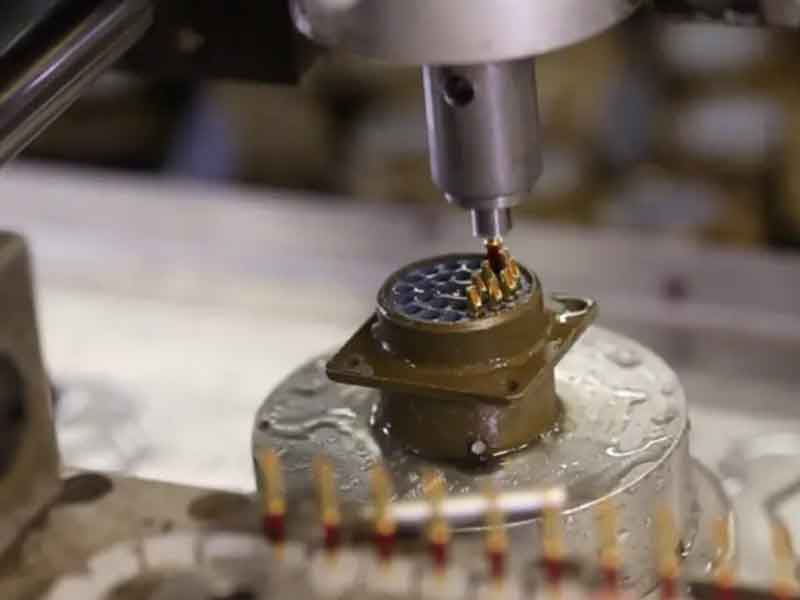
Precision Electrical
Connector Manufacturing
Electrical connector manufacturing converts conductive alloys into turned connector components, contact pins, socket contacts, terminals, shells, backshells and connector bodies that create repeatable electrical and mechanical connections.
Connector reliability depends on contact diameter, socket bore, spring geometry, surface finish, material, plating thickness and traceable inspection. CNCPioneer controls these details from drawing review and DFM through CNC machining, plating verification and shipment documentation.
-
Turned connector components to ±0.003mm Swiss CNC contact pins, socket contacts and terminals from Ø0.3mm, with diameter, roundness, concentricity and surface-finish control for miniature signal and power contacts.
-
Connector shells and body machining Shells, backshells and connector bodies are machined with controlled threads, cavities, insert pockets and mounting features in brass, stainless steel, aluminum and special alloys.
-
Functional plating coordination Gold, silver, tin, palladium-nickel, nickel and rhodium plating can be coordinated with XRF thickness records, adhesion checks and shipment documentation.
-
Automotive and aerospace quality support IATF 16949 supports PPAP, SPC and MSA for automotive programs. AS9100D supports FAIR per AS9102 for aerospace connector components.

Why Swiss CNC for Electrical
Connector Manufacturing?
Swiss CNC guide-bushing support is well suited to long, slender connector contacts and socket features. It helps maintain diameter, roundness, concentricity and surface finish across prototype and production electrical connector machining programs.
Contact Pin Diameter Control
Diameter tolerance to ±0.003mm and roundness to ±0.002mm help stabilize mating force, retention and contact resistance in high-volume connector programs.
Socket Bore Concentricity
Socket bore concentricity to the OD helps keep spring force distribution consistent around the mating pin, improving withdrawal force and contact stability.
Contact Surface Finish
Ra 0.2µm contact surfaces can be produced for mating zones where plating adhesion, contact resistance and wear behavior depend on a stable finish.
Retention and Anti-Backout Geometry
Multi-axis Swiss machining supports retention lances, grooves, shoulders, polarization features and crimp transitions without moving the part through many setups.
100% CCD Sorting
Critical contact pin and socket dimensions can be sorted automatically at production speed, supporting special-characteristic control for IATF 16949 connector programs.
Turned Component Production
Stable material sourcing, tool-life control, statistical monitoring and lot traceability support repeatable production of turned connector components at program volume.
Electrical Connector
Component Types
CNCPioneer manufactures turned contact pins, socket contacts, connector shells, backshells, crimp terminals, RF connector parts and PCB terminals for connector OEMs and harness suppliers.

Turned Contact Pin Components
Male contact pins in brass, phosphor bronze and beryllium copper, from miniature signal contacts to larger power terminals. Tip geometry, diameter, roundness and finish are machined to drawing.

Socket Contact Components
Female socket contacts with precision bores, spring features, retention grooves and mating geometry. Bore size, concentricity and surface finish are controlled for stable contact force.

Connector Shells & Bodies
Circular connector shells, rectangular housings, backshell bodies, coupling features and contact insert pockets, machined with thread, cavity and mounting feature control.

Crimp Contact Terminals
Machined contact zones combined with crimp barrel geometry for wire termination. Brass, phosphor bronze and beryllium copper options support tin, gold or silver plating.

RF Coaxial Connector Components
SMA, N-type, BNC, TNC, SSMA, 2.92mm and 2.4mm center conductor and body components, with bore and conductor dimensions reviewed for impedance and frequency requirements.

PCB Terminal & D-Sub Components
Press-fit terminal pins, through-hole solder tail contacts and D-sub contact pin and socket components for industrial, computing and telecommunications connector interfaces.
Industries & Applications
CNCPioneer supplies connector components for automotive, aerospace, industrial automation, EV charging, telecommunications, RF and medical device applications.
Automotive
Contacts, ECU connectors, ADAS interfaces, automotive Ethernet contacts and EV terminals with IATF 16949 support, PPAP, SPC, RoHS/ELV records and Cpk review.
Aerospace & Defense
MIL-DTL connector contacts, shells and precision hardware with AS9100D controls, hard gold plating support and FAIR per AS9102 when specified.

Industrial Automation
M8, M12, DIN, heavy-duty power connector terminals, robot interface contacts and sealed connector body components for factory automation equipment.

Electric Vehicles & Charging
High-current charging contacts, socket components and copper terminals for CCS, CHAdeMO and GB/T-style programs, with silver plating and heat control reviewed by application.

Telecommunications & RF
RF connector center conductors, outer conductor bodies, high-density data contacts and mmWave connector components requiring stable conductor and bore geometry.

Medical Devices
Connector contacts and housings in titanium, MP35N, platinum-iridium and stainless alloys for medical device programs requiring lot traceability and clean packaging.
Electrical Connector Manufacturing
Capabilities at CNCPioneer
Our Shenzhen facility combines Swiss CNC turned-component production, MAZAK mill-turn machining, CMM inspection, CCD sorting, XRF material checks and plating verification for precision connector programs.
Swiss CNC Lathe Fleet
78+ Swiss CNC lathes support Ø0.3mm to Ø32mm contact pins, miniature contacts, socket bodies and high-volume terminals with diameter and roundness control.
MAZAK Mill-Turn Fleet
66+ MAZAK mill-turn centers support connector shells, backshells, larger body components, coupling features, threaded housings and multi-feature connector hardware.
Connector Precision Specifications
Capabilities include contact diameter to ±0.003mm, socket bore to ±0.004mm, concentricity to ±0.003mm, retention geometry review and thread gauge verification.
Connector Manufacturing Materials
Brass, phosphor bronze, beryllium copper, copper, stainless steel, aluminum, Kovar, titanium, MP35N and PEEK can be sourced with material certificates and lot tracking.
Connector Quality Inspection
CCD sorting, Mitutoyo CMM, air gauges, bore gauges, profilometry, thread gauges and XRF plating measurement are applied according to the control plan.
PPAP & FAIR Documentation
PPAP Level 1-5, FAIR per AS9102, material certs, CMM reports, XRF records, RoHS/ELV documents, SPC charts and C of C are available when specified.
Materials for Electrical Connector Manufacturing
Material choice is based on conductivity, spring force, fatigue life, crimp ductility, corrosion resistance, biocompatibility and plating compatibility.
C3604 Free-Cutting Brass
High machinability, good conductivity and low cost for high-volume automotive, industrial and telecom connector contacts.
C2600 Cartridge Brass
High ductility and low lead content for crimp barrel components, formed contacts and RoHS/ELV-sensitive connector programs.
C2680 Yellow Brass
Good machinability and ductility for contacts that combine machined mating zones with formed crimp or retention features.
CuZn37 CW508L
European low-lead brass option for automotive and industrial connector programs requiring RoHS or ELV compliance.
C51000
Good spring properties and corrosion resistance for signal contacts, moderate-cycle socket contacts and spring features.
C17200 AT
High-strength copper alloy for high-reliability socket contacts, aerospace contacts and spring elements requiring fatigue resistance.
C11000 ETP
High conductivity and ductility for power connector terminals, EV charging contacts and high-current electrical interfaces.
303 / 316L
Corrosion-resistant and low-magnetic stainless options for outdoor, marine, harsh-environment and instrument connector bodies.
17-4PH
High strength and corrosion resistance for connector shell components, aerospace connector bodies and high-load hardware.
6061-T6
Lightweight, machinable and anodizable for connector shells, backshells and larger connector body assemblies.
ASTM F15 Kovar
Matched thermal expansion for hermetic feedthroughs, glass-sealed connector bodies and ceramic package components.
Grade 5 Ti-6Al-4V
Lightweight, non-magnetic and corrosion resistant for medical, aerospace and specialty connector hardware.
MP35N UNS R30035
High strength, corrosion resistance and biocompatibility for implantable medical device connector contacts.
Plating & Surface Finishing for
Electrical Connector Manufacturing
Plating determines contact resistance, corrosion protection, mating durability and solderability. CNCPioneer coordinates connector plating through qualified partners and verifies thickness by XRF when required.
Gold Plating
Hard gold is used for high-reliability signal contacts, aerospace contacts and low-level circuits. Selective gold can reduce precious metal cost on automotive and industrial programs.
Silver Plating
Silver is used for high-current power terminals and EV charging contacts where conductivity and heat control are more important than tarnish sensitivity.
Tin Plating
Tin is widely used for automotive and commercial connector contacts because it is cost-effective, solderable and compatible with RoHS/ELV programs.
Palladium-Nickel Plating
Palladium-nickel is a hard, wear-resistant contact finish for moderate-cycle applications that need better durability than tin at lower cost than gold.
Nickel Underplate
Nickel is commonly used below gold, silver and palladium finishes to prevent base metal diffusion and improve plating durability on contact surfaces.
Rhodium Plating
Rhodium is reserved for demanding, high-cycle contact applications that require a very hard and wear-resistant surface finish.
XRF thickness records, plating certificates and adhesion test results can be included in the shipment package according to the drawing, specification or purchase order.
Quality Assurance for
Electrical Connector Manufacturing
The quality plan is built around three connector risks: dimensional fit, plating performance and traceable documentation.
Contract & Drawing Review
Engineering reviews connector series requirements, critical dimensions, materials, plating callouts and PPAP or FAIR needs before order acceptance.
Material Incoming Inspection
XRF composition checks, hardness review for spring materials, bar stock inspection, RoHS/ELV review and lot traceability are planned according to program requirements.
First Article Inspection
CMM inspection verifies contact diameter, roundness, concentricity, socket bore, retention geometry, crimp barrel features and overall length before production release.
In-Process Statistical Control
CCD sorting, SPC charts, tool-life control and special-characteristic monitoring support high-volume automotive and industrial connector programs.
Plating Verification
XRF thickness measurement, adhesion checks, visual inspection and corrosion testing can be included based on the plating specification.
Documentation & Shipment
Material certs, dimensional reports, XRF records, RoHS/ELV certificates, PPAP, FAIR and Certificate of Conformance are prepared when required.
IATF 16949 & AS9100D Quality System for
Electrical Connector Manufacturing
Dual certification supports automotive and aerospace connector qualification programs that need process capability, documented inspection and special process records.
Automotive PPAP
PPAP Level 1-5 support is available for automotive connector programs, including process flow, PFMEA, control plan, dimensional results, MSA and capability data.
- PPAP Level 1-5 support
- Cpk review for special characteristics
- MSA / Gage R&R when required
100% CCD Sorting
Critical contact pin and socket bore dimensions can be sorted automatically to support high-volume connector programs with strict outgoing quality requirements.
- Contact pin diameter sorting
- Socket bore sorting
- SPC control charts available
XRF Plating Verification
Gold, tin, silver, palladium and nickel plating thickness can be verified by XRF, with records included for automotive, aerospace or high-reliability programs.
- XRF measurement by lot
- Plating certificates available
- Adhesion or corrosion testing when specified
Aerospace FAIR & AS9100D
FAIR per AS9102, AMS material review, MIL-spec plating records and Certificate of Conformance are available for aerospace connector component programs.
- FAIR per AS9102
- Certificate of Conformance
- Material and plating records
Electrical Connector Manufacturing FAQ
Quick answers for connector OEMs, harness assemblers and electrical equipment manufacturers comparing precision connector component suppliers.
C3604 free-cutting brass is the most common choice for high-volume connector contacts because it machines efficiently, holds a clean finish and balances cost, conductivity and ductility. Beryllium copper and phosphor bronze are selected when spring force or fatigue life is more important.
Automotive programs usually require IATF 16949 controls, PPAP, special-characteristic monitoring, Cpk review, RoHS/ELV documentation and stronger lot traceability than standard industrial connector projects.
It depends on current level, mating cycles, environment and reliability target. Many automotive contacts use tin; gold is typically reserved for low-level signal, safety-critical, aerospace or high-reliability contacts. XRF thickness records can be provided.
Yes. Low-lead brass options such as C2600, C2680 and CuZn37 can be reviewed for RoHS or ELV-sensitive programs. Restricted substance records can be included when required.
CNCPioneer supports PPAP Level 1-5. Level 3 packages can include process flow, PFMEA, control plan, MSA, dimensional results, material tests and initial capability data.
Prototype and qualification quantities can start around 100-500 pieces depending on material, tooling and inspection requirements. Production programs can scale to recurring high-volume supply with scheduled delivery.
China Swiss CNC production can reduce connector component cost versus many Western suppliers, especially at volume. The comparison should include material, plating, inspection, PPAP/FAIR and traceability requirements, not only unit price.
Get a Quote for Electrical Connector Manufacturing
Upload your connector component drawing, CAD model, connector series specification, material, plating and annual volume. We will review turned-component geometry, contact fit, plating, inspection, PPAP or FAIR needs, then return a quote and DFM feedback.