
Precision CNC Flange Machining
CNCPioneer machines precision flanges for piping, equipment mounting, pressure systems, and specialty assemblies. Swiss CNC and MAZAK mill-turn capacity supports aluminium, stainless steel, brass, and special materials, with tolerance capability to ±0.003mm, documented inspection, and a 24-hour quote.
What Is
Flange Machining?
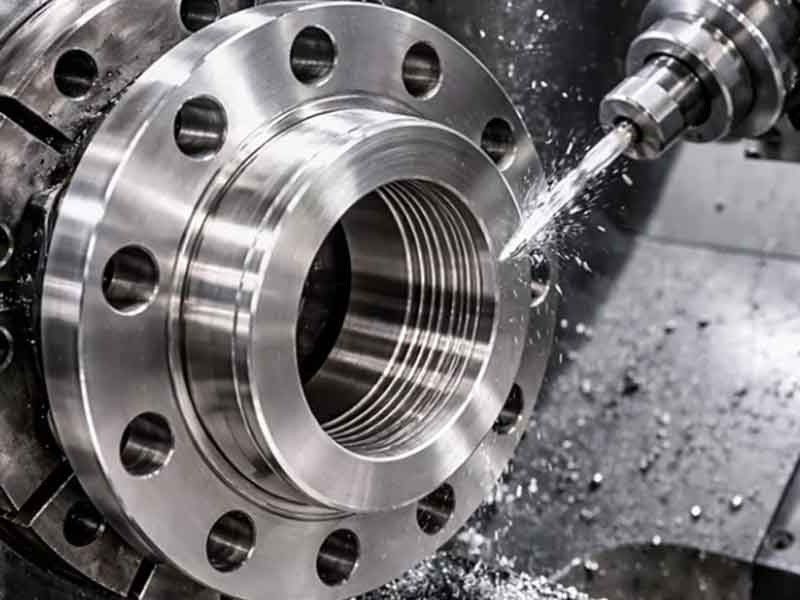
Flange machining produces pipe connections, equipment mounts, structural interfaces, and specialty fittings through turning, face milling, boring, drilling, and threading. The process controls sealing-face finish, bolt pattern, bore alignment, and overall dimensions for ASME and custom applications.
Three features govern performance: a flat, correctly finished sealing face for gasket compression; an accurate bolt circle for even clamping; and controlled bore-to-face alignment for clean installation. CNCPioneer plans these dimensions together, not as separate operations.
-
Single-setup MAZAK mill-turn machining Face, bore, bolt circle, hub, and thread features can be machined in one setup to protect bore-to-face and bolt-circle alignment. MAZAK covers bores from 10mm to 500mm; Swiss CNC supports miniature flanges from 0.5mm to 32mm.
-
Multi-material flange capability Machine 6061-T6 and 7075-T6 aluminium, 316L, 304, 17-4PH, duplex stainless, C3604 brass, titanium, Inconel, carbon steel, and selected specialty materials.
-
High-precision face and bore control Typical capability includes 0.005mm face flatness, 0.01mm/100mm bore-to-face perpendicularity, ±0.02mm bolt-circle position, and Ra 0.8µm or Ra 0.4µm sealing finishes. Serrated faces can meet ASME B16.5 125–250 AARH.
-
Competitive China production cost Qualified Asian material sourcing and efficient production can reduce cost by 40–60% versus comparable Western suppliers, without changing the planned tolerance, PMI, or documentation scope.

Why CNCPioneer for
Flange Machining?
One source for materials, turning, milling, sealing faces, bolt patterns, finishing, inspection, and quality documentation across industrial and precision flange programmes.
Complete Flange Machining in One Source
Material PMI, rough and finish turning, face and bore machining, bolt drilling, threading, surface treatment, and inspection are coordinated in one production plan to preserve critical geometry and simplify sourcing.
MAZAK Mill-Turn Capability
Single-setup turning and milling protect bore-to-face perpendicularity and bolt-circle concentricity. The MAZAK platform covers 10–500mm bores and flange faces up to 550mm.
Stainless Steel Flange Expertise
316L machining plans control work hardening, built-up edge, and heat with suitable carbide tooling, coolant, and cutting sequences. XRF PMI can verify each lot and prevent 304/316L mix-ups.
High-Precision Flange Capability
Qualified programmes can reach ±0.003mm bore diameter, 0.003mm face flatness, ±0.010mm bolt circle, and Ra 0.4µm sealing surfaces for aerospace, vacuum, semiconductor, and pharmaceutical equipment.
24-Hour Flange Quotes
Send a drawing for DFM and pricing within 24 hours. The review covers material, tolerance feasibility, gasket-facing requirements, finishing, and prototype or production quantity pricing.
Competitive China Production Cost
Qualified material supply, machining capacity, and inspection can reduce total cost by 40–60% versus comparable Western suppliers while retaining MAZAK machining, CMM verification, and IATF 16949 / AS9100D documentation.
Types of Flanges
We Machine
From ASME B16.5 pipe and API 6A wellhead flanges to lightweight aerospace, corrosion-resistant process, vacuum, and semiconductor designs, each programme can include CMM verification and complete documentation.

Pipe Flange Machining
Weld neck, slip-on, blind, socket weld, threaded, lap joint, orifice, and spectacle blind flanges to ASME B16.5 and EN 1092-1. Raised-face and RTJ surfaces, pipe fit-up bores, NPT/BSPT/metric threads, and required tap patterns are machined to drawing and pressure-class requirements.

Custom Aluminum CNC Machining Flange
Lightweight 6061-T6 or high-strength 7075-T6 flanges for aircraft hydraulic, fuel, and pneumatic systems; automotive exhaust, turbocharger, and EV cooling; robot mounts; and pneumatic manifolds. Bore, face, and bolt-circle requirements are matched to sealing, alignment, PPAP, or FAIR needs.

Stainless Steel CNC Machining Flange
316L for chemical and chloride service, 304/304L for general corrosion resistance, 17-4PH H900 for high-strength aerospace or marine parts, and duplex 2205 / 2507 for offshore and subsea environments. PMI and finish requirements are planned by application.

Brass Machining Precision Flange
Precision brass flanges for pressure gauges, flow meters, isolation valves, pneumatic manifolds, plumbing, and hydraulic connections. C3604 supports efficient instrumentation machining; DZR CuZn36Pb2As suits warm-seawater cooling systems. Bore, thread, face, and O-ring requirements are controlled for the application.

High Precision Machining Flange
High-precision flanges for aerospace hydraulics, UHV CF vacuum systems, semiconductor process chambers, pharmaceutical vessels, optical equipment, and laser systems. Capability can include ±0.003mm bores, 0.003mm face flatness, knife-edge or O-ring geometry, electropolished Ra 0.4µm, and full traceability.

Specialty & RTJ Flange Machining
RTJ faces for high-pressure oil, gas, and reactor piping can meet ASME B16.20 / API 6A groove requirements. Titanium, Inconel, PEEK, and ASTM A105 carbon steel support corrosive, high-temperature, electrical-isolation, or standard pressure-piping applications.
Industries & Applications
Flanges for pressure systems, aerospace hardware, process equipment, vehicles, marine service, vacuum systems, pharmaceutical processing, and food equipment.

Oil & Gas
API 6A wellhead and Christmas tree flanges, super duplex subsea pipeline parts, 316L sour-gas process flanges, Class 900–2500 RTJ faces, and NACE MR0175 Inconel 625 components for H2S environments. Suitable for offshore, FPSO, and subsea production systems.

Aerospace & Defense
Aluminium flanges for aircraft hydraulic, fuel, and propulsion systems, plus 17-4PH H900 parts for hydraulic shafts. AS9100D, AS9102 FAIR, approved heat treatment, and hard anodising can be included for flight-critical programmes.
Chemical & Petrochemical
316L, Hastelloy C-276, and Inconel 625 flanges for vessel nozzles, reactors, heat exchangers, pumps, and aggressive chemical service. Electropolished Ra 0.4µm surfaces support high-purity processes; RTJ grooves support high-pressure reactors and columns.

Automotive
Aluminium flanges for exhaust manifolds, turbochargers, EV cooling systems, and engine mounts. IATF 16949, PPAP Level 3, Cpk targets, RoHS support, and 100% sorting for critical bores can be planned for high-volume programmes.

Marine, Industrial & Water
Stainless steel and brass flanges for seawater cooling, propulsion shafts, and offshore piping, with corrosion-resistant material selection for continuous marine service. Carbon steel and ductile iron flanges support water treatment, pumps, and wastewater systems in standard ASME pressure classes.

Semiconductor, Scientific & Food
CF vacuum flanges, semiconductor CVD/PVD/etch chambers, particle-accelerator and microscope hardware, pharmaceutical vessels, and sanitary food equipment. Electropolished 316L, controlled bores, knife edges, Ra requirements, and crevice-free sealing geometry are available.
Flange Machining Process
& Capabilities
A controlled production sequence from incoming material verification through machining, finishing, and final inspection, with PPAP or FAIR records when required.
Material Incoming PMI Inspection
XRF PMI and certificate review confirm alloy identity before production, with hardness, dual certification, and aerospace heat-treatment documentation checked where the programme requires them.
Rough & Finish Machining
Rough machining establishes the bore or OD datum before finish boring, face turning, and hub profiling. Typical targets include ±0.005mm bores, 0.005mm face flatness, Ra 0.8µm or Ra 0.4µm, ASME B16.5 serrations, and ASME B16.20 RTJ grooves where specified.
Bolt Circle Drilling & Thread Machining
Bolt circles are drilled with face and bore datums in the same setup when possible. Standard or high-precision BCD targets can be ±0.05mm or ±0.02mm; NPT, BSPT, BSPF, metric, UNC, and UNF threads are verified with calibrated gauges.
Surface Treatment
Stainless flanges can receive ASTM A967 passivation or electropolishing; aluminium can receive MIL-A-8625 Type III hard anodise or MIL-DTL-5541 chemical film; brass can receive electroless nickel or tin. Finish choice follows corrosion, wear, conductivity, sealing, and dimensional-fit needs.
Flange Machining Materials
Material options include 316L, 304/304L, 17-4PH, duplex 2205 / 2507, 6061-T6, 7075-T6, C3604 and DZR brass, ASTM A105, titanium, Inconel, PEEK, and coated carbon steel. Selection follows the service environment, pressure, strength, temperature, and cost.
IATF 16949 / AS9100D Documentation
Automotive programmes can include PPAP Level 3 with APQP, FMEA, MSA, Cpk targets, and control plans; aerospace programmes can include AS9102 FAIR. PMI, passivation, electropolishing, C of C, and traceability records are available and retained for at least 15 years.
Materials for Flange
Machining
Choose material by corrosion resistance, pressure strength, temperature, machining response, weldability, sealing-face requirements, and ASME, ASTM, or API compliance. 316L is widely used for process service, ASTM A105 for standard pipe flanges, and 6061-T6 for lightweight applications.
316L / ASTM A182 F316L
Process-industry stainless with 2–3% molybdenum for better pitting and crevice corrosion resistance than 304, plus low carbon for welded assemblies. Dedicated machining controls and PMI can prevent 304/316L mix-ups.
304 / 304L
General corrosion-resistant choice for atmospheric, water, and mild chemical service when 316L is unnecessary. It typically lowers material cost versus 316L; 304L supports welded assemblies with lower sensitisation risk.
17-4PH H900
Precipitation-hardened stainless for high-strength flanges that also need corrosion resistance. Suitable for aerospace hydraulic systems, marine propulsion shafts, and precision mounts subject to combined pressure and structural load.
2205 / 2507 Super Duplex
Duplex 2205 and super duplex 2507 suit offshore piping, subsea equipment, and chemical plants with chloride exposure beyond 316L's corrosion margin. 2507 is reserved for the most demanding seawater and process-chemical service.
6061-T6
General lightweight flange alloy with strong machining performance and good corrosion resistance when anodised. Its low density suits mass-sensitive aerospace and automotive hydraulic, fuel, and pneumatic systems.
7075-T6
High-strength aluminium for weight-critical aerospace structures and high-load robot mounts. It can reduce required section size where 6061-T6 cannot provide enough yield strength at the mass target.
ASTM A105 Carbon Steel
Cost-effective structural material for high-volume ASME B16.5 pipe flanges in non-corrosive service, including Class 150 through 2500. Blasting, zinc phosphate, and epoxy can support outdoor or buried installations.
C3604 Free-Cutting Brass
Highly machinable brass for instrumentation ports, pressure gauges, pneumatic manifolds, and plumbing valves. It takes electroless nickel and tin well, with good corrosion resistance for indoor industrial and plumbing service.
DZR CuZn36Pb2As Brass
Dezincification-resistant brass for warm seawater environments where ordinary brass can suffer selective zinc leaching. Well suited to marine cooling-water and engine-room plumbing flanges requiring long service life.
C17200 Beryllium Copper
High-strength, conductive, non-sparking copper alloy for precision instruments and pressure fittings. Suitable for explosive-atmosphere instrument flanges, electronic contact carriers, and high-cycle pneumatic valve bodies.
Grade 2 / Ti-6Al-4V
Exceptional corrosion resistance in nitric acid, wet chlorine, and seawater. Grade 2 suits chemical and marine service; Ti-6Al-4V suits high-strength aerospace fuel systems where its performance justifies higher machining cost.
Inconel 625 / 718
High-temperature nickel alloys that need dedicated tooling and conservative cutting. Inconel 625 suits sour gas, subsea, and concentrated chemical service; Inconel 718 suits aerospace engine and high-temperature reactor flanges.
PEEK
Chemical-resistant engineering polymer for HF and strong-acid service, electrical isolation between dissimilar metals, food-grade non-metallic equipment, and halogen-resistant semiconductor gas systems. Capability can include ±0.005mm bores and 0.008mm face flatness.
Surface Treatments for
Flange Machining Components
Select finishing by corrosion, sealing-surface protection, dimensional effect on bores and faces, applicable standards, and service environment. Masking and post-finish inspection preserve critical geometry.
Passivation — ASTM A967
Removes free iron and machining contamination to support stainless corrosion resistance in process, marine, and food applications. ASTM A967 passivation can be specified for piping and pressure work, with no material effect on sealing-face finish or bore dimensions.
Electropolishing (Stainless Steel CNC Machining Flange)
Electrochemical smoothing to Ra 0.4µm for high-purity semiconductor, pharmaceutical, food, and biotechnology equipment. It improves cleanability and reduces particle or biofilm adhesion on specified stainless surfaces.
Hard Anodize — MIL-A-8625 Type III (Aluminum)
Type III hard anodise adds surface hardness above HV 400 for corrosion and wear resistance. Coating thickness is typically 25–50µm with dimensional allowance included in the machining plan for aerospace and automotive parts.
Chemical Film — MIL-DTL-5541 (Aluminum)
Conversion coating for conductive aerospace and automotive bonding, RF continuity, and ESD protection. Class 3 supports low-resistance bonding; Class 1A prioritises corrosion protection. Its minimal thickness suits tight bores and sealing faces.
Electroless Nickel (Brass Machining Precision Flange)
Uniform 25–50µm corrosion and wear protection for brass flanges in marine or aggressive chemical service. The deposit covers bores, threads, and sealing faces evenly, making it useful for saltwater cooling assemblies.
Zinc, Epoxy & Hot-Dip Galvanizing (Carbon Steel)
Hot-dip galvanising, zinc phosphate plus epoxy, and cold-zinc systems protect carbon steel outdoors, underground, and near marine service. Sealing faces and bores are masked to retain dimension and 125–250 AARH serrated-face requirements.
Passivation, electropolishing, hard anodise, conversion coating, electroless nickel, and zinc or epoxy systems are planned with masking for sealing faces and precision bores. Certificates and Ra records can be included in the shipment package.
IATF 16949 & AS9100D Quality Assurance
for Flange Machining
IATF 16949 statistical control and AS9100D quality practices protect sealing-face flatness, bore accuracy, bolt-circle position, and finish across qualified automotive, aerospace, and precision programmes.
Contract & Drawing Review
Engineering review confirms drawing requirements, ASME B16.5, API 6A, EN 1092-1, or customer standards, pressure class, PMI, finish, face type, and PPAP or FAIR needs before release. Sealing-face, bolt-circle, and pressure-class questions are resolved up front.
Material Incoming PMI Inspection
XRF PMI and certificates confirm alloy identity and prevent 304/316L mix-ups. Hardness, dual certification, and heat-treatment condition are verified as needed, with lot traceability from mill certificate through shipment.
PPAP Level 3 & FAIR per AS9102
Automotive PPAP Level 3 can include MSA, Cpk targets, FMEA, and a control plan. Aerospace FAIR follows AS9102 with ballooned drawings and measurements. Profilometry verifies specified AARH serrations or electropolished Ra 0.4µm sealing surfaces.
In-Process Statistical Control
Air gauges monitor critical bores at defined intervals; 100% CCD sorting can be used for high-volume critical dimensions. SPC tracks bore, face flatness, and bolt circle with Cpk targets, supported by signed process travellers.
Final Inspection
CMM reports can cover bore, roundness, concentricity, face flatness, bolt circle, hole position, perpendicularity, and overall size. Profilometry confirms specified AARH or Ra surfaces; thread gauges and visual checks verify ports, burrs, tool marks, and sealing faces.
Shipment Documentation Package
Shipment documents can include C of C, CMM, material and PMI records, finish certificates, Ra reports, PPAP, FAIR, and RoHS documentation. Quality records are retained for at least 15 years.
IATF 16949 & AS9100D Quality System for
Flange Machining Service
IATF 16949 and AS9100D provide the independently audited framework for qualified automotive, aerospace, and precision flange programmes.
PPAP Level 3 (Automotive) & FAIR per AS9102 (Aerospace)
Automotive PPAP Level 3 can include APQP, FMEA, MSA, Cpk targets, and a control plan. Aerospace FAIR follows AS9102. Both support customer approval before production quantity release.
- PPAP Level 3 for automotive programs
- FAIR per AS9102 for aerospace programs
- Records retained for at least 15 years
Material PMI Traceability
SII XRF PMI on incoming stainless material can prevent 304/316L mix-ups and support pressure-vessel compliance. Dual certification and lot traceability link the mill certificate to finished shipment.
- XRF PMI every stainless flange lot
- 316L vs. 304 mix-up prevention
- Mill cert lot traced to shipment
Flange Face & Sealing Surface Verification
CMM verifies face flatness on first articles and defined intervals; raised faces can target 0.005mm and RTJ grooves ±0.025mm per ASME B16.20. Profilometry confirms 125–250 AARH serrations or Ra 0.4µm electropolished surfaces, with results documented.
- Raised face flatness: 0.005mm CMM
- RTJ groove: ±0.025mm per ASME B16.20
- Serrated AARH: 125–250 profilometry
Cpk ≥ 1.67 / Air Gauge 100% Bore Inspection
SPC can target Cpk ≥ 1.67 on special bore, face, and bolt-circle characteristics. High-volume programmes can use 100% CCD sorting and air-gauge monitoring to detect drift; CMM confirms BCD targets on each first article.
- Cpk ≥ 1.67 on special characteristics
- 100% CCD sorting on critical bore dims
- BCD: ±0.05mm / ±0.02mm high precision
Flange Machining FAQ
Answers to common questions about face finish, material selection, bolt-circle accuracy, quality control, quotes, and lead times.
Face flatness is central because it distributes gasket load across the full sealing area. For standard raised-face, spiral-wound gasket applications, CNCPioneer can target 0.005mm flatness. For high-pressure RTJ joints, groove width and depth can be held to ±0.025mm to support reliable ring-gasket interference.
316L stainless is preferred for direct chemical media, chlorides, sour gas, seawater, and higher-temperature service where corrosion margin is decisive. 6061-T6 or 7075-T6 aluminium is much lighter for aerospace, automotive, and automation, with anodise or chemical film for typical outdoor exposure. DFM confirms the trade-off for the actual medium and load.
BCD and individual-hole position control the uniformity of gasket loading. Standard programmes can target ±0.05mm BCD, while high-precision work can target ±0.02mm BCD and position. The required value depends on gasket type, pressure class, and bolt count.
ASME B16.5 uses a 125–250 AARH concentric serrated finish for spiral-wound gaskets, approximately Ra 3.2–6.3µm. Profilometry verifies the required texture on the first article and at planned intervals so the gasket can seat without damaging sealing reliability.
Quotes arrive within 24 hours. Typical prototypes take 5–7 business days for untreated carbon steel or 6061-T6, 7–10 for 316L, 8–12 with hard anodise, and 10–14 for titanium or Inconel. Established production is typically 3–6 weeks; new tooling, fixtures, or first PPAP/FAIR may require 6–8 weeks.
Quality plans combine MAZAK mill-turn and Swiss CNC machining, CMM verification, XRF PMI, profilometry, and calibrated thread gauges with IATF 16949 and AS9100D documentation. PPAP or FAIR samples, dimensional results, and audits can support supplier qualification. The cost advantage comes from production economics, not a reduced control plan.
Get Flange Machining Quotes
Upload a flange drawing or CAD file for a 24-hour quote and focused DFM review. We confirm material, machining feasibility, sealing-face and gasket needs, critical dimensions, finishing, and PPAP or FAIR requirements where applicable.