
Humanoid Robot
Finger Joints Manufacturer
CNCPioneer supplies precision phalanx bodies, micro pivot pins, palm plates, tendon-routing parts, and complete end-effector kits. Swiss CNC achieves ±0.001mm pivot-pin roundness, supported by AS9100D controls, AS9102 FAIR, mass verification, and 24-hour DFM.
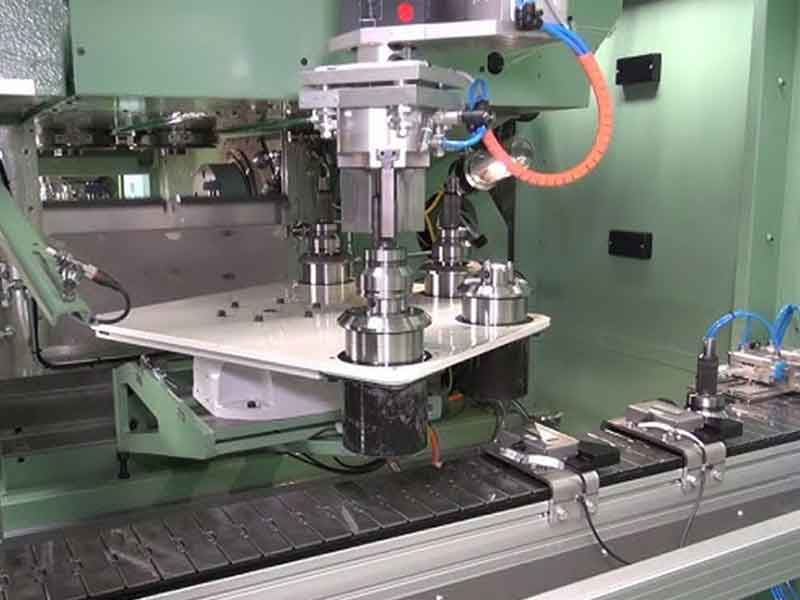
What Are Humanoid
Robot Finger Joints?
Humanoid robot finger joints are miniature precision parts that form the articulated hand: phalanx bodies, pivot pins, tendon-routing hardware, pulley mounts, fingertip interfaces, palm plates, and wrist flanges. We supply individual components and coordinated end-effector kits.
Performance depends on pivot fit and roundness, bore concentricity, tendon-channel geometry, mass control, and wrist-interface accuracy. Swiss CNC, mill-turn machining, CMM inspection, balance verification, and traceability support repeatable production.
-
Swiss CNC from Ø0.5mm — ±0.001mm pivot-pin roundness Guide-bushing Swiss CNC limits deflection in pivot pins, pulley axles, and phalanx bores below 2mm. Our platform achieves ±0.002mm pivot-pin diameter and ±0.001mm roundness, preventing elliptical contact and irregular joint motion.
-
Mass verification ±0.05g — every component and kit Hand mass affects actuator payload, reach, and speed. Every mass-specified component receives precision-balance verification to ±0.05g, supported by CAD prediction and cumulative kit-mass tracking before shipment.
-
Complete end-effector kitting from one source One coordinated shipment can include phalanx bodies, thumb segments, pivot pins, MCP joints, pulley mounts, palm plates, wrist flanges, and related precision hardware for a complete robot hand.
-
China production — 5–14 day prototype delivery Aluminium phalanx prototypes typically take 5–7 business days; coordinated end-effector kits take 10–14 days, depending on material, geometry, and inspection scope.

Why CNCPioneer — China Humanoid
Robot Finger Joints Supplier
Swiss CNC miniature machining from Ø0.5mm, mass-controlled production, end-effector kitting, AS9100D certification, and rapid China supply support humanoid OEMs, research teams, and commercial hand programmes.
Swiss CNC — ±0.001mm Roundness on Ø0.8mm Pins
Guide-bushing support next to the cutting zone prevents deflection in Ø0.8–4.0mm slender pins, while controlled tooling maintains the profile. 100% roundness testing at 0.0001mm resolution verifies ±0.001mm roundness and reduces stick-slip motion.
Mass-Critical Manufacturing — ±0.05g per Component
Every gram affects payload, reach, and manipulation speed. Precision-balance verification at ±0.05g–±0.1g is applied to mass-specified parts, with CAD mass prediction and kit-level cumulative tracking confirming the assembly stays within budget.
Complete End-Effector Kitting — One Shipment
Coordinated kit supply reduces multi-source logistics. A complete kit can include phalanx bodies, thumb parts, pivot pins, MCP joints, pulley mounts, a palm plate, and wrist flange, all produced to one controlled release plan.
Thin-Wall Miniature Machining — 0.5mm Wall Section
Distal phalanx shells can use 0.5mm wall sections, with bore coaxiality to ±0.050mm. Five-axis machining produces lightened palm structures, while Ra 0.4µm tendon channels reduce dry-running friction.
AS9100D Certified — OEM Supply-Chain Ready
AS9100D supports risk management, configuration control, AS9102 FAIR, and counterfeit-material prevention. For teams qualifying China suppliers, it reduces audit burden; XRF differentiates titanium grades and human-contact programmes can include biocompatibility certificates.
Prototype Delivery & Production Support
Typical delivery is 5–7 days for aluminium phalanx bodies, 7–12 days for titanium structures, and 10–14 days for complete kits. Expedited machining is available for parts blocking hand assembly.
Humanoid Robot Finger Joint
Components — Complete Product Range
Precision components from Ø0.5mm pulley axles and micro pivot pins to phalanx bodies, palm plates, wrist flanges, and coordinated end-effector kits.

Phalanx Structural Body Components
Proximal, middle, and distal phalanx bodies combine pivot bores to ±0.003mm, controlled tendon channels, and thin-wall structures. Choose 7075-T6 for standard structures, Ti-6Al-4V for mass-critical applications, or 6061-T6 for cost-sensitive programmes. Distal shells can reach 0.5mm walls and ±0.05g mass control.

Joint Pivot & Hinge Hardware
Swiss CNC produces Ø0.8–4.0mm pivot pins with ±0.002mm diameter, ±0.001mm roundness, Ra 0.2µm finish, and controlled retention features. Target clearance is 0.003–0.010mm between pin OD and bore ID, supported by matched pin and phalanx-bore tolerances. Bearing seats, thumb CMC bodies, and dual-axis MCP joints are also machined for controlled kinematics.

Tendon Routing & Drive Train Components
Pulley mounts, routing channels, terminations, and differential mechanisms maintain tendon alignment and low dry-running friction. Typical controls include ±0.003mm pulley bores, ±0.050mm channel widths, Ra 0.4µm channel finish, and PTFE or PEEK interfaces. Titanium terminations and 7075-T6 differential bodies support compact, load-adaptive drives.

Fingertip & Tactile Interface Components
Fingertip shells, tactile-sensor frames, and nail structures are made for low inertia, reliable sensor registration, and controlled pad bonding. Shells use 0.5–0.8mm walls, sensor pockets to ±0.030mm, and ±0.05g mass control; titanium, anodised 6061-T6, and engineering ceramic options support the required interface.

Palm, Metacarpal & Wrist Interface Components
Palm plates, metacarpal beams, actuator bays, wrist flanges, and controller housings establish hand alignment and integration. Pocketed 7075-T6 reduces palm mass while retaining stiffness. The wrist flange is the key kinematic datum, with bolt circles to ±0.020mm, h6 registers to ±0.008mm, and 0.005mm face flatness.

Complete End Effector Component Kitting Programs
Complete kits combine phalanx bodies, thumb components, pivot pins, MCP joints, pulley mounts, palm plates, wrist flanges, electronics housings, and retention hardware in one coordinated shipment. R&D kits in 7075-T6 typically take 10–14 days; production kits can use Ti-6Al-4V, bearings, or task-specific configurations. Cumulative mass is tracked before shipment.
Industries & Applications
Precision finger-joint and end-effector components for humanoid OEMs, robot manufacturers, dexterous-hand researchers, prosthetic developers, integrators, and teleoperation teams.

Commercial Humanoid Robot OEMs
Rapid prototype components and production-intent qualification for global commercial humanoid OEMs. Complete end-effector kitting supports development cycles with 5–14 business day prototype delivery.

Chinese Domestic Humanoid Robot Manufacturers
Local China supply for domestic robot manufacturers needing short logistics lead times, RMB-denominated pricing, and compatible quality documentation for development and production programmes.

Dexterous Hand Research & Academic Programs
Rapid-to-production supply for university, national, and corporate research teams developing dexterous hands, teleoperation systems, and robot-learning platforms.
Humanoid Robot Finger Joints
Manufacturing Capabilities
78+ Swiss CNC lathes for micro pivots and bores, 66+ mill-turn centres for palm and wrist geometry, plus CMM, roundness, mass, traceability, and AS9102 FAIR support.
Swiss CNC — Ø0.5mm to Ø32mm Miniature Finger Joint Parts
Guide-bushing Swiss CNC covers Ø0.5–32mm parts and L/D ratios to 20:1. Pivot pins reach ±0.002mm OD, ±0.001mm roundness, Ra 0.2µm, and ≤0.003mm/20mm straightness; phalanx bores reach ±0.003mm with ±0.050mm coaxiality. Minimum wall: 0.5mm.
MAZAK Mill-Turn — Complex Phalanx Housing & Palm Geometry
Mill-turn centres machine Ø5–150mm phalanx housings, palm plates, MCP bodies, wrist flanges, and electronics housings. Five-axis single-setup machining preserves relationships among pivots, tendons, pulleys, and sensors. Palm joint locations reach ±0.050mm; wrist flanges hold ±0.020mm bolt circles, h6 registers to ±0.008mm, and 0.005mm face flatness.
Mass-Critical Manufacturing — ±0.01g Balance, 100% Verification
A ±0.01g calibrated balance verifies every mass-specified part before kit inclusion. CAD prediction, individual weighing, and cumulative kit tracking manage the mass budget from DFM through shipment. Typical controls range from ±0.05g at the fingertip to ±1.0g at the wrist flange.
100% Roundness Tester + CMM + Profilometer Verification
100% pivot pins and bearing seats are checked on a 0.0001mm-resolution roundness tester. CMM reports cover bores, channels, joint locations, flanges, and walls; profilometer targets include Ra 0.4µm channels and Ra 0.2µm pivots. Air gauges and XRF support production monitoring and titanium-grade verification.
Humanoid Robot Finger Joint Material Range
Choose Ti-6Al-4V for mass-critical structures, Grade 23 ELI for biocompatible and MRI-compatible applications, 7075-T6 for standard phalanx and palm parts, and 17-4PH H900 for high-cycle pivots. 316L, PEEK, AZ91D, CFRP, and C17200 cover corrosion, low friction, low mass, high stiffness, and spring-contact needs.
Prototype & Production Programs
7075-T6 prototypes take 5–7 business days, or 7–10 with hard anodise; titanium parts take 7–12 days; 17-4PH pivots take 7–10; and full kits take 10–14. FAIR adds 2–3 days. Production programmes run on scheduled capacity, with 2–5 week lead times by volume and blanket-order releases.
Materials for Humanoid
Robot Finger Joints
Materials are selected for minimum mass, structural performance, and biocompatibility. Ti-6Al-4V Grade 5 suits mass-critical distal structures, 7075-T6 serves standard phalanx and palm programmes, and 17-4PH H900 supports high-cycle pivot performance.
7075-T6
Density 2.80 g/cm³ · Yield strength 503 MPa · The standard material for phalanx bodies and palm structures. Its high specific strength supports complex, pocketed housings with 40–50% mass reduction at equivalent stiffness. Use Type III hard anodise for wear surfaces or custom anodise for exterior finishes.
6061-T6
Density 2.70 g/cm³ · Excellent machinability and anodisability. Suits actuator bays, sensor housings, electronics mounts, complex pocketed palm parts, and tendon-channel inserts. Alodine supports EMC bonding; Type II anodise is a practical R&D finish.
Magnesium AZ91D
Density 1.81 g/cm³ · 35% lighter than 7075-T6 at the same wall section. Suits ultra-light distal phalanges and fingertip structures where inertia constrains grasping bandwidth. Requires anodise or conversion coating for corrosion protection.
Ti-6Al-4V Grade 5
Density 4.43 g/cm³ · Specific strength 199 MPa·cm³/g · Non-magnetic · AMS 4928. The premium option for mass-critical components, enabling 40–50% thinner walls than 7075-T6 at comparable margin. Suits distal shells, fingertips, wrist flanges, lightened proximal links, and thumb CMC bodies.
Ti Grade 23 ELI
Density 4.43 g/cm³ · Higher fracture toughness than Grade 5 · MRI-compatible · ISO 10993 biocompatible · ASTM F136. For direct-skin-contact prosthetics, medical end effectors, and MRI-adjacent systems. Full traceability and electropolished Ra ≤0.4µm finishes support regulated programmes.
CFRP Machined & Hybrid Designs
Density 1.55 g/cm³ · Specific stiffness 5–10× aluminium. CFRP tubes and palm beams suit designs governed by stiffness at minimum mass. Machined CFRP end fittings enable hybrid tube-and-titanium structures, with dedicated cutting protocols to prevent delamination.
17-4PH H900
Hardness 388–444 HBW · Yield strength 1,310 MPa · Corrosion resistant · AMS 5643. The standard pivot-pin material for contact-fatigue resistance, holding ±0.002mm on sub-2mm pins. XRF and hardness are verified by lot; it also suits bearing seats and high-load MCP hardware.
316L & 303
316L is non-magnetic, biocompatible, and suitable for food, medical, washdown, and direct-contact applications; ASTM A967 passivation and Ra ≤0.4µm electropolishing support sanitary finishes. 303 is a machinable option for general pivots, connector bodies, retention hardware, and fasteners.
Beryllium Copper C17200 AT
Density 8.25 g/cm³ · Non-magnetic, non-sparking, and high-strength. For electrical contact springs, retention clips, and snap rings that must maintain force through millions of flex cycles. Applicable beryllium documentation is available.
PEEK
Density 1.32 g/cm³ · Chemical-resistant, MRI-compatible, biocompatible, and low friction. PEEK pulley bodies reduce dry tendon wear and efficiency loss; it also suits insulating, imaging-compatible, and sterilisation-resistant medical components.
Delrin (POM) & PTFE
Delrin POM provides low-friction tendon-guide inserts and miniature bearing cages. PTFE coatings reduce dry tendon-channel friction below 0.04 for efficient force transmission; PTFE-lined Bowden-cable bores can be held to ±0.030mm.
DLC (Diamond-Like Carbon) Coating
HV 2,000–5,000 · 1–3µm thickness. DLC gives wear-critical pivots and saddle bearings high tribological performance while preserving ±0.002mm pin OD. It is well suited to 17-4PH H900 pivots targeting 10+ million cycles.
Surface Treatments for Humanoid
Robot Finger Joint Components
Treatments are selected for pivot and tendon-channel wear, dry-running friction, biocompatibility, long pivot life, low reflectance for machine vision, and medical or prosthetic compliance.
Hard Anodize Type III / Type II — Aluminum Phalanx & Palm Components
Primary treatment for aluminium phalanx bodies, palm structures, and MCP housings. HV 400+ surfaces resist pivot-bore wear against 17-4PH pins. Clear hard anodise adds ±0.025µm per side for precision features; black hard anodise reduces reflectance, while Type II suits lower-wear R&D work.
PTFE Dry Lubrication Coating — Tendon Routing Channels
PTFE lowers tendon-channel friction below 0.04, improving force transmission without liquid lubrication. It is applied at 5–15µm to phalanx and palm passages, and supports Bowden-cable routing in commercial dry-running hands.
Passivation ASTM A967 & Electropolishing — Biocompatible Programs
ASTM A967 passivation removes free iron from 17-4PH, 316L, and stainless hardware for corrosion resistance and human-contact use. Electropolishing gives medical stainless and Grade 23 ELI parts Ra ≤0.4µm, improving fatigue resistance and supporting regulated prosthetic programmes.
DLC (Diamond-Like Carbon) Coating — Pivot Pin Maximum Wear Life
HV 2,000–5,000 DLC at 1–3µm protects wear-critical pivots and saddle bearings while preserving ±0.002mm pin OD. It is applied to 17-4PH H900 pins for 10+ million-cycle targets and dry-running hands where liquid lubrication is unsuitable.
Chemical Film MIL-DTL-5541 & Gold Plating MIL-G-45204
Alodine chemical film provides low-resistance EMC bonding for aluminium wrist-controller housings. MIL-G-45204 hard gold plating gives connector contacts and flex-circuit pads stable low resistance through repeated finger articulation.
Black Oxide & Black Anodize — Machine Vision Guided Manipulation
Black oxide and black hard anodise reduce reflections that can affect vision-guided grasping. Both give consistent low-reflectance surfaces with negligible dimensional change on tight-tolerance pivot bores and pins.
DFM selects anodise, PTFE, passivation, electropolishing, DLC, chemical film, gold plating, and black finishes for wear, friction, biocompatibility, medical compliance, and vision compatibility. Treatment and biocompatibility certificates are available with shipment documentation.
Quality Assurance for
Humanoid Robot Finger Joints
AS9100D controls combine pivot-pin roundness checks, mass verification, titanium-grade XRF, AS9102 FAIR, and biocompatibility certificates for human-contact and prosthetic programmes.
Contract & Drawing Review
Engineering reviews drawings, AS9100D, ISO 10993, ISO 9283, and customer requirements before acceptance. Mass-budget assessment sets component targets and projects cumulative hand mass; DFM confirms miniature CNC feasibility, tendon friction geometry, material selection, and wrist-interface compatibility.
Material Incoming Inspection
XRF verifies alloy grade on every lot. This is critical for distinguishing titanium Grade 5 from Grade 23 ELI in medical and biocompatible programmes. 17-4PH H900 hardness is verified at 388–444 HBW, with full lot traceability and ISO 10993-1 or ASTM F136 documents where required.
First Article Inspection (FAIR) per AS9102
Every new part number receives CMM verification, pivot and bearing-seat roundness testing, and mass measurement. AS9102 FAIR packages include measurements, material, treatment, and biocompatibility records; customer approval precedes production release.
Material Hardness, Traceability & Certification
Pivot pins and bearing seats receive hardness verification at 389–444 HBW. Mill-to-shipment traceability and ISO 10993-1 or ASTM F136 documentation are available for human-contact and prosthetic programmes.
First Article Inspection (FAIR) per AS9102
CMM verification, pivot and bearing-seat roundness testing, and mass measurement support AS9102 FAIR packages with material, treatment, and biocompatibility records. Customer approval is required before production release.
- 100% CCD inspection where specified
- CMM geometry checks to the control plan
- Lot Cpk based on full distributions
In-Process Statistical Control
Air gauges monitor pivot-bore production in real time, with SPC targets of Cpk ≥1.33 for critical bores and pin diameters. 100% CCD sorting is available for volume programmes. Dedicated Swiss CNC protocols maintain ±0.002mm roundness across Ø0.8–4.0mm pin families.
- Real-time SPC at Cpk ≥1.33 for critical pivot features
- 100% CCD sorting for specified bores and pins
- Dedicated protocols for Ø0.8–4.0mm pin families
Humanoid Robot Finger Joints FAQ
Key answers on pivot precision, mass verification, end-effector kitting, materials, lead times, and supplier qualification.
The usual target is 0.003–0.010mm clearance between pin OD and bore ID, supported by ±0.002mm pivot-pin OD and ±0.003mm phalanx-bore tolerances. Guide-bushing Swiss CNC, stable tooling, and 100% testing at 0.0001mm resolution verify ±0.001mm roundness, preventing elliptical contact and irregular joint motion. Each Ø0.8–4.0mm pin family uses a dedicated process.
An individual finger joint includes the pivot, phalanx, bearing, and related parts for one articulation. An end-effector kit covers the complete hand: all digits, palm, wrist interface, actuation, sensor structures, and electrical interfaces. We supply both individual components and coordinated kits for customer assembly.
Ti-6Al-4V Grade 5 reduces wall thickness by 40–50% against 7075-T6 at comparable structural margin, making it the preferred phalanx material where mass is critical. AZ91D can reduce distal mass by about 35%; CFRP offers high specific stiffness for tube structures. For pivots and bearings, 17-4PH H900 remains the preferred choice for hardness, roundness, and corrosion resistance.
Three controls manage mass: CAD prediction during DFM to identify over-budget designs, precision-balance verification to ±0.01g for every specified component, and cumulative kit weighing before shipment. This confirms the complete hand assembly remains within its mass target.
Unfinished 7075-T6 phalanx and palm parts take 5–7 business days, or 7–10 with hard anodise. Ti-6Al-4V structures take 7–12 days; 17-4PH pivots and bearing seats take 7–10; and full hand kits take 10–14. AS9102 FAIR adds 2–3 days. Expedited machining plus express delivery can achieve 5–8 day door-to-door cycles.
Three capabilities matter: guide-bushing Swiss CNC for sub-2mm pivots, mass verification against hand-level budgets, and AS9100D documentation. Together with AS9102 FAIR, material traceability, and biocompatibility certificates, these controls reduce sourcing risk and incoming-inspection burden for professional humanoid OEM programmes.
Request a Humanoid Robot Finger-Joint Quote
Upload a drawing or CAD file for a 24-hour DFM and quote review. Engineering will assess miniature CNC feasibility, pivot and bore tolerances, material and mass targets, tendon routing, wrist-interface geometry, inspection, and end-effector kitting.