
Semiconductor Connector
Machining
CNCPioneer is a precision semiconductor connector machining specialist and certified semiconductor connector parts manufacturer delivering custom vacuum electrical feedthrough connector bodies, RF coaxial connector elements, UHP gas line face-seal fittings, high-voltage insulator assemblies, ATE socket frames, and wafer probe components — with connector body bore accuracy of ±0.002mm, bore concentricity of ±0.003mm, contact zone surface finish of Ra 0.1μm, and ASTM E595 TML ≤0.01% on electropolished 316L.
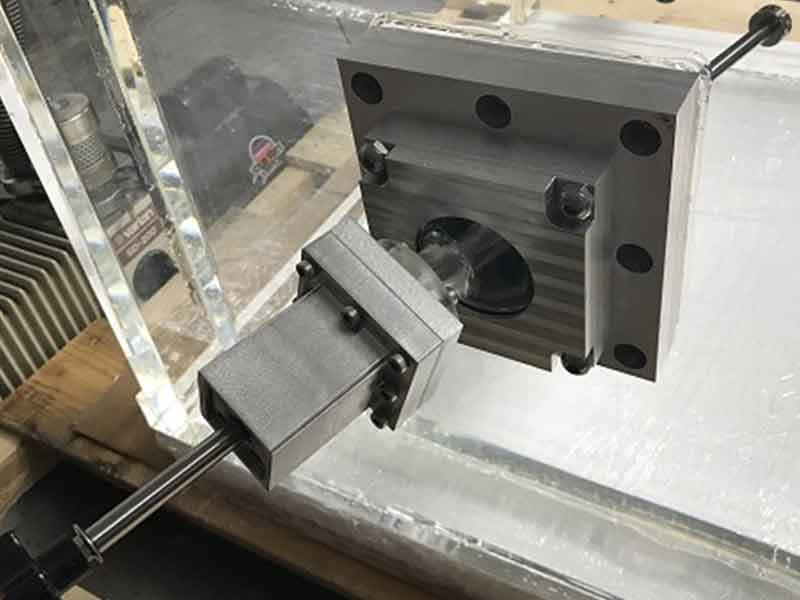
What Is Semiconductor
Connector Machining?
Semiconductor connector machining is the precision CNC manufacturing process — executed on Swiss CNC turning platforms, MAZAK mill-turn centers, 5-axis simultaneous machining systems, wire EDM, and precision grinding equipment — that produces the machined metallic bodies, insulator elements, contact pin assemblies, fitting bodies, and structural interface components constituting the connectors and connection hardware of semiconductor manufacturing equipment, wafer test systems, and semiconductor process infrastructure.
The term "connector" in semiconductor equipment encompasses a far broader category than pluggable electrical connectors. In semiconductor equipment, a connector is any machined mechanical interface that makes, breaks, routes, or seals a functional connection — electrical signal, high-voltage power, radio-frequency power, ultra-high-purity process gas, process chemical fluid, vacuum envelope, or thermal pathway — between system modules that must be assembled, serviced, or reconfigured. Semiconductor connector machining imposes requirements across four technical domains simultaneously: dimensional precision at the connector interface; material purity and outgassing control; chemical compatibility at process interfaces; and RF and electromagnetic integrity at measurement interfaces.
-
Swiss CNC bore concentricity as the alignment foundation The most functionally critical geometric relationship in every semiconductor connector is the coaxiality between the connector body bore axis and the electrical contact or fluid channel axis. CNCPioneer's Swiss CNC programs machine connector body bore, contact registration surface, and thread features in one guide bushing zone from one spindle datum — achieving bore-to-OD concentricity ±0.003mm for Ø2–30mm bodies without the re-chuck eccentricity that multi-setup machining introduces.
-
Outgassing compliance as material and process competency Every material surface inside semiconductor process equipment must comply with ASTM E595 TML ≤0.01% for UHV-adjacent programs. CNCPioneer's DFM review identifies the outgassing contribution of each material in the connector assembly, specifies the correct material + surface treatment combination, and coordinates electropolish on stainless and anodize on aluminum as standard manufacturing scope.
-
UHP cleanliness protocol for gas line connector parts UHP gas delivery system connectors require machined surfaces Ra ≤0.4μm, particle count ≤5 particles per liter at Ø≥0.2μm, no petroleum-based machining oil residues, and individually nitrogen-purge packaged in double cleanroom-grade polyethylene bags. CNCPioneer's UHP machining programs apply these cleanliness standards as production protocol — not as special additional scope.
-
40–60% China semiconductor connector cost advantage 40–60% below equivalent semiconductor connector machining from US, European, and Japanese specialty precision machining facilities at identical ±0.002mm bore accuracy, ASTM E595 outgassing compliance, UHP cleanliness protocol, and AS9100D documentation — enabling semiconductor equipment OEMs to achieve BOM cost targets in competitive capital equipment markets.

Why CNCPioneer for Semiconductor
Connector Machining?
Among semiconductor connector parts manufacturers globally, CNCPioneer's Swiss CNC concentricity precision, outgassing compliance competency, UHP cleanliness protocol, material compatibility DFM, complete connector type portfolio, and China cost advantage establish our factory as the preferred semiconductor connector machining partner for equipment OEMs and Tier 1 component suppliers worldwide.
Swiss CNC Bore Concentricity Foundation
The most functionally critical geometric relationship in every semiconductor connector is the coaxiality between the connector body bore axis and the electrical contact or fluid channel axis. CNCPioneer's Swiss CNC programs machine connector body bore, contact registration surface, and thread features in one guide bushing zone from one spindle datum — achieving bore-to-OD concentricity ±0.003mm for Ø2–30mm semiconductor connector bodies without the re-chuck eccentricity (±0.010–0.030mm per rechuck) that multi-setup machining introduces.
Outgassing Compliance Competency
Semiconductor connector bodies installed in process chambers, gas delivery systems, and vacuum-adjacent equipment require ASTM E595 TML compliance — with the additional constraint that the connector body may be made from a material combination rather than single-material construction. CNCPioneer's semiconductor connector DFM review identifies the outgassing contribution of each material in the connector assembly, specifies the correct material + surface treatment combination for the target vacuum environment, and coordinates electropolish and anodize as standard manufacturing scope.
UHP Cleanliness Protocol
Semiconductor process gas delivery system connectors contacting ultrapure process gases at 5N–7N purity require cleanliness standards far beyond standard precision machining: machined surfaces Ra ≤0.4μm on all gas-wetted surfaces; particle count ≤5 particles per liter at Ø≥0.2μm; no petroleum-based machining oil residues; and individually nitrogen-purge packaged in double cleanroom-grade polyethylene bags. CNCPioneer's UHP semiconductor connector machining programs apply these cleanliness standards as production protocol — not as special additional scope.
Material Compatibility DFM
CNCPioneer's 24-hour DFM for every semiconductor connector machining inquiry includes chemical compatibility analysis: identifying the corrosion mechanism of the specific semiconductor process chemistry against each candidate connector body material, calculating expected material dissolution rate and metallic ion contamination potential, and recommending the correct material (316L, Hastelloy C-276, Inconel 625, PTFE, PEEK, or specialty alloy) that survives the process chemistry without contaminating the gas or fluid stream.
Complete Connector Type Portfolio
Vacuum feedthrough connector bodies, RF coaxial connector elements, UHP gas face-seal connector fittings, high-voltage insulator connector bodies, ATE socket connector frames, wafer probe connector parts, fluid delivery connector fittings, and heated stage thermocouple feedthrough connector parts — all from CNCPioneer's semiconductor connector machining facility under one IATF 16949/AS9100D quality system, eliminating the multi-supplier coordination that sourcing different connector types from different specialty machining facilities imposes on OEM purchasing programs.
40–60% China Cost Advantage
CNCPioneer delivers semiconductor connector parts China production at 40–60% below US, European, and Japanese specialty precision machining facilities at identical ±0.002mm bore accuracy, ASTM E595 outgassing compliance, UHP cleanliness protocol, and AS9100D documentation. For a semiconductor equipment OEM with 250 tools per year each requiring 20 precision vacuum/UHP connector bodies, CNCPioneer delivers approximately $500,000 annual connector BOM savings.
Semiconductor Connector Types
We Manufacture
CNCPioneer's semiconductor connector machining programs cover the complete connector component architecture of semiconductor manufacturing equipment — from miniature SMA inner conductors at Ø1.27mm through large-diameter vacuum feedthrough flange bodies at DN160, including UHP gas manifold blocks, HV ceramic insulator bodies, and ATE socket frames at every specification level.

Vacuum Electrical Feedthrough Connectors
Hermetically sealed connector assemblies that pass electrical conductors through vacuum chamber walls — maintaining the vacuum envelope while providing electrical access to electrodes, heaters, sensors, and actuators inside. Machined outer body (316L stainless): OD ±0.020mm for ISO-KF or CF flange mounting; concentricity to inner bore ±0.010mm; inner insulator seat bore ±0.010mm for ceramic or glass insulator registration; brazing land ±0.005mm; electropolish all vacuum-wetted surfaces to Ra ≤0.2μm with ASTM E595 TML ≤0.01%. HV feedthrough bodies rated 1–600kV with creepage distance DFM confirmed per IEC 60664-1.

RF & Microwave Connector Components
Precision RF and microwave coaxial connector bodies for semiconductor equipment operating from DC to 110 GHz. SMA connector body (to 18 GHz): outer conductor ID = 4.166mm ±0.005mm governing 50Ω impedance; concentricity to thread axis ±0.003mm. 2.92mm K-connector (to 40 GHz): concentricity ±0.002mm — the tightest commercial coaxial connector tolerance. 1.85mm connector (to 67 GHz): Swiss CNC bore ±0.002mm at Ø0.8–1.2mm. CuCrZr or silver-plated copper inner conductors for minimum RF surface resistance. WR-series waveguide-to-coaxial transition bodies to 110 GHz.

UHP Gas Line Connector Fittings
VCR face-seal fitting bodies in 316L electropolished stainless: body bore ±0.020mm with Ra ≤0.4μm on all gas-wetted surfaces; face-seal surface flatness 0.003mm; thread 1/4"-28 UNF ±0.005mm; ASTM E595 TML ≤0.010%; particle count ≤5 particles @0.2μm per liter per SEMI F57. Hastelloy C-276 for corrosive halogen gas service (Cl₂, HBr, NF₃, HF). High-pressure gas connector fittings for H₂, O₂, and specialty gases at 100–3,000 psi with ASME B31.3-compliant body geometry. 6-port and 12-port gas manifold connector blocks with single-setup port array machining.

High-Voltage & High-Power Insulator Bodies
Ion implant extractor assembly connector insulators in Al₂O₃ 99.5% ceramic (dielectric strength 10 kV/mm) coordinated at qualified diamond grinding partners; PEEK insulator bodies (dielectric strength 19 kV/mm; ASTM E595 TML ≤0.03%) for moderate HV programs to 15kV; Macor machinable glass-ceramic for complex-geometry HV insulators. Electrostatic chuck HV power connector bodies with helium backside gas feedthrough integration — co-axial design with HV conductor in center and He channel as annular bore, machined to ±0.010mm on both bores simultaneously from one MAZAK mill-turn program.

ATE Socket & Wafer Probe Connectors
ATE socket connector bodies: package guidance bore ±0.020mm; probe contact bore array pitch ±0.010mm center-to-center for 0.5–1.27mm pitch arrays; bore diameter ±0.005mm; socket body temperature rating to 175°C in PEI/Ultem or 250°C in PEEK. Wafer probe connector bodies: probe body alignment bore ±0.005mm; probe tip holder bore ±0.002mm (Swiss CNC) for tungsten-rhenium probe tip engagement; GSG coplanar RF probe connector bodies with center-to-outer conductor concentricity ±0.003mm at 50–150μm pitch. Titanium non-magnetic probe bodies for magnetic field-sensitive device measurement.

Fluid & Chemical Delivery Connectors
Chemical delivery system connector fittings for HF, H₂SO₄ piranha, SC-1, SC-2, TMAH, and IPA: body bore ±0.020mm; Ra ≤0.4μm on wetted surfaces; face-seal fitting face flatness 0.005mm. Materials: PVDF (standard to 100°C); PFA (HF service to 150°C); PTFE (all chemicals to 260°C); quartz (ultra-pure programs). DI water and ultrapure water connector fittings in PVDF or PTFE with no dead legs and no sharp internal corners. CMP slurry connector fittings with body bore Ra ≤1.6μm to minimize particle agglomeration and scratching.
Industries & Applications
CNCPioneer's semiconductor connector machining serves every industry consuming precision connector bodies, insulators, and fittings at vacuum-compatible, UHP-clean, and RF-qualified tolerances — from semiconductor capital equipment OEMs coordinating complete per-tool connector BOM programs to research institutions requiring single-unit custom feedthrough bodies.

Semiconductor Capital Equipment
Complete semiconductor connector machining programs covering the full connector BOM for process equipment platforms — vacuum electrical feedthrough bodies for etch, CVD, PVD, and ALD chambers; UHP gas manifold connector blocks for gas delivery systems; RF power feedthrough bodies for plasma tools; ESC HV feedthrough assemblies; and wafer handling connector interface components. Single semiconductor connector parts manufacturer supply relationship for complete connector hardware BOM.
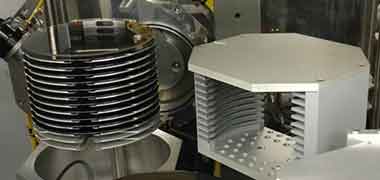
Ion Implantation & E-Beam Systems
High-voltage feedthrough connector body programs — 10–600kV rated HV insulator connector assemblies in Al₂O₃ ceramic, Macor, and PEEK; Kovar inner conductors for ceramic braze seal feedthrough; corona shield outer body machining; ion beam column connector insulator bodies for beam-forming electrode electrical isolation; and HV ribbon cable feed-through connector structural bodies.

CVD, ALD & PVD Equipment Manufacturers
UHP process gas connector fitting bodies in 316L electropolished for silane, TEOS, TMG, TMA, and other precursor gas delivery; multi-port gas distribution manifold connector blocks for showerhead gas distribution; heated gas line connector fittings in Hastelloy C-276 for corrosive gas service; and thermocouple feedthrough connector parts for substrate temperature monitoring.
Plasma Etch Tool Producers
RF power feedthrough connector body machining for 13.56 MHz ICP and CCP plasma sources; RF matching network connector interface bodies; HV DC bias electrode feedthrough connector assemblies; plasma-resistant gas injection connector fitting bodies in 316L and Hastelloy C-276 for halogen etch gas service; and endpoint detection viewport connector window holder bodies.
ATE & Wafer Test System Developers
ATE socket connector body machining programs — PEEK burn-in socket bodies for −55°C to 175°C; probe card connector alignment frame bodies; wafer-level probe connector body machining; RF probe (GSG coplanar) connector body programs in 6061-T6 and titanium; and semiconductor parametric test connector interface components for multi-site test parallelism.

Process Gas & Metrology Instrument Producers
UHP gas line VCR and face-seal connector fitting bodies in 316L electropolished for 5N–8N purity gas delivery; precision RF and microwave connector body machining for semiconductor S-parameter measurement instruments — 2.92mm to 40 GHz and 1.85mm to 67 GHz connector bodies for on-wafer device characterization; and optical measurement system connector body machining for fiber-coupled metrology tools.
Semiconductor Connector Machining
Process & Capabilities
CNCPioneer's semiconductor connector machining process runs on 78+ Swiss CNC lathes, 66+ MAZAK Integrex and Quick Turn mill-turn centers, MAZAK VARIAXIS 5-axis platforms, and wire EDM systems — delivering complete semiconductor connector parts in China production programs from single prototype first articles through 500,000+ annual unit volumes.
24-Hour Outgassing DFM & Engineering Review
Every semiconductor connector machining inquiry receives vacuum engineering DFM: material selection for specified operating vacuum level and ASTM E595 TML requirement; electropolish allowance calculation for connector bore and face dimensions; creepage distance adequacy for HV connector bodies; RF coaxial impedance geometry verification (inner conductor OD / outer conductor ID / dielectric constant combination achieves specified 50Ω ±0.5%); UHP cleanliness protocol specification; chemical compatibility analysis; and leak test protocol specification per connector vacuum class.
Swiss CNC Miniature Connector Body Machining
Mandatory platform for semiconductor connector bodies below Ø30mm — guide bushing support is the only manufacturing process achieving ±0.002mm bore accuracy at L/D > 5:1 without workpiece deflection. Programs: SMA coaxial RF feedthrough inner conductor (Ø1.27mm × 15mm, Kovar) with OD ±0.003mm, Ra 0.2μm, and 1/4"-36 UNF thread ±0.005mm; multi-pin signal connector pin arrays (gold plated) with OD ±0.002mm; and 2.92mm connector bodies with concentricity ±0.002mm for 40 GHz operation.
MAZAK Mill-Turn Medium Connector Bodies
Single-setup programs for medium-format semiconductor connector bodies — vacuum feedthrough flanges, gas manifold connector blocks, multi-pin feedthrough bodies, and semiconductor equipment connector housing assemblies. CF DN40 vacuum feedthrough flange body: bore ±0.005mm; insulator seat bore concentric to flange bore ±0.005mm; CF knife edge Ra 0.1μm; C-axis bolt holes ±0.010mm; electropolish all vacuum-wetted surfaces. 6-port and 12-port gas manifold connector blocks with all ports from single setup eliminating re-fixture accumulation error.
5-Axis Complex Semiconductor Connector Bodies
MAZAK VARIAXIS 5-axis for connector bodies with non-orthogonal port arrangements, compound-angle connection interfaces, and topology-optimized mass-reduction geometry. Multi-directional gas distribution manifold bodies with gas inlets from MFC outputs at varying angular positions and gas outlets at non-standard angles for process chamber port alignment — all port bores from one manifold body datum in one 5-axis program with port-to-port true position ±0.030mm.
In-Process Precision Controls
Swiss CNC: first-off laser micrometer OD measurement; in-process bore CMM before batch continuation. MAZAK mill-turn: first-off CMM on CF knife edge position, flange bore diameter, and insulator seat bore concentricity before batch release. RF connector coaxial concentricity: roundness tester measurement on first-off and 10% production sample — VSWR correlation between concentricity measurement and RF network analyzer VSWR data verified on qualification lot. Post-EP dimensional re-verification: all bore and face critical dimensions re-measured after electropolish.
IATF 16949 / AS9100D Documentation
Certificate of Conformance · CMM dimensional report · Profilometry Ra records · ASTM E595 TML batch certificate · He leak test records (vacuum programs) · Particle count records (UHP programs) · Material certificates with lot traceability · Plating XRF records · PPAP Level 3 for OEM programs · FAIR per AS9102 for aerospace semiconductor equipment programs · SEMI F57 cleanliness report per UHP connector lot · SEMI S2 material hazard declaration · Records retained 20 years.
Materials for Semiconductor
Connector Machining
Semiconductor connector machining material selection is governed by vacuum compatibility, outgassing compliance, chemical resistance to process chemistries, RF conductivity requirements, dielectric strength for HV isolation, and thermal expansion matching for brazed ceramic-to-metal seals. 316L electropolished stainless dominates vacuum and UHP gas applications as the standard UHP-compatible material.
Stainless 316L Electropolished
UHV-compatible; corrosion resistant; weldable. ASTM E595 TML ≤0.010% after electropolish. The standard material for vacuum feedthrough bodies, UHP gas fittings, and RF outer conductors. CNCPioneer verifies 316L grade by SII XRF C content measurement on every bar lot — confirming C ≤0.030% before machining begins to prevent sensitization during brazing and ensure uniform electropolish response.
Kovar UNS K94610
CTE 5.2 ppm/°C matched to Al₂O₃ ceramic (6.5 ppm/°C). ASTM E595 TML ≤0.010%. Prevents thermal fatigue at the brazed ceramic-to-metal interface during thermal cycling from ambient to process temperature. Used for HV feedthrough inner conductors and glass-to-metal seal elements. Composition verified: Ni 29%, Co 17%, balance Fe.
Aluminum 6061-T6
Lightweight; machinable; suitable for HV-range applications. ASTM E595 TML ≤0.020% (anodized). Used for ATE socket bodies, probe connector frames, and semiconductor equipment connector housings. Type II clear anodize per MIL-A-8625 provides electrical insulation on outer surfaces with 5–10μm coating; bore anodize growth allowance incorporated in machined dimensions.
PEEK Victrex 450G
Electrical isolation; UHV-compatible; chemical resistant. ASTM E595 TML ≤0.030%; dielectric strength 19 kV/mm. Used for HV insulator connector bodies to 15kV, RF connector dielectrics, and ATE socket bodies. Machined to ±0.005mm bore and OD tolerance with Ra 0.4μm from PCD turning; no post-machining heat treatment required.
PTFE Virgin Unfilled
Maximum chemical resistance; low dielectric constant εᵣ = 2.1 for RF applications. ASTM E595 TML ≤0.020%. Used for RF coaxial dielectric spacers, gas fitting bodies, and chemical connector fittings. Machined with PCD tooling in temperature-stabilized environment; guide bushing support at L/D > 3:1.
PFA Semiconductor Grade
HF and acid resistance to 150°C; semiconductor purity grade. ASTM E595 TML ≤0.020%. Used for UHP chemical connector fittings and HF gas connector bodies. Provides the chemical resistance of PTFE with improved mechanical strength and weldability for complex fitting geometries.
PVDF Kynar
Chemical resistance to 140°C; low TOC leaching. ASTM E595 TML ≤0.020%. Used for wet chemical connector fittings, DIW connector bodies, and CMP slurry fittings. Standard material for most semiconductor wet chemistry applications where PTFE cost is not justified.
Macor Corning Ceramic
Machinable glass-ceramic; high-temperature insulator; UHV-compatible. ASTM E595 TML ≤0.020%. Suited for moderate-temperature feedthroughs to 1,000°C and complex-geometry HV insulator bodies where diamond grinding of Al₂O₃ would be prohibitively expensive. Machined by CNC diamond grinding at CNCPioneer partner facilities.
Titanium Grade 2 CP / Ti-6Al-4V
Non-magnetic (μᵣ ≈ 1.0005); non-sparking; strong. ASTM E595 TML ≤0.010%. Grade 2 for non-magnetic probe connector bodies and MRI-adjacent tools. Ti-6Al-4V for high-stress connector structural bodies requiring maximum strength with non-magnetic properties. DLC coating compensates for lower surface hardness at bearing interfaces.
CuCrZr C18150 / Copper C11000
High-current RF inner conductor material. CuCrZr C18150 for high-power RF feedthroughs where RF skin depth at 13.56 MHz in copper (δ = 17.7μm) requires inner conductor OD >> δ for low surface resistance; minimum practical OD 3mm. Silver-plated for minimum RF surface resistance. Copper C11000 for low-frequency RF feedthrough conductors and HV braid connectors.
Hastelloy C-276 / Inconel 625
Hastelloy C-276: halogen gas corrosion resistance for Cl₂, HBr, NF₃, HF service where 316L corrosion produces metallic ion contamination. ASTM E595 TML ≤0.010%. Inconel 625: elevated-temperature halogen resistance for high-temperature corrosive gas connector bodies. Both materials verified by XRF composition confirmation per lot.
Quartz Fused SiO₂
Ultra-pure; UV-transparent; zero metallic ion leaching. ASTM E595 TML ≤0.010% (electropolished). Used for ultra-pure gas fitting bodies and UV-compatible connector windows in lithography and metrology equipment. Provides maximum chemical inertness for the most demanding ultra-pure inert gas programs where even 316L electropolished is insufficient.
Surface Treatments for
Semiconductor Connectors
Semiconductor connector machining surface treatment selection addresses vacuum outgassing compliance (electropolish, passivation), electrical insulation (anodize), contact resistance and corrosion stability (gold, rhodium plating), wear resistance at sliding interfaces (DLC), and diffusion barrier protection (nickel undercoat) — with coating allowances machined-in and verified post-treatment.
Electropolish — 316L & 304L Vacuum/UHP Bodies
Mandatory surface treatment for 316L and 304L stainless semiconductor connector bodies in vacuum and UHP service — Ra ≤0.2μm on all vacuum-wetted and gas-wetted surfaces after electropolish; ASTM E595 TML ≤0.010%. CNCPioneer coordinates electropolish through qualified EP partners as an integrated supply step — parts machined to pre-EP dimensions with 10–20μm per side EP allowance; post-EP dimensional verification confirms bore and face dimensions within specification; ASTM E595 batch TML certificate included in shipment documentation.
Passivation — ASTM A967
For stainless semiconductor connector bodies where electropolish is not required (atmospheric-pressure moderate cleanliness applications) — nitric or citric acid passivation; ASTM E595 TML ≤0.020% after passivation + cleaning; standard for gas distribution manifold connectors in non-UHP applications. Removes machining free iron and enhances the passive chromium oxide layer for maximum corrosion resistance across connector service life; applies zero dimensional change.
Type II Clear Anodize — 6061-T6 Aluminum
For aluminum ATE socket bodies, probe connector frames, and semiconductor equipment connector housings in non-vacuum programs — 5–10μm clear anodize; ASTM E595 TML ≤0.020%; electrically insulating on outer surfaces; bore anodize growth allowance incorporated in machined dimensions. Provides wear resistance at housing interfaces without the mass penalty of steel; Type II anodize is the standard finish for aluminum connector bodies in semiconductor equipment cabinets.
Gold Plating — Contact Zones & Inner Conductors
Hard gold (Au-Co 0.1–0.3%): 0.3–1.0μm on Ni 1.5–2.0μm undercoat for signal connector pins, ATE probe contact bodies, and SMA connector pin contact zones — minimum contact resistance, maximum corrosion stability. Soft gold (Au 99.9%): 0.5–2.0μm for wire-bonding interface elements and highest-conductivity RF inner conductor surfaces. XRF thickness verification: 3 points per connector pin or body per lot; ±0.1μm accuracy.
Rhodium Plating — High-Wear Contact Zones
For semiconductor equipment connector contacts requiring maximum wear resistance at repeated mate/unmate cycling — 0.1–0.3μm Rh over Ni; HV 800–900; on SMA and 2.92mm connector center pin contact zones in high-cycle ATE test programs. Rhodium's extreme hardness and corrosion resistance make it the preferred plating for connector interfaces subject to thousands of mate/unmate cycles in production test environments where gold would wear through.
DLC Coating — Ultra-Low Friction Sliding Zones
Diamond-like carbon (1–3μm, μ 0.05–0.15, HV 2,000+) for semiconductor connector bodies requiring ultra-low friction coefficient and maximum wear resistance at sliding contact zones — applied to RF connector inner conductor sliding zones where repeated connection cycling generates friction and wear. DLC's extreme hardness and low friction coefficient extend connector life in high-cycle applications while maintaining the dimensional precision of the underlying machined surface.
All surface treatments on semiconductor connector machining programs — electropolish, passivation, anodize, gold plating, rhodium plating, and DLC — are documented with treatment certifications and post-treatment dimensional verification in the shipment package. Plating and coating allowances are machined-in to journal and bore dimensions at the CNC machining stage and confirmed post-treatment by air gauge, laser micrometer, or CMM — ensuring dimensional specifications are met in the final delivered condition. Treatment selection guidance and dimensional allowance calculation are included in CNCPioneer's 24-hour DFM review at no additional cost.
Quality Assurance for
Semiconductor Connector Machining
Semiconductor connector machining quality assurance addresses four technical domains simultaneously — dimensional precision at the connector interface, material purity and outgassing control, chemical compatibility at process interfaces, and RF/electromagnetic integrity at measurement interfaces — with 100% verification on critical features and full lot traceability on all materials.
Outgassing DFM Review (24 Hours)
Every semiconductor connector machining inquiry receives vacuum engineering DFM: material selection for specified operating vacuum level (rough/HV/UHV) and ASTM E595 TML requirement; electropolish allowance calculation for connector bore and face dimensions; creepage distance adequacy for HV connector bodies; RF coaxial impedance geometry verification (inner conductor OD / outer conductor ID / dielectric constant combination achieves specified 50Ω ±0.5%); UHP cleanliness protocol specification for gas connector programs; chemical compatibility analysis for process chemistry connector programs; and leak test protocol specification per connector vacuum class.
Material Incoming Inspection
SII XRF composition verification: 316L C ≤0.030%; Ni 10–14%; Mo 2–3%; Kovar Ni 29%, Co 17% (Fe balance) confirmed. Electrical conductivity measurement on CuCrZr inner conductors: 83–87% IACS. PEEK and PVDF fluorescence FTIR: virgin unfilled grade confirmed (no glass fiber, no carbon filler). EN 10204 3.1 certificates archived per material lot; cross-referenced to semiconductor connector production lot.
In-Process Precision Controls
Swiss CNC: first-off laser micrometer OD measurement; in-process bore CMM before batch continuation. MAZAK mill-turn: first-off CMM on CF knife edge position, flange bore diameter, and insulator seat bore concentricity before batch release. RF connector coaxial concentricity: roundness tester measurement on first-off and 10% production sample — VSWR correlation between concentricity measurement and RF network analyzer VSWR data verified on qualification lot. Post-EP dimensional re-verification: all bore and face critical dimensions re-measured after electropolish.
Leak & Cleanliness Verification
Vacuum feedthrough connector bodies: helium leak test at 1×10⁻⁸ Pa·m³/s (standard) or 1×10⁻¹⁰ Pa·m³/s (UHV) on 100% of vacuum-sealed connector assemblies; test records per serial number. UHP gas connector fittings: 1L DI water flush particle count per SEMI F57 on 100% of UHP connector lots (≤5 particles @0.2μm per liter acceptance); records per lot. Chemical connector fittings: 100% visual inspection of gas-wetted bore surfaces under 5× magnification; no machining marks, no residual chip material, no surface defects >0.050mm.
Final Inspection & Documentation
CMM: all bore diameters, concentricity measurements, face flatness, thread positions, port array positions, CF knife edge radial position. Profilometry: contact zone Ra, gas-wetted bore Ra, CF knife edge Ra. Roundness tester: bore roundness, OD-to-bore concentricity. Thread gauges: GO/NO-GO all critical threads. XRF plating thickness: precious metal contact programs. He leak test records per serial number (vacuum programs). Particle count records per lot (UHP programs).
Complete Documentation Package
Certificate of Conformance per lot · CMM dimensional report · Profilometry Ra records · ASTM E595 TML batch certificate · He leak test records (vacuum connector programs) · Particle count records (UHP programs) · Material certificates with lot traceability · Plating XRF records · PPAP Level 3 for OEM programs · FAIR per AS9102 for aerospace semiconductor equipment programs · SEMI F57 cleanliness report per UHP connector lot · SEMI S2 material hazard declaration · All records retained 20 years.
IATF 16949 Quality System for
Semiconductor Connector Machining
CNCPioneer's IATF 16949 and AS9100D certified semiconductor connector machining quality system addresses the four domain requirements that distinguish semiconductor connectors from standard precision machined components: dimensional precision, outgassing compliance, UHP cleanliness, and RF/electromagnetic integrity — with structural guarantees, not sampled outcomes.
Dimensional Precision Structural Guarantee
Bore concentricity ±0.003mm and bore diameter ±0.002mm are structural guarantees — not outcomes of skilled operators achieving best possible results. CNCPioneer's Swiss CNC single-setup programs make concentricity a machine-positioning accuracy outcome rather than a rechucking-uncertainty outcome: every bore and OD shares the same guide bushing datum, eliminating re-registration error from the concentricity budget entirely. This structural guarantee extends through volume production without degradation.
- Bore-to-OD concentricity ±0.003mm structural
- Bore diameter ±0.002mm single-setup
- No rechucking error in precision budget
Outgassing Compliance by Design & Verification
ASTM E595 TML ≤0.01% for UHV programs and ≤0.05% for HV programs is verified by design (material selection + surface treatment specification in DFM) and by measurement (batch TML certificate from qualified test laboratory). Every vacuum and UHP semiconductor connector lot ships with TML documentation — not as a special request but as standard production documentation. Electropolish and anodize processes are qualified to TML compliance before any production lots are released.
- ASTM E595 TML batch cert per EP/anodize lot
- Material + surface treatment DFM verification
- 316L C ≤0.030% XRF verified per bar lot
UHP Cleanliness Protocol — SEMI F57
CNCPioneer's UHP semiconductor connector machining protocol achieves SEMI-clean particle count through five sequential disciplines: water-soluble cutting fluid (not petroleum-based); Ra ≤0.4μm on all gas-wetted surfaces; 15-minute ultrasonic clean in 18 MΩ·cm DI water; cleanroom nitrogen-purge packaging; and 1L DI water flush particle count verification at ≤5 particles @0.2μm per liter — consistently achieving ≤3 particles per liter on polished 316L UHP fittings, 40% below the SEMI F57 acceptance criterion.
- 100% particle count per SEMI F57 per UHP lot
- ≤3 particles @0.2μm/L typical (40% below limit)
- Water-soluble fluid + ultrasonic + N₂ purge
RF Integrity & Coaxial Concentricity Correlation
RF connector coaxial concentricity is verified by roundness tester on first-off and 10% production sample, with VSWR correlation between concentricity measurement and RF network analyzer VSWR data verified on qualification lot. For 2.92mm connectors to 40 GHz, ±0.002mm concentricity produces ~−35 dB return loss — within specification. At 1.85mm to 67 GHz, ±0.002mm high-precision Swiss CNC is required to maintain VSWR contribution ≤0.010. This concentricity-to-VSWR correlation is documented per qualification lot and retained for reference.
- Roundness tester + RF network analyzer correlation
- VSWR ≤1.05 verified on qualification lots
- Concentricity ±0.002mm for 1.85mm / 67 GHz
Semiconductor Connector Machining FAQ
Common questions from semiconductor capital equipment OEMs, ion implantation system builders, CVD/PVD process equipment manufacturers, plasma etch tool producers, ATE developers, and process gas delivery system integrators about CNCPioneer's semiconductor connector machining capability, material selection, outgassing compliance, UHP cleanliness, and volume program economics.
The L-grade distinction — 316L versus 316, 304L versus 304 — is governed by two vacuum-specific failure mechanisms that the carbon content difference determines. First, sensitization during brazing: at 750–900°C braze temperatures, standard-grade 316 (C up to 0.080%) precipitates chromium carbide (Cr₂₃C₆) at grain boundaries, depleting adjacent zones below the 12% Cr minimum for passivity. These sensitized zones are preferentially attacked during electropolish, producing rougher grain boundary texture (Ra 0.4–0.8μm) that elevates outgassing and creates micro-channels that propagate micro-leaks under cyclic thermal stress. 316L with ≤0.030% C contains insufficient carbon for significant Cr₂₃C₆ precipitation even at 900°C — maintaining uniform grain boundary chemistry and uniform electropolish response that achieves ASTM E595 TML ≤0.010% consistently. Second, preferential grain boundary etching during electropolish: standard-grade stainless produces preferential grain boundary etching that creates textured surface with elevated Ra at grain boundaries. 316L electropolishes uniformly (no grain boundary precipitation to preferentially etch), achieving true Ra ≤0.1μm. CNCPioneer verifies 316L grade by SII XRF C content measurement on every stainless bar lot — confirming C ≤0.030% before any semiconductor vacuum connector body machining begins.
RF coaxial connector body concentricity governs VSWR (voltage standing wave ratio) through the relationship between physical eccentricity of the inner conductor relative to the outer conductor and the resulting discontinuity in characteristic impedance. For a 50Ω coaxial connector, the nominal geometry satisfies Z₀ = (138/√εᵣ) × log₁₀(D/d) = 50Ω. When the inner conductor is eccentric by δ, the local impedance varies around the circumference, producing a discontinuity that partially reflects the incident signal — the VSWR contribution. For SMA connectors to 18 GHz, δ = 0.003mm produces a negligible VSWR contribution of ~1.004. For 2.92mm connectors to 40 GHz, same δ produces VSWR = 1.007, acceptable within typical ≤1.05 specification. For 1.85mm connectors to 67 GHz, δ must be reduced to ±0.002mm to maintain VSWR contribution ≤0.010. CNCPioneer achieves ±0.003mm concentricity on SMA and 2.92mm bodies by Swiss CNC single-setup machining: outer conductor bore and inner conductor register OD both machined from the same guide bushing position without rechucking — the physical datum continuity that makes concentricity a function of machine positioning accuracy (±0.001–0.002mm) rather than of chuck re-registration (±0.010–0.030mm per rechuck on standard lathes).
SEMI F57 defines the particle count acceptance criterion for components in semiconductor UHP gas delivery systems as: ≤5 particles per liter at Ø≥0.2μm, measured from a 1L DI water flush through the assembled component at 1L/min flow rate. This is the threshold below which the gas connector fitting does not measurably increase particle count in the process gas stream. CNCPioneer's UHP protocol achieves SEMI-clean particle count through five sequential disciplines. First, cutting fluid selection: water-soluble cutting fluid (not petroleum-based) for all UHP gas connector body machining — petroleum residues are extremely difficult to remove and continuously outgas hydrocarbon contamination. Second, Ra ≤0.4μm on all gas-wetted surfaces: rough surfaces trap chips and cutting fluid that resist ultrasonic cleaning; smooth surfaces clean completely. Third, post-machining ultrasonic clean: 15-minute ultrasonic agitation in 18 MΩ·cm DI water at 45°C → DI water rinse → IPA purge → N₂ dry → visual inspection under 5×. Fourth, cleanroom packaging: individual nitrogen purge + double cleanroom-grade polyethylene bag seal. Fifth, particle count verification: 1L DI water flush at 1L/min; liquid particle counter measures effluent; acceptance ≤5 particles @0.2μm per liter; result recorded against component lot number. CNCPioneer consistently achieves particle counts ≤3 @0.2μm per liter on polished 316L UHP fittings — 40% below the SEMI F57 acceptance criterion.
Prototype lead times: Swiss CNC SMA coaxial RF feedthrough inner conductor (Kovar, 316L) — 3–5 business days; Swiss CNC multi-pin signal connector pin array (brass, gold-plated) — 3–5 days; MAZAK mill-turn 316L CF vacuum feedthrough body (DN40, electropolished) — 5–7 days; MAZAK mill-turn 316L 6-port UHP gas manifold block (electropolished + He leak test) — 6–8 days; MAZAK mill-turn PEEK HV insulator connector body — 4–6 days; 5-axis compound-angle gas distribution manifold (316L, 12-port + EP) — 8–12 days; PVDF chemical fitting connector body — 4–6 days; PEEK ATE socket connector body with probe bore array — 5–8 days. Electropolish coordination: 2–3 additional days. Gold plating coordination: 3–5 additional days. He leak test: 1–2 additional days. Pilot production (50–500 units): 2–3 weeks per batch; pre-certified EP lots beginning; SPC accumulation. PPAP Level 3: 6–8 weeks from pilot approval; Cpk ≥1.67 on bore diameter, concentricity, and VCR gland flatness confirmed. Volume OEM production: 2-week monthly blanket releases with dedicated Swiss CNC capacity; pre-purchased 316L safety stock; pre-certified monthly EP lots with single ASTM E595 TML certificate per monthly lot. Economics: a 316L electropolished CF DN40 vacuum signal feedthrough body costs approximately $285 from a US vacuum component specialist at prototype pricing; approximately $165 at CNCPioneer prototype; and $62–80 at 2,000 annual units in China production. A 316L electropolished 6-port UHP gas manifold connector block costs approximately $340 from a US specialist; approximately $185 at CNCPioneer prototype; $72–90 at 2,000 annual units.
Get a Quote for Semiconductor Connector Machining
Submit your semiconductor connector machining requirements — vacuum feedthrough connector bodies, RF coaxial connector components, UHP gas fitting bodies, HV insulator connector assemblies, ATE socket connector frames, or any semiconductor equipment connector parts — and receive a free vacuum engineering DFM review and competitive quotation within 24 hours. Include connector type, operating environment, connector standard, material preference, quantity, and ASTM E595 or SEMI F57 compliance requirement for the most accurate DFM and pricing response.