
Titanium Swiss Screw
Machined Parts for Regulated Industries
CNCPioneer manufactures high-precision titanium swiss screw machined parts with tolerances as tight as ±0.005 mm — for aerospace, medical, defense, and semiconductor applications.
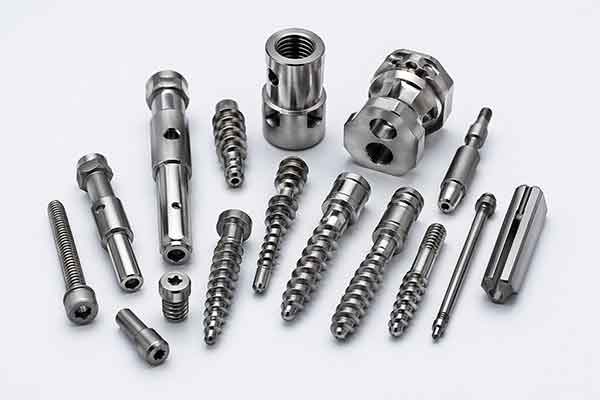
What Are Titanium Swiss
Screw Machined Parts?
Titanium swiss screw machined parts are precision components produced on Swiss-type automatic screw machines using titanium bar stock. The guide bushing system supports the workpiece directly at the cutting zone, eliminating deflection caused by titanium's high cutting forces — enabling consistent thread forms, tight diameters, and superior surface finishes on small, slender components.
Swiss screw machining completes turning, threading, milling, cross-drilling, and slotting in a single setup — minimizing thermal cycling and handling that can compromise titanium's dimensional stability between operations.
-
Guide-bushing anti-deflection Supports titanium at the cut — eliminates springback and dimensional drift on threaded features.
-
Thread tolerances to 6H/6g ISO thread accuracy across full production volumes, with 100% CMM verification on medical parts.
-
Full features in one cycle Threads, cross-holes, hex drives, and cannulated bores — no re-fixturing for titanium.
-
L/D ratios up to 15:1 Ideal for bone screws, spinal pins, and aerospace fasteners that challenge conventional lathes.
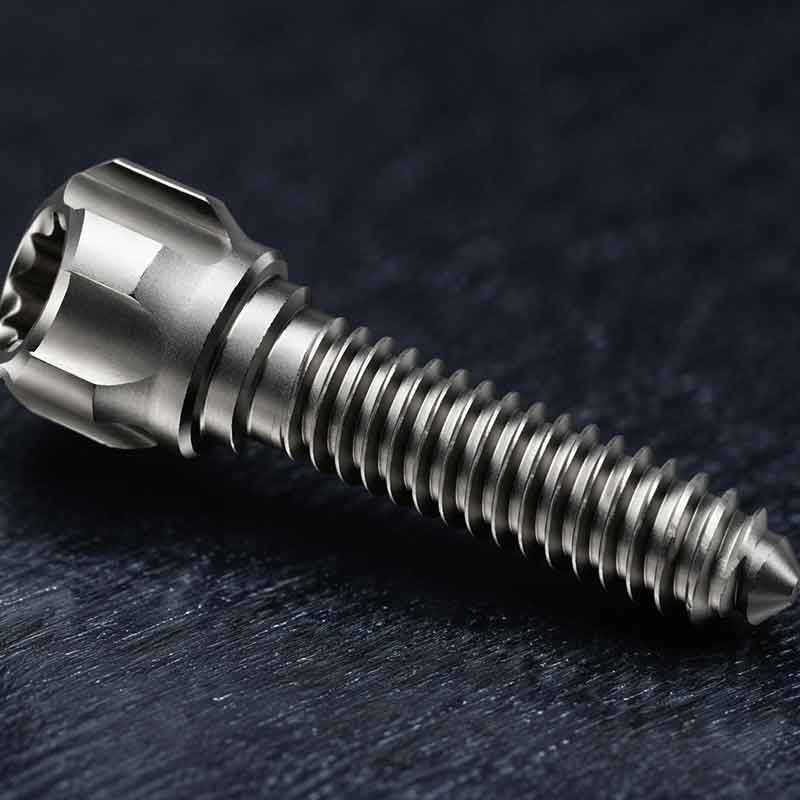
Why Titanium for Swiss
Screw Machined Parts?
Titanium is the material of choice when screw machined components must withstand demanding mechanical, biological, or chemical environments where no other material can match its performance profile.
Strength-to-weight ratio
Titanium screw machined parts offer the tensile strength of steel at roughly half the weight — preferred for weight-critical aerospace fasteners and implant hardware.
Biocompatibility
Grade 2 and Grade 5 titanium fully satisfy ISO 10993 requirements — enabling direct use in implantable bone screws, dental fixtures, and surgical instruments.
Corrosion resistance
The self-repairing titanium oxide layer provides outstanding resistance to saline, body fluids, and aggressive chemicals — ideal for long-term implanted service and subsea hardware.
Non-magnetic properties
Critical for screw machined components in MRI equipment, defense electronics, and precision instruments where magnetic interference must be eliminated.
Superior fatigue life
Titanium's fatigue resistance exceeds stainless steel and aluminum — essential for cyclically loaded aerospace fasteners and dynamic implant environments.
High temperature stability
Retains mechanical properties at elevated temperatures — making titanium screw parts suitable for aerospace engine hardware and high-heat industrial assemblies.
Titanium Screw Machined Parts We Commonly Produce
Our titanium swiss screw machining capability is optimized for small, precise, feature-rich components used in regulated and performance-critical assemblies.

Bone Screws & Orthopedic Fasteners
Titanium bone screws, pedicle screws, and cannulated orthopedic fasteners in Grade 5 and Grade 23 ELI with full material traceability and 100% CMM inspection.

Aerospace Fasteners & Structural Pins
Lightweight titanium screw machined fasteners, structural pins, and precision hardware for airframe, hydraulic system, and avionics enclosure applications.

Dental Implant Screws & Abutments
Grade 2 and Grade 5 titanium dental implant screws, abutment components, and dental fixture hardware produced to implant-grade surface finish requirements.

Spinal Fixation Hardware
Titanium pedicle screws, set screws, and spinal fixation fasteners in Grade 23 ELI for superior fracture toughness under cyclic in-vivo loading.

Surgical Instrument Components
Titanium instrument screws, pins, and threaded components for surgical instruments and reusable device assemblies requiring cleanroom-compatible finishing.

Semiconductor & Process Equipment Hardware
Titanium screw machined fittings, fasteners, and process equipment components for semiconductor fabrication requiring extreme chemical resistance and EP-polished ultra-high purity surfaces.
Industries We Serve with Titanium Swiss Screw Machined Parts
CNCPioneer's AS9100D certification and ISO 10993-compatible production processes ensure every titanium screw component meets traceability, cleanliness, and dimensional requirements across regulated sectors.

Medical & Dental
Bone screws, pedicle screws, dental implant screws, and surgical instrument fasteners in Grade 2, Grade 5, and Grade 23 ELI with full lot traceability and cleanroom-compatible packaging.

Aerospace
Lightweight titanium fasteners, structural pins, and precision hardware for airframe, hydraulic, and avionics applications. AS9100D certified with FAIR documentation and AMS material compliance.

Defense
High-strength titanium screw components for guidance systems, weapon system hardware, and communication equipment assemblies requiring non-magnetic properties and full material certification.

Semiconductor
Titanium screw machined fittings and process equipment hardware for semiconductor fabrication environments. EP polishing and passivation available for process gas and chemical delivery systems.

Oil & Gas
Corrosion-resistant titanium screw components for subsea valve assemblies, downhole tool hardware, and offshore structural fasteners where seawater resistance and high-pressure performance are critical.

Consumer Electronics
Precision titanium screws, pins, and threaded inserts for premium laptops, wearables, optical instruments, and audio equipment where lightweight strength and premium material character are required.
Titanium Swiss Screw Machining
Capabilities at CNCPioneer
CNCPioneer operates dedicated titanium machining protocols across 78+ Swiss lathes, with tooling, cutting parameters, and coolant strategies specifically optimized for titanium's thermal and mechanical characteristics.
Bar Stock Range
Ø1 mm to Ø32 mm titanium bar stock — covering miniature implant screws through large aerospace fasteners.
Tolerance Capability
Standard ±0.01 mm; high-precision ±0.005 mm with full CMM verification. Thread accuracy to 6H/6g class per ISO standard.
Titanium Grades
Grade 1, 2, 4, 5 (Ti-6Al-4V), 9, and Grade 23 (Ti-6Al-4V ELI). Grade selection guided by biocompatibility and strength requirements.
78+ Swiss CNC Lathes
Star SR-32J, Citizen A20/A16, Tsugami B206 — up to 9-axis simultaneous turning with high-pressure through-tool coolant for titanium.
Titanium-Specific Controls
PVD-coated carbide tooling, optimized feed rates to prevent work hardening, and dedicated inspection protocols for titanium surface integrity.
DFM & Engineering Review
24-hour DFM report on uploaded CAD. Grade recommendation, surface treatment selection, and FAIR documentation for aerospace programs.
Titanium Grades We Machine for Swiss Screw Parts
We machine the full range of titanium alloys — from commercially pure grades optimized for biocompatibility to high-strength aerospace alloys. Grade selection is guided by strength requirements, biocompatibility classification, and end-use environment.
Grade 1
Highest ductility · Best formability · Excellent corrosion resistance · Chemical fittings, marine fasteners
Grade 2
Balanced strength & ductility · Fully biocompatible · Medical implant screws, dental fixtures, surgical fasteners
Grade 4
Highest CP strength · Good corrosion resistance · Medical device screws, aerospace fittings
Grade 5 (Ti-6Al-4V)
Most widely used alloy · High strength · Biocompatible · Aerospace fasteners, orthopedic screws, defense hardware
Grade 23 (Ti-6Al-4V ELI)
Extra-low interstitials · Superior fracture toughness · Implantable bone screws, spinal fixation hardware, surgical instruments
Grade 9 (Ti-3Al-2.5V)
Good strength-weldability balance · Hydraulic fittings, aerospace structural fasteners
Surface Finishing Options for
Titanium Swiss Screw Machined Parts
Titanium screw machined components frequently require post-machining surface treatments to meet medical biocompatibility standards, aerospace corrosion specifications, or functional performance requirements.
Electropolishing (EP)
Removes surface contaminants and micro-peaks from titanium screw surfaces — producing an ultra-smooth, passive finish ideal for implantable components, surgical instruments, and semiconductor process hardware.
Passivation
Enhances titanium's natural oxide layer for improved corrosion resistance in aggressive biological and chemical service environments — standard for medical implant screw components.
Electropolishing
Electrochemical process that removes a thin surface layer, resulting in ultra-smooth, bright finishes. Commonly specified for medical and semiconductor components.
Plating (PVD Coating)
TiN and TiAlN physical vapor deposition coatings for extreme wear resistance on titanium screw components in cutting tool and high-friction aerospace applications.
Anodizing (Type II & Type III)
Produces stable colored oxide layers for part identification, corrosion protection, and wear resistance on titanium screw components. Widely used for aerospace fasteners and medical instrument parts.
Bead Blasting & Acid Etching
Bead blasting delivers a uniform matte finish for surgical screws and aerospace fasteners. Acid etching creates controlled Ra 1.0–2.0 μm surfaces on bone contact areas to promote osseointegration.
Surface finish requirements on titanium screw components often affect clinical performance as much as dimensional accuracy. Our engineering team recommends the appropriate treatment based on your part's specific application and regulatory classification.
From Drawing Review to Finished Titanium Parts
Our workflow is designed to move titanium screw machined programs from first article to qualified production with the documentation and material traceability regulated industries require.
Drawing Review & DFM
Upload your CAD file. Our team reviews titanium grade suitability, thread geometry, tolerance stack, and surface finish requirements — returning a DFM report within 24 hours.
Grade & Process Confirmation
We confirm the optimal titanium grade (Grade 2, 5, or 23 ELI), cutting protocol, and surface treatment for your part's application, regulatory classification, and cost target.
First Article / FAIR Production
For new programs, we produce sample parts or First Article Inspection Reports for dimensional review and approval before volume production is released.
Titanium Swiss Screw Machining
Parts are produced on dedicated titanium programs with PVD-coated tooling, high-pressure coolant, and optimized feed rates to prevent work hardening and hold thread tolerances.
Surface Finishing
Parts move into finishing — EP polishing, passivation, anodizing, bead blasting, or acid etching — per clinical, aerospace, or functional requirements.
Inspection, Documentation & Shipment
100% CMM inspection for aerospace and medical parts. Ships with material certificates, inspection reports, and FAIR documentation. Cleanroom-compatible packaging available for implantable components.
Quality Assurance for Titanium
Swiss Screw Machined Parts
Titanium screw machined parts — especially implantable medical devices and certified aerospace assemblies — demand a higher standard of oversight. CNCPioneer applies dedicated inspection protocols covering material verification, in-process dimensional control, and final thread and surface inspection.
Incoming Material Verification
SII X-ray fluorescence analyzer confirms titanium alloy grade and composition. Mill test reports reviewed and retained for every batch. Grade 23 ELI materials verified against interstitial content specifications per AMS 4930.
- XRF alloy grade confirmation
- Mill test report review & retention
- ELI interstitial content verification
In-Process Inspection
Real-time dimensional checks with Mitutoyo micrometers and height gauges. Tool wear monitoring prevents surface work hardening on titanium threaded features. Thread gauging at defined production intervals.
- Real-time dimensional checks
- Tool wear monitoring for titanium
- Thread gauging at set intervals
Final Inspection
Mitutoyo CMM (±0.001 mm) for complex geometries. Optical thread measurement for pitch diameter and form verification. Surface roughness tester confirms Ra values. 100% visual inspection on aerospace and medical parts.
- CMM ±0.001 mm measurement
- Optical thread form verification
- 100% inspection for aero/medical
Documentation & Delivery
Ships with full material certificates, CMM inspection reports, and FAIR reports for aerospace programs. Cleanroom-compatible packaging and full lot traceability for implantable medical components.
- Material certs & mill test reports
- CMM reports & FAIR documentation
- Cleanroom-compatible packaging
- Protective packaging for precision parts
Titanium Swiss Screw Machined Parts FAQ
Common questions from engineers and buyers about our titanium swiss screw machining capabilities.
Titanium's low thermal conductivity concentrates cutting heat at the tool edge, accelerating tool wear and causing surface work hardening if cutting parameters are not carefully controlled. Its high strength-to-modulus ratio also causes springback on threaded features. CNCPioneer addresses these challenges through PVD-coated carbide tooling, optimized cutting speeds, high-pressure through-tool coolant, and in-process thread gauging developed specifically for titanium.
Grade 23 (Ti-6Al-4V ELI — Extra Low Interstitials) is the standard choice for load-bearing implantable screws. Its reduced oxygen, nitrogen, and iron content versus standard Grade 5 provides superior fracture toughness and fatigue resistance under cyclic in-vivo loading. Grade 2 commercially pure titanium is used for non-load-bearing implant screws and dental fixtures where maximum corrosion resistance and osseointegration are the primary requirements.
For standard threads, we produce to 6H/6g tolerance class per ISO 261/965. For high-precision aerospace and medical applications, tighter thread tolerances are achievable with full optical measurement verification. Titanium's springback characteristics require dedicated process parameter development to hold pitch diameter consistently — an area where CNCPioneer's dedicated titanium screw machining experience is critical.
For prototypes using in-stock titanium (Grade 2, Grade 5), lead time is typically 5–7 days due to titanium's longer cycle times versus aluminum or brass. Standard production volumes are completed in 3–5 weeks depending on quantity, thread complexity, and surface finishing requirements. Rush options are available for repeat orders with established programs.
Yes. CNCPioneer is AS9100D certified and works exclusively with titanium bar stock meeting AMS 4928 (Ti-6Al-4V), AMS 4930 (Ti-6Al-4V ELI), and other applicable aerospace material specifications. We provide full material traceability, mill test reports, and First Article Inspection Reports (FAIR) for all aerospace fastener and screw machined component programs.
Bone contact surfaces on titanium implant screws are typically bead blasted or acid etched to a controlled Ra 1.0–2.0 μm to promote osseointegration. Non-bone-contact surfaces and instrument screws are electropolished for maximum corrosion resistance and biocompatibility. Our engineering team recommends the appropriate surface treatment combination based on your screw's anatomical application and regulatory classification.
Yes. Every titanium order is supported by full material certifications including mill test reports confirming alloy composition, mechanical properties, and compliance with AMS, ASTM, and ISO material specifications. For implantable medical device programs, we maintain complete lot traceability from raw bar stock to finished screw component, supporting your device history record requirements.
Upload your CAD file (STEP, IGES, or SolidWorks) and receive a free DFM review and competitive quote within 24 hours. Include your titanium grade, thread specification, surface finish requirement, and target quantity. Our engineering team will confirm the optimal grade and process for your application.
Need a Reliable Supplier for Titanium Swiss Screw Machined Parts?
Upload your CAD file to CNCPioneer for a free DFM review and competitive quote within 24 hours. Our engineering team will confirm the optimal titanium grade, thread specification, and surface treatment for your application.