When it comes to selecting the right metal for your project, two of the most popular options are aluminum and stainless steel. Both materials offer unique properties that make them ideal for a wide range of applications, from construction and automotive parts to kitchenware and aerospace components.
But what sets them apart? In this article, we’ll explore the key differences between aluminum and stainless steel, comparing their properties, applications, corrosion resistance, and cost. Whether you’re a fabricator, engineer, or DIY enthusiast, understanding these distinctions can help you make an informed choice for optimal performance and longevity.
Aluminum vs. Stainless Steel: Which is Best for My Project?
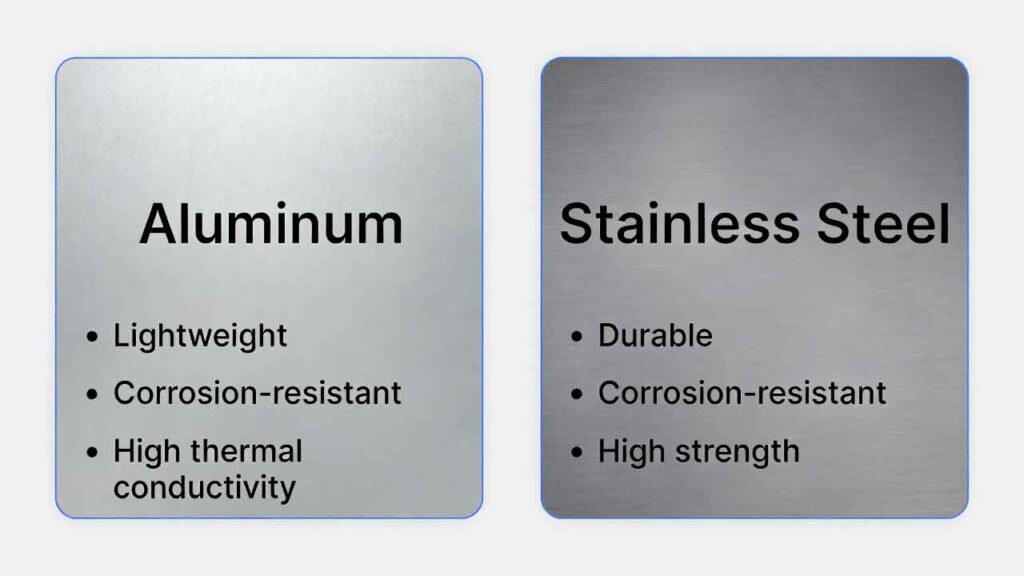
The “best” material depends on your specific needs. Aluminum is lightweight, highly conductive, and cost-effective for projects where weight reduction is key, such as in transportation or electrical applications.
Stainless steel, on the other hand, shines in environments requiring superior strength, durability, and resistance to extreme conditions, like marine or high-heat settings.
By weighing factors like budget, environment, and functionality, you can determine which metal aligns with your goals. Let’s dive deeper into the comparisons.
Aluminum vs. Stainless Steel: Properties
Both metals boast impressive characteristics, but their properties vary significantly, influencing their suitability for different uses. Here’s a breakdown:
Weight and Density
Aluminum is notably lighter, with a density of about 2.7 g/cm³—roughly one-third that of stainless steel (around 8.0 g/cm³). This makes aluminum ideal for applications where reducing overall weight is crucial without sacrificing too much structural integrity.
Strength and Durability
Stainless steel generally offers higher tensile strength (515-1300 MPa) and hardness (Brinell hardness 80-600 HB), making it more resistant to impacts, deformation, and wear.
Aluminum has lower raw strength (100-400 MPa tensile, 15 HB hardness) but provides an excellent strength-to-weight ratio, allowing it to support comparable loads in lighter designs. For high-stress environments, stainless steel is tougher, while aluminum’s flexibility prevents cracking under bending.
Conductivity
Aluminum excels in both electrical and thermal conductivity. It conducts electricity at about 61% of copper’s level (vs. stainless steel’s 3.5%) and heat at around 210 W/mK (vs. stainless steel’s lower rate).
This makes aluminum perfect for heat sinks, radiators, or power lines, whereas stainless steel’s poorer conductivity suits applications needing heat retention.
Heat Resistance and Melting Point
Stainless steel withstands higher temperatures, with a melting point of 1230-1530°C and the ability to maintain integrity up to 1400°C in some grades.
Aluminum softens around 400°C and melts at about 660°C, but it performs better in cold conditions, where its tensile strength increases while stainless steel may become brittle.
Malleability and Workability
Aluminum is more malleable, ductile, and easier to form, cut, or machine—up to 3-4 times faster than stainless steel. This allows for complex shapes without cracking. Stainless steel is harder and more rigid, which can make it less formable but easier to weld in many cases.
Magnetic Properties
Aluminum is non-magnetic across all alloys, while stainless steel varies—ferritic grades are magnetic, but austenitic ones (like 304) are not.
Other Traits
Aluminum often appears duller with white, chalky oxidation, while stainless steel maintains a shiny, reflective finish. Both can be treated (e.g., anodizing for aluminum) to enhance properties.
Aluminum vs. Stainless Steel: Applications
The choice between these metals often boils down to the industry and specific demands. Here’s how they stack up:
Aluminum Applications
Commonly used in aerospace (aircraft frames and components), automotive (body panels, engines for weight savings), transportation (trains, trucks, spaceships), electrical (power lines, transformers), architecture (window frames, cladding, high-rises like the Empire State Building), packaging, and household items (appliances, cans).
Its lightweight nature and conductivity make it a go-to for efficiency-focused designs.
Stainless Steel Applications
Excels in construction (bridges, beams, sculptures); automotive (bodies, rail cars, exhaust systems); marine (due to salt resistance); medical (surgical tools, implants, equipment); food service (cookware, sinks, cutlery for easy cleaning and non-reactivity); aerospace (high-strength parts); and industrial machinery.
Overlapping Uses
Both appear in oil and gas, power generation, and electronics, where hybrids (e.g., aluminum for conductivity with stainless steel reinforcements) leverage their strengths.
For precision stamping or fabrication, aluminum suits lightweight electronics, while stainless steel handles corrosive or high-stress parts.
Aluminum vs. Stainless Steel: Corrosion Resistance
Corrosion resistance is a standout feature for both, but they differ in mechanisms and performance:
Aluminium
Forms a natural oxide layer that protects against rust (since it contains no iron) and general oxidation. It’s highly effective in neutral environments but can corrode quickly in acidic, basic, or salty conditions. Marine-grade alloys or anodizing improve resistance, but avoid galvanic corrosion when paired with other metals.
Stainless Steel
Relies on chromium (at least 11%) to create a self-regenerating passive oxide layer, offering superior protection against rust, acids, bases, and chlorides. It’s non-porous and performs better in harsh settings like marine or chemical exposure. However, some grades may rust if the layer is damaged, and it’s more resilient overall than aluminum in aggressive environments.
In summary, stainless steel edges out in extreme corrosion scenarios, while aluminum suffices for everyday use with proper treatments.
Aluminum vs. Stainless Steel: Cost
Cost considerations go beyond the sticker price and include long-term value:
Upfront Cost:
Aluminum is generally cheaper by weight and more cost-effective by volume, as you get more material for the same price due to its lower density. Stainless steel can be 30% more expensive, influenced by alloying elements like chromium and nickel.
Long-Term Factors
Stainless steel’s durability and low maintenance (e.g., no need for frequent replacements) can make it more economical over time, especially in corrosive or high-wear applications.
Aluminum’s recyclability (75% of produced aluminum is still in use) and lower processing energy add to its affordability, but treatments like anodizing increase costs.
Market Influences
Prices fluctuate with supply, demand, and recycling rates—both metals are highly recyclable without property loss, with stainless steel being the most recycled material globally.
Ultimately, aluminum may win for budget-conscious, lightweight projects, while stainless steel justifies higher costs through extended lifespan and performance.
Final Thoughts
Aluminum and stainless steel each bring valuable benefits to the table, making them indispensable in modern manufacturing and design.
Aluminum’s lightweight, conductive, and malleable nature suits innovative, efficiency-driven projects, while stainless steel’s strength, heat resistance, and superior corrosion protection make it a reliable choice for demanding environments.
The right pick hinges on your project’s priorities—consider weight, strength, environment, and budget to ensure success.
If you’re unsure, consult a metal fabrication expert to tailor the material to your needs. At the end of the day, both metals contribute to sustainable, high-performance solutions across industries. What’s your next project?