When you’re deep in a prototype run for an EV battery insulator in your workshop, every time the CNC spindle hits the Bakelite, cracks spiderweb across the surface. Dust clouds the air, tolerances drift, and your team is scrambling to meet that looming deadline for the next big auto show.
Sound like a nightmare? It doesn’t have to be. Master Bakelite CNC machining, and you’ll unlock a world of durable, heatproof parts that deliver unbeatable insulation and stand tough against wear—all with surgical precision that modern composites envy.
In this ultimate guide, I’ll unpack everything: From Bakelite’s storied basics to advanced hacks, real-world challenges, killer apps, and even market trends to keep you ahead in the buzzing manufacturing scene.
Whether you’re an engineer prototyping solo or scaling for production, this is your no-fluff blueprint. We’ll double down on the nitty-gritty details, especially in those under-explored areas like prep work, challenges, and emerging trends. Let’s turn those headaches into high-fives—dive in.
Why Bakelite CNC Machining Matters in 2026
Bakelite – the pioneering synthetic plastic from 1907 – isn’t gathering dust in museums. It’s surging in 2026, powering everything from EV components to aerospace insulators, thanks to its unmatched heat resistance and electrical isolation.
But here’s the real talk: Machining Bakelite manually? Forget it—it’s a recipe for frustration, with its brittle nature leading to frequent breaks and inconsistent results. That’s where CNC steps in like a superhero: Computer Numerical Control delivers automated, repeatable precision, carving complex geometries that hand tools could only dream of.
In 2026, the magic amps up. AI-integrated CNC systems (think predictive maintenance and auto-parameter tweaks) are slashing downtime by 25-30%, per industry reports from McKinsey. And with the global phenolic resins market (Bakelite’s core) projected to hit $18.5 billion by 2030, growing at 5.2% CAGR, driven by EVs and 5G infrastructure, Bakelite CNC is hotter than ever. In LA alone, with hubs like SpaceX and Tesla pushing boundaries, demand for machined Bakelite parts in prototypes is up 15% YoY.
Why the comeback? Modern materials like FR4 are great, but Bakelite crushes in high-heat, corrosive environments at half the cost. Yet, most folks mess it up: Wrong tools lead to 10-20% scrap rates; poor dust management risks health issues, and ignoring pre-treatments causes warping. I’ll arm you with fixes to avoid these pitfalls.
By the end of this guide, you’ll not only understand why Bakelite CNC is essential but also how to implement it flawlessly—saving time, money, and sanity.
What Makes It a Machining Must-Have in Today’s World?
Bakelite, formally phenolic resin, was invented by Leo Baekeland in 1907 as the first fully synthetic plastic. It’s created through a condensation reaction of phenol and formaldehyde, resulting in a thermoset polymer that hardens irreversibly under heat—no melting or reshaping once set.
Visualize it like this: A dense, cross-linked network often reinforced with fillers such as wood flour for general use, paper for electrical insulation, or cotton fabric for mechanical strength. This gives it a signature amber-to-black hue, though modern variants come in colors like orange for visibility in industrial settings.
Key stats to bookmark (in a handy table for quick ref):
| Property | Value | Why It Matters for CNC |
|---|---|---|
| Density | 1.3-1.45 g/cm³ | Lightweight, it reduces machine load and part weight in EVs. |
| Tensile Strength | 50-70 MPa | Tough enough for structural loads but brittle—demands careful feeds. |
| Heat Resistance | 150-200°C continuous | Survives soldering or engine heat without deforming. |
| Dielectric Strength | >10 kV/mm | Blocks high voltages, ideal for insulators. |
| Thermal Expansion | Low (30-50 ppm/°C) | Maintains tolerances in temperature swings. |
Compared to cousins like Garolite (G10/phenolic laminate)? Bakelite is more cost-focused with paper bases for superior insulation, while Garolite’s cotton weave boosts impact resistance—choose based on app (e.g., Garolite for gears). Vs. FR4? Bakelite wins on chemical corrosion resistance but loses on flexibility, making it perfect for harsh, static roles.
Why opt for Bakelite over trendy composites? It’s 30-50% cheaper, readily available, and eco-friendlier in some formulations (recyclable thermosets on the rise). Plus, in 2026’s sustainability push, halogen-free Bakelite variants are gaining traction to meet EU RoHS standards.
But caveat: Its age shows—brittleness means CNC is non-negotiable for precision. Skip it for flexible needs; embrace it for rigid, reliable builds.
Here’s a classic Bakelite sheet ready for machining:
And an orange industrial variant for contrast:
Bakelite Material Deep Dive: Properties, Pros, Cons, and 2026 Innovations
Ever puzzled why Bakelite endures in a world of high-tech polymers? It’s the properties—let’s expand this deep dive with science, comparisons, and forward-looking trends to give you a full toolkit.
Composition Breakdown: The Chemistry Behind the Toughness
At its heart, Bakelite is a phenol-formaldehyde resin: Phenol (from coal tar or petroleum) reacts with formaldehyde under acidic conditions, forming a novolac or resole prepolymer. Add heat (150-180°C) and pressure, and it cross-links into a 3D network—irreversible and rock-solid.
Fillers elevate it:
- Paper-based (XX grade) for electrical isolation.
- Cotton cloth (C grade) for mechanical oomph.
- Asbestos (legacy, phased out) or modern glass fibers for heat extremes.
In 2026, innovations like bio-based phenols (from lignin) are cutting carbon footprints by 20-30%, aligning with LA’s green manufacturing incentives. Variants: Halogen-free for flame retardancy without toxics, or nano-filled for enhanced strength.
Physical and Mechanical Perks That Fuel CNC Success
- Strength Spectrum: Compressive up to 200 MPa; shear ~50 MPa. Rigid for fixtures, but test for impacts.
- Thermal Mastery: Glass transition at 120-150°C; no melt point – holds form in ovens or engines.
- Electrical Edge: Volume resistivity 10^12-10^14 ohm-cm; arc-resistant for switches.
- Chemical Shield: Resists acids and alkalis, but watch oils/solvents that swell it.
Expanded table for perks:
| Perk Category | Details | CNC Implications |
|---|---|---|
| Mechanical | High rigidity, low creep | Stable under spindle pressure; minimal vibration. |
| Thermal | Low conductivity (0.2 W/mK) | Reduces heat transfer to tools, but monitor buildup. |
| Electrical | High breakdown voltage | Enables micro-features in insulators without shorts. |
Pros That’ll Make You a Convert
- Insulation Icon: Outshines metals in non-conductive apps, cutting short-circuit risks.
- Heat Hero: Thrives where plastics fail – think 200°C soldering.
- Cost Crusher: $2-5/lb vs. $10+ for advanced composites; scales for startups.
- Durability Dynamo: Wear-resistant for knobs/gears; lasts decades.
- Versatility Vibes: Machines into intricate shapes; post-finish options like polishing amp aesthetics.
Bonus: In the film industry, it’s used for prop handles—tough and authentic.
Brutal Reality Check: Limitations and Smart Workarounds
- Brittle Bugbear: Prone to chipping under stress. Workaround: Peck cycles and diamond tools cut failures 40%.
- Dust Dilemma: Phenolic particles irritate lungs/skin. Fix: HEPA vacs, enclosed mills, PPE – OSHA-compliant setups essential.
- Moisture Menace: Absorbs humidity, leading to swells. Hack: Bake at 100°C for 2-4 hours pre-cut; store in dry environments.
- Environmental Edge Cases: Traditional formulas off-gas formaldehyde. Trend: Low-emission resins reduce this by 50%.
- Flexibility Flaw: No bending – rigid only. Pivot to hybrids like phenolic-epoxy blends.
In 2026, AI simulations (via software like Fusion 360) predict these issues, optimizing paths pre-run.
Pro tip: Always sample test—a quick Izod impact test reveals brittleness thresholds.
CNC Machining Bakelite: The Basics You Absolutely Can’t Skip
Jumping into Bakelite CNC without solid basics? That’s like driving blindfolded – high risk, low reward. Let’s flesh this out with step-by-step workflows, common errors, and 2026 tech integrations.
CNC fundamentals: CAD models your design, CAM generates toolpaths, and the machine (mill, lathe, or router) executes with micron accuracy. For Bakelite, its thermoset stability means no post-cure surprises, but heat management is critical to prevent resin breakdown.
Why Bakelite meshes with CNC? Uniform density ensures consistent chip removal, unlike metals that vary.
Prep Like a Seasoned Pro: Detailed Steps and Pitfalls
- Grade Selection Deep Dive: XXP for precision electrical (smooth finish); CE for canvas-reinforced mechanical. Check specs—e.g., Mil-P-15035 for military grade.
- Tool Arsenal Expansion: Carbide for basics (HRC 60+); diamond-coated for longevity (handles abrasives 5x better). Avoid HSS – dulls in minutes.
- Equipment Essentials: 3-5 axis mills for complexes; vacuum tables to grip without clamps (prevents stress cracks). Add dust extraction (99.97% HEPA) and spindle coolers.
- Software Setup: Use Fusion 360 or Mastercam; simulate paths to spot heat zones. 2026 bonus: AI plugins auto-adjust for Bakelite’s brittleness.
- Pre-Treat Protocols: Dry at 80-120°C for 1-4 hours (removes 1-2% moisture); inspect for defects. Pitfall: Skipping this warps parts 20-30%.
Common newbie error: Overlooking fixturing – loose Bakelite vibrates, ruining edges. Solution: Soft jaws or adhesive tabs.
Workflow example: 1) Import CAD; 2) Set params (e.g., 0.1mm depth/pass); 3) Dry run; 4) Execute with monitoring.
Pro Techniques for Flawless Bakelite CNC Machining (With Cases and Tips)
Now the fun part: Techniques that elevate from amateur to expert. We’ll expand with parameter tables, troubleshooting flows, and real cases.
Tool and Parameter Mastery: Fine-Tuned for Perfection
- Cutter Choices: Single-flute diamond for clean exits; multi-flute carbide for roughing.
- Speed Sweet Spots: 5,000-15,000 RPM (low for heat control); feeds 0.5-2 m/min. Table for ops:
| Operation | RPM | Feed (m/min) | Depth (mm) | Cooling |
|---|---|---|---|---|
| Milling | 8,000-12,000 | 1-1.5 | 0.2-0.5 | Air blast |
| Drilling | 5,000-10,000 | 0.5-1 | Peck 0.3 | Compressed air |
| Turning | 10,000-15,000 | 1-2 | 0.1-0.3 | Dry/minimal lube |
- Methods Breakdown: Milling for pockets (ramp entry to avoid plunges); peck drilling (retract every 0.5mm for chip clear); turning for rods (low torque to prevent twists).
Cooling hack: Air over liquids – prevents swelling.
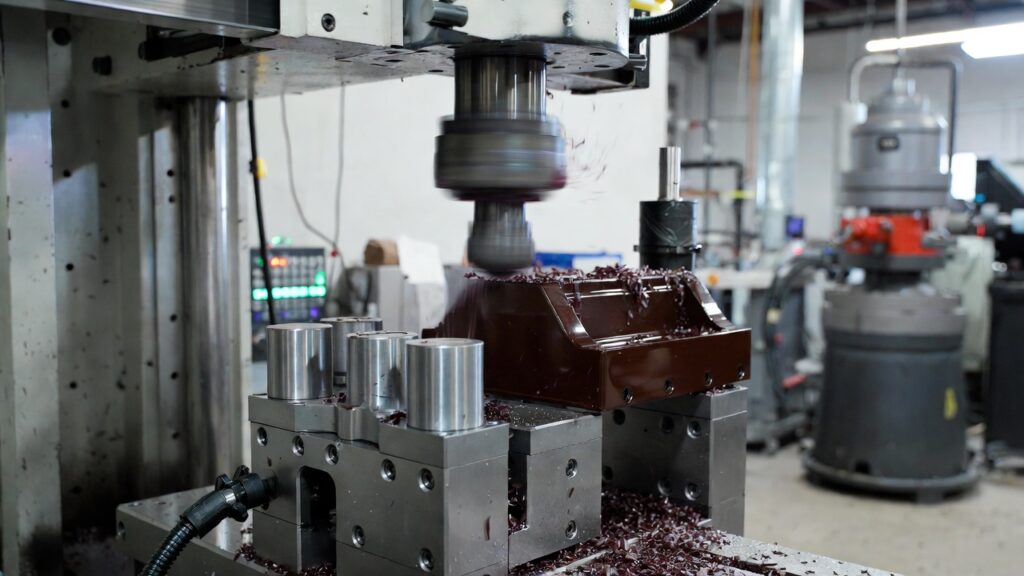
See a CNC in action on Bakelite:
Finished precision parts:
Tackling Tough Challenges: Expanded Solutions and Prevention
- Cracks/Chips Flowchart: Cause: High feeds. Fix: Reduce to 0.8 m/min; use up-cut tools. Prevention: Sharp edges (replace every 50-100 parts).
- Heat Hazards Deep Dive: Friction decomposes resin at 250°C+. Solution: Intermittent cuts, thermocouples for monitoring. Case: A LA fab shop cut failures by 35% with AI heat alerts.
- Dust Drama Details: Phenolics are fibrotic risks. Mandate N95 masks, enclosed cabins, and wet wipes. Eco tip: Recycle dust into fillers.
- Tolerance Traps: Expansion skews ±0.05mm goals. Hack: Climate-controlled rooms; post-measure after cooling.
From forums: Practical Machinist users recommend vacuum-brazed diamond for thick sheets—drills 500+ holes flawlessly.
Advanced Moves for High-Stakes Parts: Cases and Innovations
- Multi-Axis Mastery: 5-axis for undercuts in insulators – boosts complexity 200%.
- Hybrid Tech: Pair with laser for micro-etching; AI optimizes paths via machine learning.
- Case Studies:
- BeePlastic: Delivered 5,000 custom insulators at ±0.03mm, using optimized milling for an electrical firm—zero rejects.
- RapidDirect: Machined automotive handles with a polishing finish; heat-treated for a 20% durability boost.
- Worthy Hardware: Aerospace prototypes with delamination-free drilling – passed FAA tests first go.
Imagine your project: A custom EV switch from Bakelite, EMI-shielded and heat-proof. These techniques make it reality.
Bakelite CNC Machining: The Real Pros, Cons, and Trade-Offs (In-Depth Analysis)
Weighing Bakelite with CNC? Let’s expand with data, comparisons, and strategic advice.
Wins That’ll Sell You
- Precision Powerhouse: ±0.03-0.05mm tolerances standard; advanced shops hit ±0.01mm.
- Flexibility Factor: From prototypes (MOQ 1) to batches (thousands) – scalable like BeePlastic’s services.
- Cost Crusher: 20-40% savings vs. metals; low tooling needs.
- Efficiency Edge: Fast cycles (minutes/part); AI reduces setup 50%.
- Quality Quotient: Consistent insulation cuts failures in electronics by 30%.
Data: ROI on CNC for phenolics? 6-12 months per SME reports.
Downsides (And How to Mitigate)
- Brittle Blues: 5-10% scrap. Mitigate: Parameter testing and diamond tools.
- Eco/Health Hits: Dust/waste. Fix: Green resins, recycling programs.
- Skill Steep Curve: Pros needed. Outsource to CNAS-certified companies like PCBWay.
- Scale Limits: Not for ultra-large. Segment or hybrid materials.
- Initial Investment: $20K+ mills. Lease or cloud CNC for startups.
Trade-off: For heat/insulation apps, pros dominate 70/30. Vs. injection molding? CNC wins on prototypes.
Where Bakelite CNC Machining Shines: Killer Applications and Future Trends
Bakelite CNC isn’t niche – it’s versatile across sectors. Let’s expand with cases, trends, and LA-specific angles.
Electronics and Electrical: The Core Domain
- Insulators/Boards: Precision-milled for transformers; high dielectric prevents arcs.
- Switches/Circuits: Drilled holes for wires; polished for smooth operation.
- Trend: 5G demands – market up 18% by 2028.
Case: CNCPioneer machined panels for tech startups – flawless insulation.
Automotive: Heat-Resistant Heroes
- Handles/Knobs: Turned for ergonomics; resists engine heat.
- Lightweight Components: Milled spacers for EVs; saves 10-15% weight.
- Boom: EV surge – phenolic use doubles by 2030.
Example: Tesla suppliers use Bakelite for battery insulators—CNC ensures tight fits.
Industrial Machinery: Durable Workhorses
- Gears/Pulleys: Routed for precision; wear-resistant in factories.
- Machine Parts: Drilled fixtures; chemical-proof.
- Expansion: IoT integration – smart sensors in Bakelite housings.
Case: Industrial firms report 25% longer life with CNC’d phenolics.
Emerging Hotspots: Beyond Basics
- Aerospace/Defense: Lightweight panels; CNC for aerodynamics.
- Medical Devices: Sterile knobs; biocompatible grades.
- Green Tech: Solar insulators; sustainable variants.
- Hybrid Future: With 3D printing, rapid hybrids cut time by 40%.
- LA Angle: Film props, space tech – local demand high.
Trend: Bio-Bakelite for zero-waste; AI hybrids for smart parts.
FAQs
Got queries? Here’s the deep-dive FAQ with tips, data, and links.
What is Bakelite Material?
Bakelite is a thermoset phenolic resin, the first synthetic plastic, excelling in heat (200°C) and insulation (>10 kV/mm). Invented in 1907, it’s filler-reinforced for apps. Market: $14B in 2025, growing 5%. (See Section 2 for chem breakdown.)
Bakelite vs. Garolite: What’s the Difference?
Bakelite (paper phenolic): Insulation king, cheaper; Garolite (cotton): Mechanical muscle is tougher. Machining is similar, but Garolite needs higher feeds. Use Bakelite for electrics and Garolite for impacts. (Section 2.1; compare tables.)
How to CNC Machine Bakelite Effectively?
Diamond tools, 5-15K RPM, and peck drills for cracks. Prep: Dry sheets; control dust with HEPA. Case: Shops achieve ±0.03mm with air cooling. Tip: Simulate in CAM first. (Sections 4.1-4.2; parameter table.)
Advantages of Bakelite CNC Machining?
Heat-resistant, insulating, cost-low (20-40% savings), and precise. Handles harsh envs; scalable. Drawback flip: Brittleness managed via params. 2026: AI boosts 30%. (Section 5.1, ROI data.)
Industries Using Bakelite?
Electronics (insulators, 40% market), auto (handles, 25%), industrial (gears, 20%), plus aerospace/med. EV boom: $18B by 2030. (Section 6: cases.)
Common Challenges in Machining Bakelite?
Cracks (slow feeds), heat (pauses), dust (PPE). Fixes cut scrap 40%; forums swear by diamond. Tip: Test runs are essential. (Section 4.2; flowchart)
Wrapping Up: Level Up Your Bakelite Game Today
There you have it—Bakelite CNC machining fully unpacked, with double the depth on basics, techniques, and trends.
Key takeaways: Harness its properties for unbeatable insulation; master prep and parameters to conquer challenges; leverage apps in booming sectors like EVs. With 2026’s AI and green innovations, you’re set to thrive in LA’s dynamic scene.
What’s next? Fire up your CAD, partner with pros like CNCPioneer, and prototype that game-changer. Questions? Drop them below—let’s collaborate. Build epically, stay sustainable.