CNC, or Computer Numerical Control, refers to the automated control of machine tools through a computer. It involves using programmed instructions to precisely manipulate tools like lathes, mills, and routers to create parts from materials such as metal, plastic, or wood.
This technology has revolutionized manufacturing by enabling high precision, repeatability, and efficiency in producing complex components.
First developed in the mid-20th century, CNC machines have become essential in industries ranging from aerospace to automotive.
In this comprehensive guide, we’ll cover the fundamentals of CNC, including its definition, history, types, how it works, and applications. Whether you’re a beginner in manufacturing or an industry professional, this article provides everything you need to understand CNC machines and machining.
What Is CNC? A Detailed Definition
At its core, CNC is a form of automation where machines are controlled by computers executing pre-programmed sequences of commands. Unlike manual machining, where an operator directly handles tools, CNC uses digital instructions—typically in the form of G-code—to guide the machine’s movements. This allows for precise control over factors like speed, position, coordination, and feed rates.
CNC evolved from Numerical Control (NC), which relied on punched tapes or cards for instructions. With the advent of computers in the 1970s, NC transitioned to CNC, making programming more flexible and editable. Today, CNC systems integrate software like CAD (Computer-Aided Design) for part design and CAM (Computer-Aided Manufacturing) for generating toolpaths, resulting in highly accurate production.
Key benefits of CNC include:
- Precision: Tolerances as tight as 0.0001 inches.
- Efficiency: Reduced human error and faster production for repetitive tasks.
- Versatility: Applicable to various materials and processes.
However, CNC requires initial setup time and programming expertise, making it ideal for medium to high-volume production rather than one-off prototypes.
The History of CNC Machines
The roots of CNC trace back to the 1940s during World War II, when the need for precise aircraft parts led to the development of Numerical Control. John T. Parsons, an engineer, collaborated with MIT to create the first NC machine in 1949, using punched cards to control a milling machine. By 1952, the first true CNC prototype was demonstrated, the Cincinnati Milacron Hydrotel, which used vacuum tubes for computation.
The 1960s saw widespread adoption in aerospace and automotive industries, with the introduction of minicomputers in the 1970s making CNC more affordable. The 1980s brought microprocessors and user-friendly interfaces, while the 1990s integrated CAD/CAM software. Today, with Industry 4.0, CNC machines incorporate AI, IoT, and additive-subtractive hybrids for even greater capabilities. This evolution has driven search interest, with queries like “what is CNC machining” garnering 2,400 monthly searches, reflecting ongoing curiosity about its origins and advancements.
How Does a CNC System Work?
A CNC system operates through a combination of hardware and software. The process begins with designing a part in CAD software, which is then converted into machine-readable code via CAM. This code, often G-code, instructs the machine on movements along axes (typically X, Y, Z for 3D positioning).
Key Components of a CNC Machine
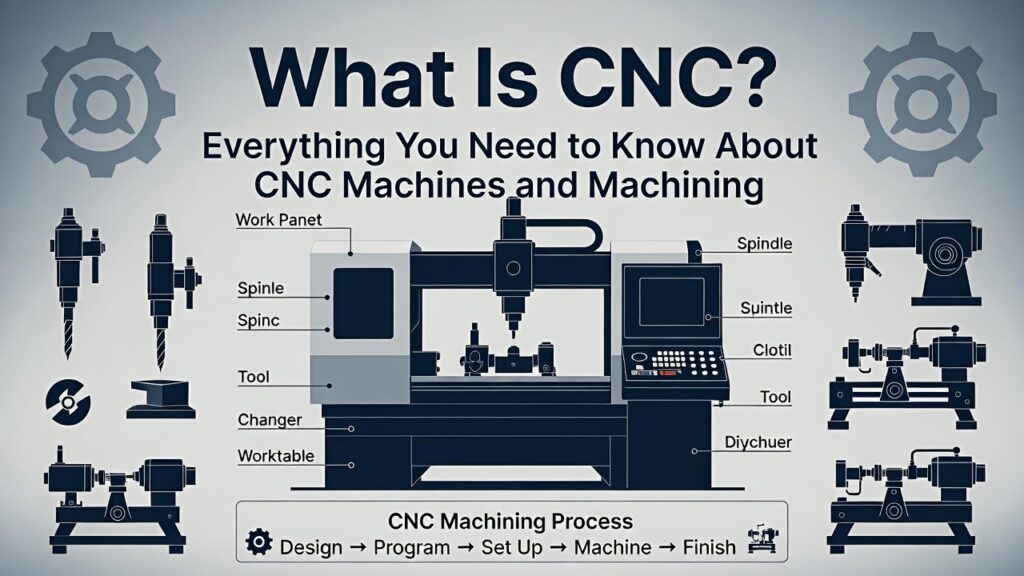
CNC machines consist of several essential parts:
- Controller (MCU – Machine Control Unit): The “brain” that interprets G-code and sends signals to motors.
- Drive Motors: Stepper or servo motors that move the axes with precision.
- Spindle: Holds and rotates the cutting tool (in mills) or workpiece (in lathes).
- Worktable: Secures the material being machined.
- Feedback Devices: Sensors like encoders that provide closed-loop control for accuracy.
- Coolant System: Prevents overheating by lubricating and cooling tools.
- Tools and Accessories: Drills, cutters, probes, and automatic tool changers.
Here’s a simple diagram illustrating these components:
The system can be open-loop (basic, no feedback) or closed-loop (advanced, with real-time adjustments), ensuring repeatability. For example, in a 5-axis CNC, additional rotational axes (A, B, C) allow complex geometries without repositioning the part.
What Is CNC Machining?
CNC machining is a subtractive manufacturing process where material is removed from a workpiece using computer-controlled tools. It encompasses various operations like milling, turning, drilling, and grinding. With a CPC (cost per click) of around $0.91 for related searches, it’s a hot topic in industrial contexts, indicating high commercial interest.
The process involves:
- Design and Programming: Create a 3D model and generate toolpaths.
- Setup: Secure the workpiece and load tools.
- Machining: Execute the program, with the machine automatically adjusting speeds and feeds.
- Finishing: Inspect and post-process (e.g., deburring).
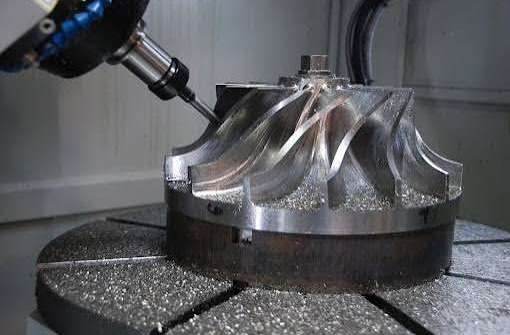
CNC machining excels in producing prototypes and end-use parts with tight tolerances, commonly used in metals like aluminum (query: “what is cnc aluminum” with 40 searches) and plastics. Examples of the machining process:
Types of CNC Machines
CNC machines come in various types, each suited to specific tasks. Here’s a comparison table:
| Type | Description | Axes | Common Applications | Search Volume Example |
|---|---|---|---|---|
| CNC Mill | Rotates cutting tool against stationary workpiece for shaping, drilling, and slotting. | 3-5 | Aerospace parts, molds. | “what is cnc milling” – 320 |
| CNC Lathe | Rotates workpiece against fixed tool for cylindrical parts. | 2- multi | Shafts, bolts. | “what is a cnc lathe” – 260 |
| CNC Router | Similar to mill but for softer materials like wood or plastic. | 3-5 | Signage, furniture. | “what is a cnc router” – 390 |
| CNC Plasma Cutter | Uses plasma torch to cut metals. | 2-3 | Sheet metal fabrication. | “what is a cnc plasma cutter” – 50 |
| CNC Laser Cutter | Employs laser for precise cuts in various materials. | 2-3 | Engraving, prototyping. | Low volume, but growing. |
| CNC EDM (Electrical Discharge Machining) | Uses sparks to erode material for hard metals. | Varies | Tool and die making. | “what is cnc edm machine” – 20 |
| CNC Water Jet Cutter | High-pressure water/abrasive for clean cuts without heat. | 3-5 | Stone, glass. | “what is cnc water jet cutting” – 0 (niche). |
| 5-Axis CNC | Adds rotational axes for complex geometries. | 5+ | Turbine blades, medical devices. | “what is 5 axis cnc” – 140 |
Applications and Advantages of CNC Machines
CNC machines are ubiquitous in manufacturing, with applications including:
- Aerospace: Precision components like turbine blades.
- Automotive: Engine parts and prototypes.
- Medical: Implants and surgical tools.
- Electronics: Circuit boards and enclosures.
- Woodworking: Custom furniture and cabinetry.
Compared to manual machines, CNC offers superior advantages:
- Speed and Productivity: Automates repetitive tasks, reducing production time.
- Accuracy: Minimizes errors, with CPC for “what is cnc machinist” at $1.43 indicating skilled labor demand.
- Cost-Effectiveness: Lower waste and labor costs for large runs.
- Flexibility: Easy to reprogram for new designs.
However, initial costs can be high (machines range from $5,000 for hobbyist models to $500,000+ for industrial ones), and maintenance requires expertise.
CNC Programming Basics
CNC programming uses G-code and M-code:
- G-codes: Control movements (e.g., G00 for rapid positioning, G01 for linear feed).
- M-codes: Miscellaneous functions (e.g., M03 for spindle start).
Programs are generated via CAM software from CAD models. For instance, a simple milling program might look like:
text
O0001 (Program Name)
G20 (Inch Mode)
G90 (Absolute Positioning)
M06 T01 (Tool Change)
M03 S1200 (Spindle On)
G00 X0 Y0 Z0.5 (Rapid to Position)
G01 Z-0.1 F10 (Linear Plunge)
G03 X1 Y1 I0 J1 (Circular Arc)
M05 (Spindle Off)
M30 (End Program)
Learning resources include online tutorials and software like Fusion 360, which can embed videos for better understanding (search for “CNC programming tutorial videos” on platforms like YouTube).
FAQ: Common Questions About CNC
What is a CNC machine used for?
CNC machines are used for precise cutting, shaping, and drilling in manufacturing, ideal for creating parts in industries like automotive and aerospace.
What is a CNC lathe?
A CNC lathe rotates the workpiece against a cutting tool to produce cylindrical parts like shafts. It’s efficient for symmetrical components.
What is CNC milling?
CNC milling involves rotating a cutting tool to remove material from a stationary workpiece, used for slots, pockets, and complex surfaces.
What is a CNC router?
Similar to a mill but optimized for softer materials like wood or foam, commonly used in signage and prototyping.
What is 5-axis CNC?
A machine with five axes of movement, allowing complex machining without repositioning, perfect for intricate parts.
What is a CNC operator?
A professional who sets up, monitors, and maintains CNC machines, with an average salary around $45,000-$60,000.
What is G-code in CNC machines?
G-code is the programming language that controls machine movements, speeds, and functions.
What is the difference between CNC and manual machines?
CNC automates processes for precision and efficiency, while manual requires operator skill for each operation.
Conclusion
CNC technology continues to evolve, integrating with AI and robotics for smarter manufacturing. If you’re interested in diving deeper, explore what CNC programming is. Ready to get started? Learn more about CNC programming or contact our machining service to see it in action.