In today’s fast-evolving manufacturing landscape, 3D printing (additive manufacturing) and CNC machining (computer numerical control subtractive manufacturing) remain two of the most widely adopted technologies for producing prototypes and functional end-use parts. Engineers, designers, and manufacturers frequently face the decision: which process delivers the best balance of speed, cost, precision, material performance, and design freedom? The answer depends on factors like part complexity, required tolerances, production volume, material demands, and intended application.
This in-depth guide compares the two technologies across key dimensions, drawing from industry-leading resources (such as Protolabs Network on process selection) and peer-reviewed academic studies. By examining real-world performance data, life-cycle assessments, and empirical comparisons, we provide an evidence-based framework to help you choose the optimal method—or a hybrid approach—for your specific needs.
Core Differences: Additive vs. Subtractive Fundamentals
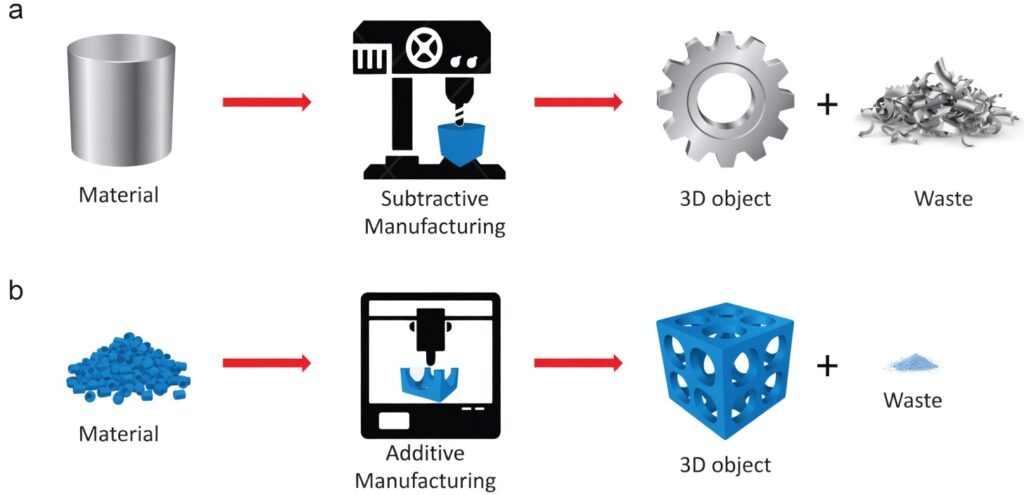
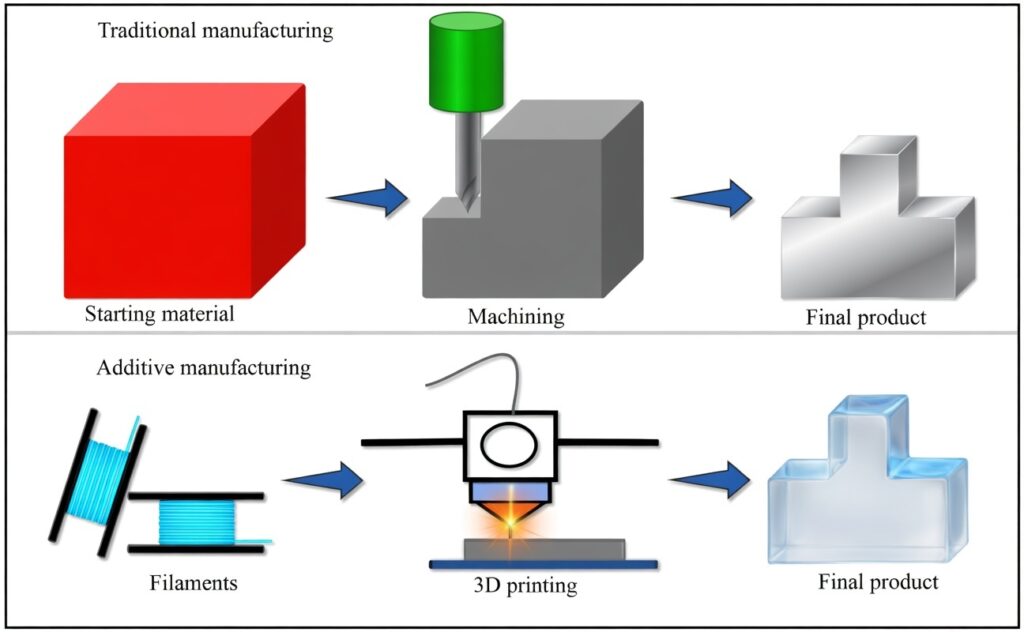
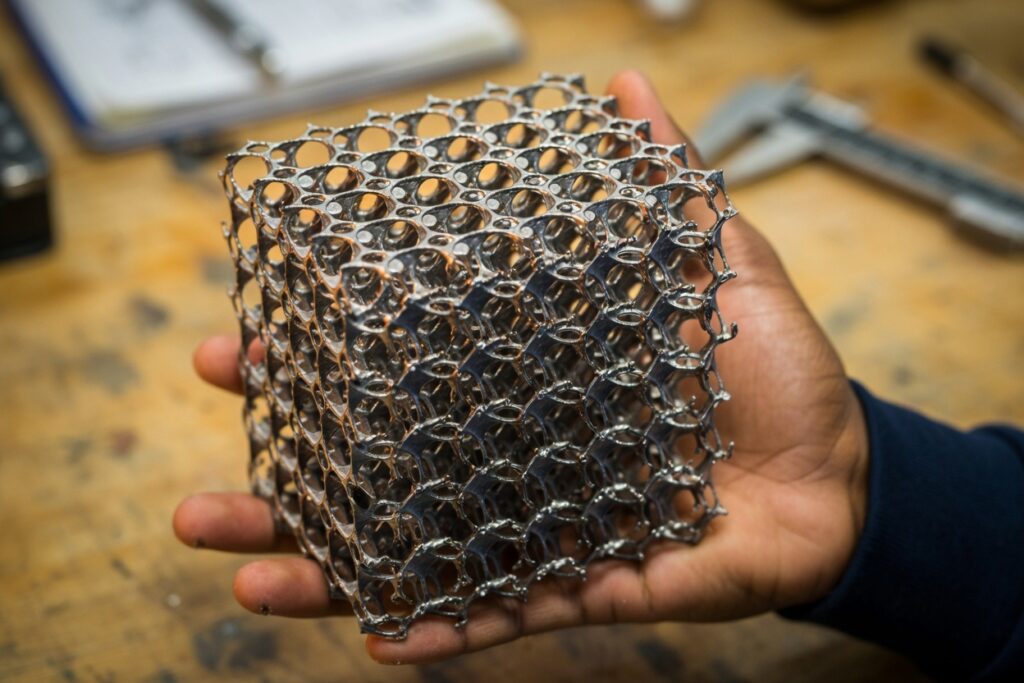
3D printing builds parts layer by layer from digital models, depositing materials like plastics, resins, metals, or composites. Techniques include Fused Deposition Modeling (FDM), Stereolithography (SLA), Selective Laser Sintering (SLS), and Direct Metal Laser Sintering (DMLS). This additive nature excels at creating complex, organic geometries without tooling.
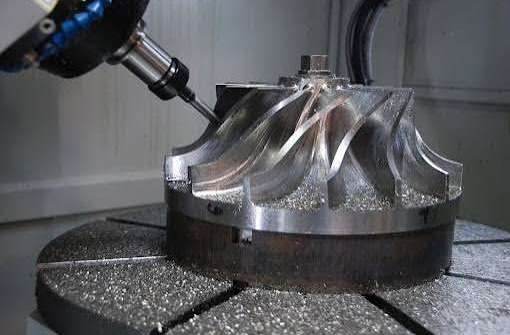
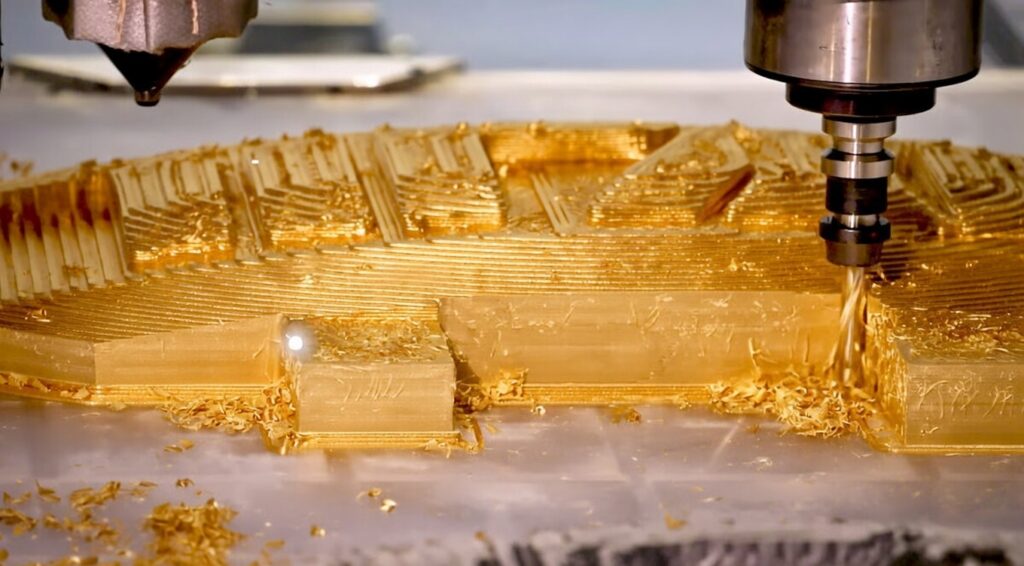
CNC machining starts with a solid block of material and removes excess via milling, turning, drilling, or other cutting operations. Multi-axis CNC (3- to 5-axis) enables precise shaping of metals, plastics, and composites. As a subtractive process, it delivers parts with isotropic properties matching the raw stock.
These opposing approaches lead to stark differences in waste, design constraints, and scalability. For prototyping, 3D printing often wins on speed and iteration; for end-use parts requiring durability, CNC frequently provides superior mechanical reliability.
When to Choose 3D Printing: Strengths for Prototyping and Complex End-Use
3D printing shines in scenarios demanding rapid design iteration, geometric freedom, and low-volume production.
- Complex Geometries and Lightweighting—Additive processes handle undercuts, internal channels, lattices, and topology-optimized structures impossible or prohibitively expensive with CNC. In aerospace and medical applications, 3D-printed parts reduce weight by 20-50% through optimized designs while maintaining strength.
- Rapid Prototyping — No tooling means design changes are as simple as updating a file. Functional prototypes can be produced in hours to days, accelerating development cycles.
- Customization and Low Volumes — Ideal for one-offs or batches under 50-100 units, such as patient-specific implants or custom tooling.
- Material Efficiency — Additive manufacturing uses only required material, generating minimal waste (often <10%).
Academic research supports these advantages. A 2022 study in The International Journal of Advanced Manufacturing Technology compared metal 3D printing (DMLS) and CNC for pump impellers, finding additive methods superior for complex geometries in low volumes, with reduced material consumption offsetting higher energy use in some cases.
Another life-cycle analysis in Sustainability (MDPI, 2023) showed DMLS outperforming CNC machining environmentally for low-volume metal parts, cutting CO₂ emissions by 20-50% due to less waste and no need for extensive tooling.
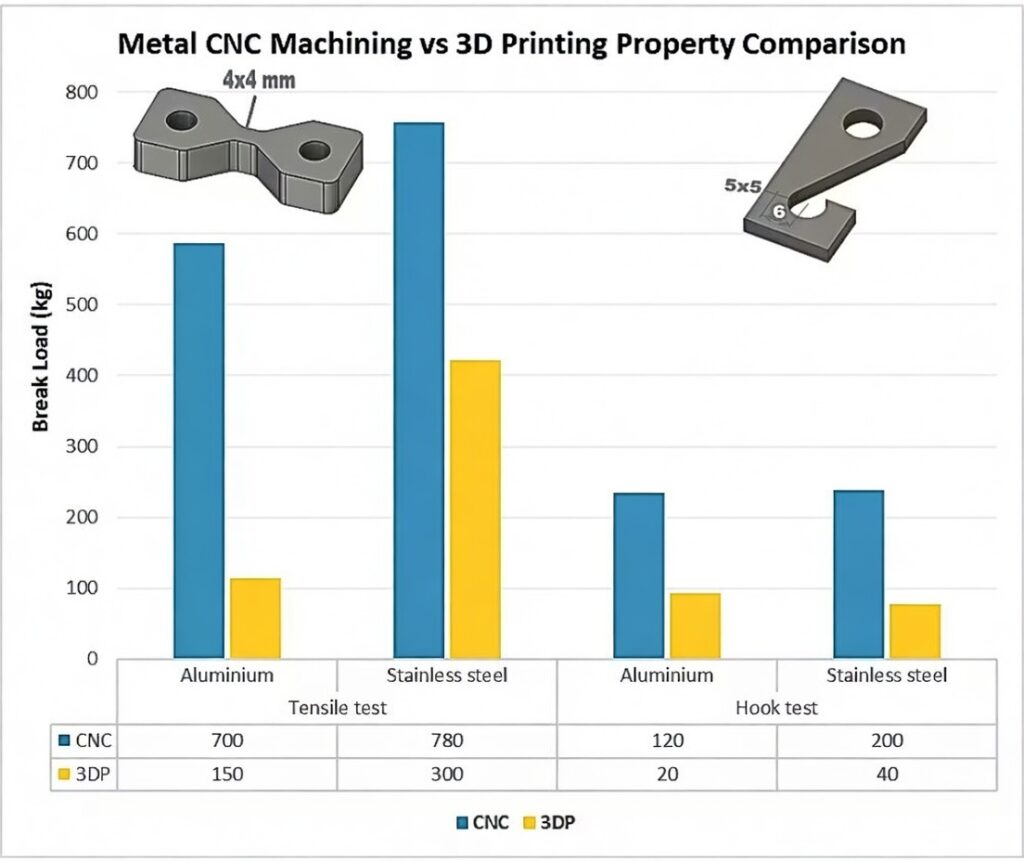
For end-use, industrial-grade 3D printing (e.g., SLS nylon or DMLS metals) produces durable components in aerospace brackets, medical devices, and automotive jigs. However, anisotropy—strength varying by build orientation (often 10-50% weaker in the Z-axis)—requires careful design.
When to Choose CNC Machining: Precision and Performance for End-Use Parts
CNC machining excels where tight tolerances, superior surface finish, and isotropic material properties are critical.
- High Precision and Tight Tolerances — Achieves ±0.005 mm or better, with surface roughness as low as 0.8 μm Ra. Essential for mating surfaces, threads, or fits in functional assemblies.
- Material Versatility and Performance—Accesses a broad range of engineering-grade stock (aluminum, titanium, PEEK, stainless steel) with full native properties—no layering weaknesses. Ideal for load-bearing, high-temperature, or fatigue-resistant parts.
- Smooth Surface Finish and Post-Processing — Minimal visible layers; easy anodizing, polishing, or coating for aesthetics and corrosion resistance.
- Medium Volumes and Scalability — Economical from 10-1,000+ units, with fast cycle times once programmed.
Studies confirm CNC’s edge in mechanical integrity. A 2015 LCA in the Rapid Prototyping Journal found CNC machining more sustainable at high machine utilization due to lower per-part energy and material waste in subtractive vs. additive for simple geometries. For functional prototypes needing real-world testing (e.g., stress, thermal), CNC parts behave closer to production equivalents.
In medical and automotive sectors, CNC-machined components dominate where precision and reliability trump complexity.
Direct Comparison: Key Metrics Side-by-Side
| Aspect | 3D Printing (Additive) | CNC Machining (Subtractive) | Winner Depends On |
|---|---|---|---|
| Best For | Prototyping, complex geometries, low volume | Functional prototypes, end-use, medium volume | Project requirements |
| Complexity | Excellent (undercuts, lattices, internals) | Limited by tool access | 3D for high complexity |
| Tolerances | ±0.1–0.5 mm (industrial: ±0.05–0.1 mm) | ±0.005–0.025 mm | CNC for tight precision |
| Surface Finish | Rough (layer lines; post-processing needed) | Excellent (smooth, machinable) | CNC |
| Material Properties | Anisotropic; direction-dependent strength | Isotropic, full stock properties | CNC for strength-critical |
| Speed (Prototypes) | Hours to days | Days (setup time) | 3D for rapid iteration |
| Cost (1-10 units) | Lower (no tooling) | Higher upfront | 3D |
| Cost (100+ units) | Higher (build time scales poorly) | Lower per unit | CNC |
| Waste | Low (5-20%) | High (up to 90% scrap, often recyclable) | 3D for sustainability |
| Volume Break-Even | Best <50-100 | Best >50-200 | Volume-driven |
Data synthesized from Protolabs comparisons and scholarly sources like Jayawardane et al. (2022) on techno-eco-efficiency.
Cost and Lead Time Breakdown
For prototyping (1-10 units):
- 3D printing: Often $20–$200 per part, 1-5 days.
- CNC: $100–$500+, 3-10 days (programming dominates).
For end-use (50-500 units):
- 3D printing costs rise due to build time; CNC drops with economies of scale.
Hybrid approaches—3D printing near-net shapes then CNC finishing—combine benefits, reducing costs 20-40% for complex metal parts.
A Monte Carlo-based LCC in Sustainability (2023) highlighted geometry complexity as pivotal: simple parts favor CNC; intricate ones favor additive.
Applications in Prototyping vs. End-Use
Prototyping:
- 3D printing dominates early-stage iteration (e.g., concept models, fit checks).
- CNC for functional prototypes needing accurate mechanics (e.g., load testing).
End-Use Parts:
- 3D printing: Custom orthotics, lightweight drone frames, low-volume spares.
- CNC: Engine components, surgical tools, structural brackets.
Industries increasingly hybridize: Print rough forms and machine critical features.
Sustainability and Future Outlook
Environmental impact varies. Additive reduces material waste but consumes more energy per part in some cases (e.g., laser sintering). Subtractive excels at high utilization.
Future trends include multi-axis 3D printing for reduced anisotropy and AI-optimized hybrids. As materials advance, 3D printing’s role in end-use grows, but CNC remains foundational for precision.
Frequently Asked Questions
Is CNC machining better than 3D printing overall?
No single process is universally superior—it depends on your needs. CNC machining excels in precision, surface finish, isotropic material strength, and medium-to-high volumes, making it ideal for functional end-use parts. 3D printing is better for complex geometries, rapid prototyping, customization, and low volumes with minimal waste. Many experts recommend hybrids for the best results (e.g., 3D printing near-net shapes and then CNC finishing critical features).
When should I choose 3D printing over CNC machining?
Choose 3D printing for highly complex designs (e.g., internal channels, lattices, or organic shapes), very low volumes (1-50 units), fast design iterations, or when minimizing material waste is a priority. It’s particularly strong in aerospace lightweighting, medical customization, and early prototyping where speed trumps ultimate precision.
When is CNC machining the better choice compared to 3D printing?
Opt for CNC when you need tight tolerances (±0.005 mm or better), smooth surfaces without extensive post-processing, full isotropic material properties, or parts for high-stress applications (e.g., load-bearing components in automotive or aerospace). It’s also more cost-effective and scalable above 50-100 units for simpler geometries.
Can 3D printing and CNC machining be used together?
Yes—hybrid manufacturing is increasingly common and often optimal. For example, 3D print a complex metal blank using DMLS, then use CNC to achieve precise tolerances, threads, or superior surface finishes on critical areas. This approach combines additive’s design freedom and waste reduction with subtractive’s accuracy and reliability, potentially cutting costs by 20-40% for intricate parts.
How do the costs compare between 3D printing and CNC machining?
For low volumes (1-10 parts), 3D printing is usually cheaper due to no tooling or setup fees ($20–$200 per part vs. $100–$500+ for CNC). For medium volumes (50+), CNC becomes more economical as per-unit costs drop with scale. Break-even points vary by complexity and material—complex parts favor 3D longer, while simple ones favor CNC sooner. Always request quotes for accurate project-specific comparisons.
Conclusion
Neither technology is universally “better.” For rapid prototyping with complex designs, 3D printing offers unmatched speed and flexibility. For end-use parts demanding precision, strength, and scalability, CNC machining delivers superior performance.
The optimal path often combines both: Use 3D printing for initial prototypes and complex features, then CNC for final tolerances and durability. Evaluate your priorities—complexity, volume, tolerances, and materials—and consult experts for data-driven decisions.
By aligning processes with requirements, manufacturers achieve faster development, lower costs, and higher-quality outcomes in an increasingly digital era.