In 2026, zero-waste CNC machining is no longer a “nice-to-have” green initiative—it’s a competitive necessity. Global supply chains demand ESG compliance, customers ask for carbon-footprint reports before signing POs, and raw-material prices keep climbing. Every kilogram of aluminum chip thrown away is money left on the table and CO₂ added to the atmosphere.
This comprehensive guide shows exactly how CNC shops — from 5-person prototype rooms to 50-machine production floors — can turn metal chips and spent coolant from liabilities into profit centers and sustainability wins.
Why Zero Waste CNC Machining Matters Right Now
CNC machining generates two major waste streams:
- Metal chips/swarf (typically 20–40 % of the raw stock weight)
- Used coolant (changed every 3–12 months in traditional shops)
By implementing proven recovery systems, shops routinely achieve:
- 50–80 % recovery value on chips
- 300–500 % extension of coolant life
- 60–90 % reduction in hazardous waste disposal costs
- ROI on equipment within 6–18 months
These numbers come from real 2025–2026 shop data across the US, Europe, and Asia.
The Metal Chip Goldmine: From Swarf to Sellable Briquettes
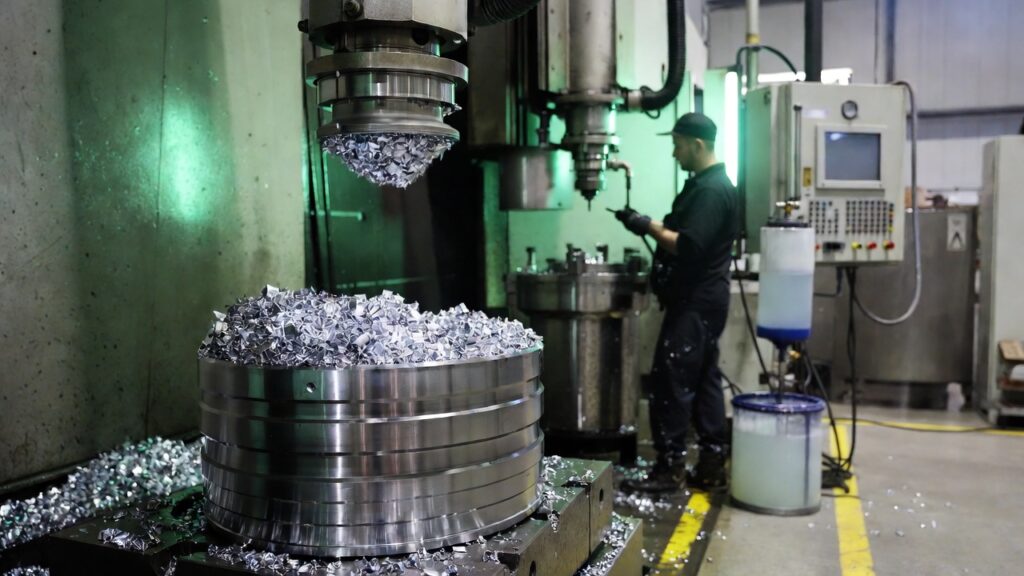
Those shiny curls flying off your end mill are not waste—they are high-purity feedstock.
Step-by-Step CNC Metal Chip Recycling Process (2026 Best Practice)
- Immediate Segregation at the Machine Color-coded bins or smart IoT bins (RFID-tagged) for every alloy: 6061 Al, 7075 Al, 304 SS, 316 SS, mild steel, titanium, brass, etc. Mixing even 1% wrong alloy can drop resale value by 30–50 %.
- Coolant Removal Centrifugal chip wringers (spin at 2,000–3,000 rpm) remove 95–98 % of cutting fluid in under 5 minutes per batch. The recovered coolant goes straight back into the filtration loop.
- Shredding (optional for long stringy chips) Small shredders break “bird’s nests” into manageable pieces so briquetters can work efficiently.
- Briquetting: Hydraulic briquetters compress chips into dense pucks (10×10 cm or 15×15 cm). Dry briquettes sell for 20–40 % more than wet loose chips and take 1/5 the storage space.
- Final Purification Magnetic separators are for ferrous contamination, eddy-current separators for non-ferrous, and thermal de-oiling kilns for aerospace-grade material.
Real Value in 2026
- Clean, dry 6061 aluminum briquettes: $1.80–$2.40/kg (vs. virgin ingot ~$3.20/kg)
- 304 stainless: $2.10–$2.80/kg
- A medium shop (10 CNCs) producing 8–12 tons of chips/month can recover $18,000–$35,000/month in scrap revenue after processing costs.
Coolant Recycling: Turn a $15,000/Year Expense into Near-Zero Cost
Traditional shops dump coolant every 3–6 months. Modern closed-loop systems keep the same fluid running for 18–36 months.
Core Technologies That Actually Work in 2026
- Tramp-Oil Skimmers (belt or disk type)—remove floating oils in hours
- Multi-Stage Filtration – 50 μm bag → 5 μm cartridge → coalescing plates
- High-Speed Centrifuges – remove fines down to 1–3 μm and bacteria
- Pasteurization / UV / Ozone units – kill microbes without adding biocides
- Evaporators – for ultra-concentrated reclaim (small shops)
Monitoring Dashboard Every Shop Needs
- Digital Brix refractometer (concentration 4–10 %)
- pH meter (target 8.5–9.5)
- Conductivity meter (tracks ion buildup)
- Bacterial dip slides or ATP swabs (weekly)
When concentration drops or bacteria spikes, the system automatically tops up or diverts to the evaporator.
Proven Results
- Coolant purchases reduced by 70–90 %
- Disposal costs drop from $4–$8/gallon to <$1/gallon
- Better surface finish and 15–30 % longer tool life because fluid stays clean
(Shows 90 % waste reduction and 75 % new coolant savings on real shop floor)
Full Implementation Roadmap – From Zero to Zero-Waste in 90 Days
Week 1–2: Audit & Planning
- Weigh current monthly chip output and coolant consumption
- Map every alloy used
- Calculate current disposal costs
Week 3–6: Equipment Selection (Budget Guide 2026) Small shop (<5 machines):
- $8k–$15k chip wringer + small briquetter
- $12k–$18k coolant recycler (SmartSkim or EdjeTech type)
Medium shop (5–15 machines):
- $25k–$45k integrated chip line
- $35k–$60k central coolant system with IoT monitoring
Week 7–12: Installation & Training
- Operator 30-minute training on bin discipline
- Weekly KPI dashboard (chip revenue, coolant life, waste tonnage)
Ongoing: Monthly Review Track ROI with simple Excel or free ERP module.
Real Case Studies (2025–Early 2026)
Case 1 – Illinois Job Shop (22 employees) Installed chip briquetter + PRAB coolant system. Results after 12 months:
- Chip revenue: +$28,400
- Coolant & disposal savings: $19,700
- Total payback: 11 months
- Waste to landfill reduced 68 %
Case 2 – German Aerospace Supplier Added AI vision sorting + thermal de-oiling.
- Achieved “aerospace-grade recycled” certification
- Sold chips at premium (+35 % price)
- Coolant life from 4 months → 28 months
2026–2028 Technology Horizon
- AI Chip Sorters – Machine-vision cameras above conveyors auto-divert alloys with 99.2 % accuracy
- IoT Sump Sensors – Predict coolant failure 7–14 days in advance
- Blockchain Traceability – Every briquette gets a QR code showing exact origin and purity for OEM audit
- Dry Machining & MQL – Minimum Quantity Lubrication & cryogenic cooling reducing liquid coolant need by another 40 %
- In-House Remelting Cells – Large shops melting their own briquettes back into bar stock
Common Challenges & Fixes
Challenge: “Our chips are always mixed.” Fix: One-bin-per-machine policy + laminated alloy charts at every station.
Challenge: “Coolant recycling is too complicated.” Fix: Start with a simple skimmer + centrifuge rental for 3 months before buying.
Challenge: “Buyers won’t pay premium for recycled chips.” Fix: Get your material tested and certified (SGS or local lab) — certified clean briquettes sell fast.
FAQs – Zero Waste CNC Machining
How much money can a typical 10-machine shop save per year?
Most shops see $35,000–$85,000 combined (chip revenue + coolant/disposal savings) in the first full year.
Do recycled chips affect part quality if re-melted?
No. Properly processed and certified chips produce identical metallurgy to virgin stock when remelted by reputable foundries.
What is the smallest shop size that benefits from coolant recycling?
Even a 2–3 machine prototype shop can justify a $12k–$15k system with payback in under 14 months.
Are there government grants or tax credits in 2026?
Yes—US Section 179, EU Green Deal subsidies, and many state-level recycling equipment rebates are still active.
How do I keep bacteria out of recycled coolant?
Weekly UV or ozone treatment + maintaining pH 8.8–9.2 and concentration via refractometer eliminates almost all issues.
Can titanium and Inconel chips be recycled the same way?
Yes, but they require dedicated bins and often thermal de-oiling because of higher value and stricter contamination rules.
What equipment brands are most reliable in 2026?
PRAB, Mayfran, ATM Recycling Systems, SmartSkim, EdjeTech, and Chinese centrifuges from WEIMA-style manufacturers all have strong track records.
How do customers verify our zero-waste claims?
Provide monthly scrap-sales reports, coolant consumption charts, and third-party waste audits. Many now request this in RFQs.
Does zero-waste CNC machining slow down production?
Actually, the opposite—cleaner coolant means fewer tool changes and better surface finishes, often increasing throughput 5–12 %.
Where do I start if budget is under $10,000?
Buy a good tramp-oil skimmer ($1,800) and a manual chip centrifuge ($3,500) and color-coded bins. You’ll still cut coolant costs 40–60 % immediately.
Implement even half of the strategies above, and your shop will be in the top 10 % of sustainable CNC operations worldwide in 2026. The tools exist, the ROI is proven, and the market is rewarding green manufacturers more than ever.
Start today — your chips and coolant are waiting to make you money.
Conclusion
Zero-waste CNC machining in 2026 is not about sacrificing speed or profit for the environment—it’s about capturing profit that was literally flying into the dumpster. Shops that implement these systems report better margins, happier customers, easier recruitment of young talent who care about sustainability, and stronger negotiating power with big OEMs.
Start small. Even adding one chip wringer and one tramp-oil skimmer this quarter will pay for itself before summer ends.
Ready to turn your waste streams into revenue streams? CNCpioneer has been quietly optimizing our own internal processes while delivering the same fast-turnaround, precision parts our customers expect. If you’re looking for a partner who walks the sustainability talk, let’s talk.