The oil and gas industry operates in some of the harshest environments on Earth — extreme temperatures, high pressures, corrosive chemicals, and abrasive conditions. Traditionally dominated by metals, the sector has increasingly turned to high-performance plastics for critical components. Oil and gas plastic machining has become essential for producing precision parts that meet these demanding requirements while offering advantages in weight, corrosion resistance, and cost.
This guide explores every aspect of oil and gas plastic machining, from material selection to machining techniques, design best practices, real-world applications, and future trends. Whether you’re an engineer specifying parts, a procurement specialist evaluating suppliers, or a machinist working with engineering polymers, this resource provides actionable insights into producing reliable CNC machining plastic parts.
Why Plastics Are Transforming the Oil and Gas Sector
Metals like steel and aluminum have long been staples in oil and gas equipment, but they come with drawbacks: susceptibility to corrosion from H₂S, CO₂, and saltwater; heavy weight that increases transportation and installation costs; and galvanic corrosion issues in mixed-material assemblies.
High-performance plastics address these challenges directly:
- Corrosion Resistance — Plastics remain unaffected by most chemicals encountered in oilfields.
- Weight Reduction — Components can be 50-80% lighter than metal equivalents, reducing overall system weight in offshore platforms and subsea equipment.
- Thermal and Electrical Insulation — Critical for preventing heat transfer or electrical shorts in downhole tools.
- Low Friction and Wear Resistance — Many plastics exhibit self-lubricating properties, extending service life in moving parts.
- Cost Efficiency — Lower material costs and easier machining for complex geometries.
These benefits have driven adoption in upstream (exploration and production), midstream (transportation), and downstream (refining) operations.
Key Engineering Plastics for Oil and Gas Applications
Not all plastics suit the oil and gas industry. Only engineering and high-performance thermoplastics withstand the conditions. Below are the most commonly machined materials in oil and gas plastic machining.
PEEK (Polyetheretherketone)
PEEK stands as the gold standard for extreme conditions. Unfilled PEEK operates continuously at 250°C (482°F) and withstands pressures exceeding 20,000 psi in downhole applications.
Key Properties:
- Excellent chemical resistance to hydrocarbons, acids, and sour gas (H₂S)
- High mechanical strength and stiffness
- Low moisture absorption
- FDA-compliant grades available for certain applications
Common Applications: Backup rings, seals, valve seats, electrical connectors, and compressor components.
PTFE (Polytetrafluoroethylene)
Known as Teflon™, PTFE offers the lowest coefficient of friction of any solid material and unmatched chemical inertness.
Key Properties:
- Near-universal chemical resistance
- Temperature range: -200°C to +260°C
- Extremely low friction
- Poor mechanical strength (often filled with glass, carbon, or bronze)
Common Applications: Seals, gaskets, chevron stacks, and glide rings.
UHMWPE (Ultra-High-Molecular-Weight Polyethylene)
UHMWPE excels in wear and impact resistance.
Key Properties:
- Exceptional abrasion resistance
- Very low friction
- High impact strength
- Good chemical resistance
Common Applications: Bushings, bearings, wear pads, and scraper blades.
PVDF (Polyvinylidene Fluoride)
PVDF balances mechanical strength with chemical resistance.
Key Properties:
- Excellent resistance to hydrocarbons and halogenated solvents
- Good creep resistance
- Temperature range up to 150°C
Common Applications: Pipe linings, valve bodies, and pump components.
Other Notable Materials
- Nylon (Polyamide) → Moisture-sensitive but cost-effective for less demanding applications.
- Acetal (POM/Delrin) → High stiffness and dimensional stability for gears and bearings.
- PEI (Ultem) → Flame-retardant with high strength for electrical insulators.
- PPS (Ryton) → Excellent dimensional stability in sour gas environments.
Machining Processes in Oil and Gas Plastic Machining
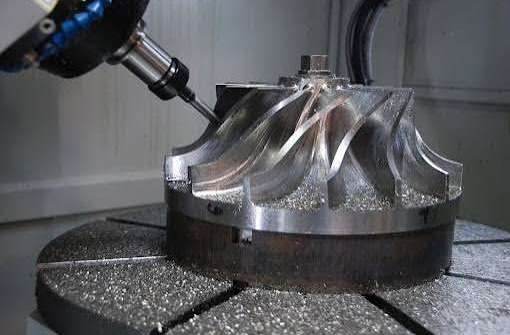
CNC machining of plastic parts dominates due to its precision, repeatability, and ability to produce complex geometries without expensive tooling.
CNC Turning
Ideal for cylindrical components like seals, bushings, and valve seats.
Best Practices:
- Use sharp, polished carbide or PCD (polycrystalline diamond) tools
- Employ positive rake angles to reduce cutting forces
- Apply air or mist coolant to prevent thermal damage
- Take light, consistent depths of cut (0.1-0.5 mm)
CNC Milling
Essential for complex features, slots, and flat surfaces.
Key Considerations:
- Secure workholding to prevent vibration (vacuum fixtures work well)
- Use climb milling to reduce heat buildup
- Implement high spindle speeds with low feed rates
- Choose tools with large relief angles
Secondary Operations
- Drilling and Tapping — Use sharp drills and avoid excessive feed to prevent cracking.
- Annealing — Stress-relieve semi-finished stock before final machining to improve dimensional stability.
- Surface Finishing — Polishing or vapor honing for low-friction surfaces.
Design Considerations for Reliable Plastic Components
Successful oil and gas plastic machining starts with intelligent design.
Wall Thickness and Uniformity
Maintain uniform wall thickness to prevent sink marks and internal stresses. Avoid sudden changes in cross-section.
Radii and Fillets
Incorporate generous radii (minimum 0.5 mm) at corners to reduce stress concentrations.
Tolerances
Engineering plastics typically hold ±0.025 mm to ±0.1 mm, depending on material and size. Specify realistic tolerances — overtightening increases costs unnecessarily.
Draft Angles
For turned parts, a slight draft helps with tool clearance and chip evacuation.
Material-Specific Guidelines
- PEEK: Account for thermal expansion (higher than metals)
- PTFE: Design for compression (it flows under load)
- UHMWPE: Allow for higher creep
Real-World Applications
Seals and Gaskets
Machined PTFE and filled-PTFE seals form critical barriers in valves, pumps, and connectors.
Bushings and Bearings
UHMWPE and filled PEEK bushings replace metal roller bearings in many applications, eliminating lubrication needs.
Valves and Fittings
Plastic valve bodies and seats in PVDF or PEEK offer corrosion resistance in chemical injection systems.
Downhole Tools
PEEK backup rings and electrical insulators support elastomeric seals in packers and bridge plugs.
Insulation and Spacers
PEI and PEEK components provide electrical insulation in measurement-while-drilling (MWD) tools.
Advantages vs. Challenges
Advantages:
- Superior corrosion resistance
- Significant weight savings
- Reduced maintenance
- Lower total lifecycle costs
Challenges:
- Higher material costs for premium polymers
- Thermal limitations compared to metals
- Creep under sustained loads
- Moisture absorption in some materials
Quality Control and Industry Standards
Reputable suppliers follow standards like the following:
- API 6A (for wellhead equipment)
- NORSOK M-710 (material qualification for harsh environments)
- ISO 23936 (petroleum and natural gas industries — non-metallic materials)
Common testing includes:
- Mechanical property verification
- Chemical compatibility testing
- Hydrostatic pressure testing
- Dimensional inspection with CMM
Future Trends in Oil and Gas Plastic Machining
- New Polymer Development — Higher-temperature PEEK variants and carbon-fiber-reinforced compounds.
- Additive Manufacturing — 3D printing of complex PEEK components for rapid prototyping and low-volume production.
- Sustainability — Recyclable thermoplastics and bio-based alternatives.
- Digital Twin Integration — Simulation-driven design to optimize plastic component performance.
Conclusion
Oil and gas plastic machining has evolved from a niche process to a critical enabling technology for modern energy production. By selecting appropriate high-performance plastics and applying best practices in CNC machining, engineers can create components that outperform traditional metals in many applications.
The key to success lies in collaboration between designers, material specialists, and experienced machinists. When executed properly, oil CNC machining of plastic parts delivers exceptional reliability in the world’s most challenging environments.

Ryan Wang
Ryan Wang is the CNC Machining Expert at Cncpioneer, with over 15 years of hands-on experience as a CNC programmer, process engineer, senior machinist, and precision manufacturing specialist. He has helped companies in aerospace, automotive, medical, and electronics sectors achieve micron-level tolerances and scale from prototypes to high-volume production. Ryan is also an experienced instructor in advanced CNC techniques, particularly five-axis machining and challenging materials.