CNC machining plays a central role in creating injection molds. These molds (also called tools) shape molten plastic into precise parts during injection molding. CNC is the go-to method because it delivers high accuracy, speed, and reliability when working with tough metals.
This guide covers the full process, main advantages, real-world cases, DIY options, and custom CNC injection mold tips. It’s written for people in mold manufacturing and custom services.
What Is an Injection Mold?
An injection mold is a metal tool with two main parts:
- Cavity — the shape of the final part
- Core — the inside features
The mold also includes:
- Cooling channels
- Ejector pins
- Guide pins
- Sprue and runner system
It must handle high pressure, high heat, and thousands (or millions) of cycles without wearing out. Tolerances are often ±0.001 inches (0.025 mm) or tighter. Surface finish is critical for part appearance.
Why CNC Is the Best Choice for Mold Making
CNC machining beats manual methods and most alternatives because:
- It achieves micro-level precision
- It repeats the same results every time
- It handles complex shapes easily
- It works fast on hard materials like tool steel and aluminum
Traditional hand machining is too slow and inaccurate for today’s molds. 3D-printed molds work for very low volume but lack durability and smooth finish compared to CNC.
Step-by-Step: How CNC Makes Injection Molds
- Design the Mold Use CAD software like SolidWorks, Fusion 360, or Creo. Create 3D models of the core, cavity, mold base, sliders, inserts, and cooling lines. Run DFM checks to avoid common issues (sink marks, warpage, and flash).
- Create Toolpaths (CAM) Import the CAD file into CAM software (Mastercam, Fusion 360 CAM, etc.). Generate G-code for:
- Roughing (remove most material quickly)
- Semi-finishing
- Final high-precision finishing
- Choose and Prepare Material
- Aluminum (e.g., 6061 or 7075): Fast to machine, low cost, great for prototypes and low-volume (up to ~10,000 shots).
- Tool steel (P20, H13, S7): Hard, long-lasting, ideal for high-volume production.
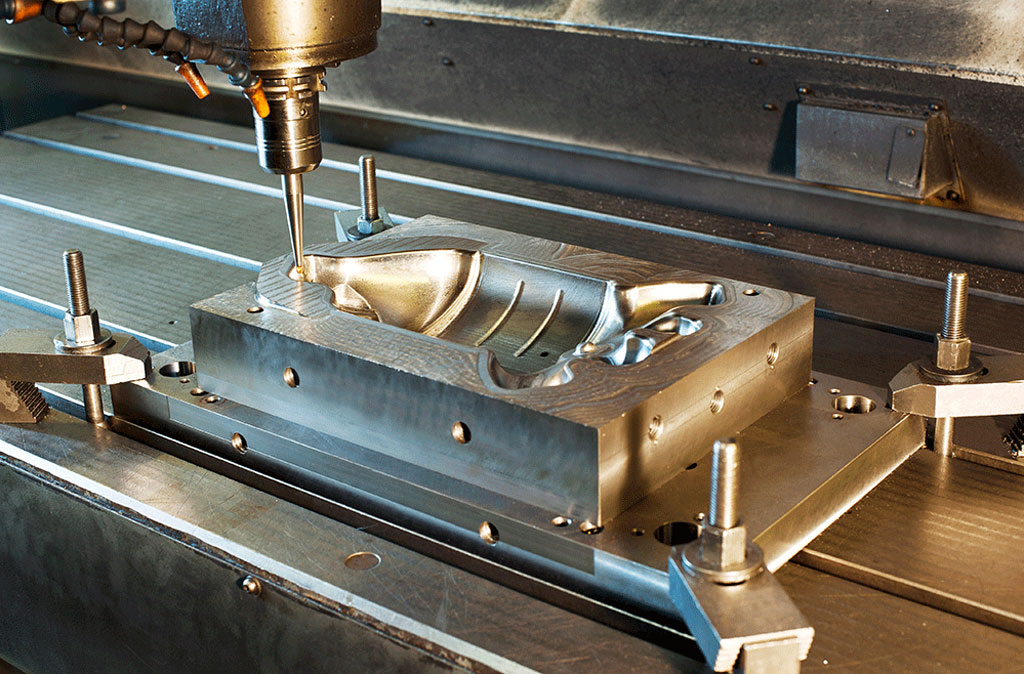
- Machine the Mold
- Roughing — Use large tools at high speed to remove bulk material.
- Semi-finishing — Get closer to final shape.
- Finishing — Use small ball-end mills for smooth surfaces (Ra 0.4 μm or better).
- 5-axis machining — Perfect for undercuts and curved features without flipping the part.
- EDM — Used together with CNC for deep, sharp corners that CNC can’t reach.
- Finish and Assemble
- Polish surfaces (hand or machine).
- Add texture (EDM, chemical etching, or bead blasting).
- Heat-treat steel for hardness.
- Install ejector pins, guide pins, and cooling fittings.
- Test the Mold Run trial shots (T0, T1, and T2 samples) on an injection machine. Check for defects like short shots, flash, or uneven cooling. Fix issues by re-machining on CNC if needed.
Main Benefits of Using CNC for Injection Mold Tooling
- Super-high precision — Consistent part quality every cycle.
- Complex designs — Easy to add conformal cooling channels (reduce cycle time 20–40%).
- Fast prototyping — Aluminum molds ready in days, not weeks.
- Repeatable results — Multi-cavity molds stay identical.
- Cost-effective for low-to-medium volume — No huge upfront costs beyond the mold.
- Material flexibility — Steel, aluminum, and copper alloys for better heat transfer.
- Hybrid options — Combine CNC with 3D printing for advanced cooling inserts.
Real-World Case Examples
Automotive Dashboards
A supplier machines large P20 steel molds using 5-axis CNC. Conformal cooling channels cut cycle time by 30%. Textured surfaces look perfect on final parts.
Medical Syringe Housings
Stainless steel or aluminum molds with ±0.0005-inch tolerances. Polished cavities ensure clean, biocompatible parts. Hybrid CNC + additive inserts extend mold life in cleanrooms.
Phone Cases & Electronics Housings
High-speed CNC finishing creates mirror-like surfaces. Multi-cavity molds (8–16 cavities) support mass production with perfect uniformity.
Startup Prototypes
A consumer product team switches from 3D printing to CNC aluminum molds. They get real injection-molded samples in under 2 weeks for testing.
DIY CNC Injection Mold Making
Hobbyists and small makers can build simple DIY CNC injection molds.
What you need:
- Desktop CNC mill (Shapeoko, Pocket NC, Tormach)
- Aluminum stock (6061 is easy to machine)
- CAD/CAM software (Fusion 360 is free for hobby use)
- Benchtop injection molder or DIY press
Basic steps:
- Design a single-cavity mold (keep it simple—no undercuts at first).
- Machine core, cavity, sprue, and alignment pins.
- Hand-polish surfaces.
- Test with low-pressure plastic shots.
Challenges:
- Achieving pro-level tolerances is hard.
- Surface finish often needs manual work.
- Expect trial and error.
Custom CNC injection molds are a step up—shops offer fast turnaround for low-volume or special projects.
Frequently Asked Questions (FAQs)
Q1: Which materials work best for CNC-machined injection molds?
A: Aluminum for prototypes and low volume (fast and cheap). Tool steels like P20 or H13 for high-volume durability.
Q2: How long does it take to machine an injection mold with CNC?
A: Simple aluminum single-cavity: 1–2 weeks. Complex multi-cavity steel: 4–12 weeks, depending on size and details.
Q3: Can CNC make conformal cooling channels?
A: Yes—especially with 5-axis machines or hybrid additive methods. They shorten cycle times and improve part quality.
Q4: Is DIY CNC injection mold making realistic for beginners?
A: Yes, for basic parts using aluminum and desktop CNC. But tolerances, finishing, and injection setup take practice.
Q5: How is machining the mold different from machining the final plastic part?
A: Mold machining needs extreme accuracy and strength in metal. Plastic parts come from injection and usually don’t require extra machining.
Q6: What’s the typical cost of a custom CNC injection mold?
A: $1,000–$5,000 for simple aluminum prototypes. $10,000–$100,000+ for production steel molds (depends on complexity, cavities, and material).
Final Thoughts
CNC machining is still the backbone of injection mold making. It turns designs into reliable, high-quality tools that produce consistent plastic parts.
Whether you’re a mold designer creating production tools, a CNC operator running jobs, a prototype engineer testing ideas, or a DIY enthusiast experimenting at home, CNC gives you control, speed, and precision.
Ready for your next project? Reach out to a precision machining shop for quotes on custom CNC injection molds or CNC machining for injection molds.