The furniture manufacturing industry in 2026 faces intense pressure: rising labor costs, demand for faster customization, tighter delivery schedules, and the constant need to reduce material waste while maintaining high quality. CNC machining has become one of the most powerful tools helping factories stay competitive — whether they produce flat-pack cabinets, modular office furniture, hotel casegoods, or high-end bespoke pieces.
For many manufacturers — especially small to mid-sized factories and growing brands — purchasing and maintaining in-house CNC equipment is increasingly difficult due to high capital investment, skilled operator shortages, and fluctuating production volumes.
This is where professional CNC machining outsourcing (particularly from specialized service providers in China) delivers major advantages: precision cutting at a fraction of the cost, rapid turnaround, and zero need to invest in machines or training.
In this 2026 guide, we explain exactly how CNC machining is transforming the furniture industry, the most valuable applications today, real-world benefits with numbers, common challenges, and why many factories are choosing to outsource rather than own the equipment.
What Is CNC Machining in the Furniture Industry?
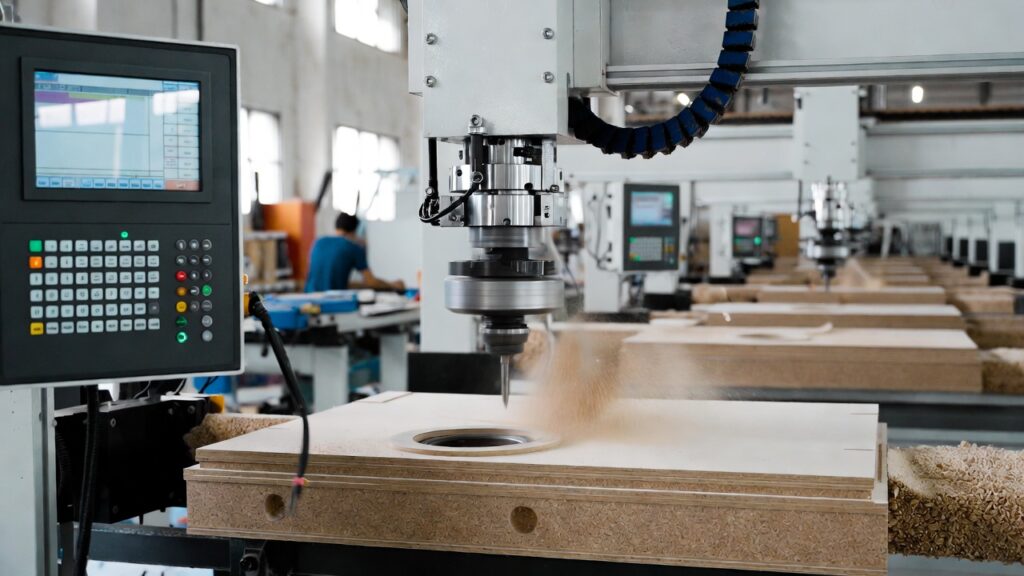
CNC (Computer Numerical Control) machining in furniture production refers to computer-controlled routers, nesting machines, panel saws with CNC capabilities, drilling centers, and edgebanding prep machines that precisely cut, drill, pocket, engrave, and shape wood-based panels (plywood, MDF, particleboard, solid wood, bamboo, etc.).
Modern furniture CNC equipment typically includes the following:
- 4×8 ft or 5×10 ft nesting routers with automatic tool changers (ATC)
- Vacuum hold-down tables for large panels
- Multi-spindle or aggregate heads for simultaneous operations
- Software for intelligent nesting (maximizing sheet yield)
- Dust extraction and safety systems
These machines read digital files (DXF, DWG, STEP, etc.) and execute thousands of repetitive, error-free operations far faster and more accurately than manual or semi-automatic methods.
Key Benefits of CNC Machining for Furniture Manufacturers
- Material Optimization & Waste Reduction Intelligent nesting software can achieve 85–95% sheet utilization (compared to 60–75% with manual layout), saving 20–40% on raw panel costs — one of the largest expenses in furniture production.
- Precision & Repeatability Joint tolerances of ±0.1–0.15 mm allow perfect cam-lock, dowel, confirmation screw, or hidden fastener assemblies—critical for flat-pack, RTA (ready-to-assemble), and modular furniture.
- Speed & Scalability A single nesting router can process 20–50 full sheets per shift depending on complexity. Small runs (10–100 pieces) and large batches (1,000+) are equally efficient.
- Customization Without Tooling Costs Design changes cost almost nothing — ideal for e-commerce brands, hotel chains, and designers who need frequent variations (different sizes, colors, or configurations).
- Labor & Error Reduction One operator can supervise multiple machines, replacing 4–8 manual workers for cutting/drilling operations. Human error drops dramatically.
- Complex Geometry Capability Curved panels, organic shapes, parametric designs, decorative engraving, and 3D carving are now economically feasible even for mid-market furniture.
Most Common Applications in Furniture Production (2026)
- Kitchen & Bathroom Cabinets—nesting full sheets for carcasses, doors, drawer fronts, and gables; pre-drilling for hinges, slides, and dowels.
- Flat-Pack & RTA Furniture — precise cam-lock holes, dados, rabbets, and edge profiles for easy consumer assembly (think IKEA-style but custom-branded).
- Office & Contract Furniture—modular desk systems, storage units, and acoustic panels with cutouts and slots.
- Hotel & Hospitality Casegoods—nightstands, dressers, and TV units with consistent quality across hundreds of rooms.
- Retail & Display Fixtures—slatwall, gondolas, and shelving with custom-cut patterns and branding engraving.
- Decorative & Feature Pieces—laser-like engraved headboards, room dividers, and parametric wall art made from plywood or MDF.
Challenges Furniture Manufacturers Face — and How Outsourcing Solves Them
Challenge 1: High Capital Investment
A good nesting CNC router + software + dust collection + installation easily costs $50,000–$150,000+ USD. Maintenance, spares, and upgrades add ongoing expense.
Challenge 2: Skilled Labor Shortage
Programming, nesting optimization, tool management, and machine maintenance require trained staff—hard to find and expensive to retain.
Challenge 3: Capacity Fluctuations
Seasonal peaks (Q4 retail, hotel refits) and quiet periods make it hard to justify full-time machine ownership.
Challenge 4: Learning Curve & Downtime
New machines often take 3–12 months to reach full productivity while operators learn software and troubleshoot.
Outsourcing Solution (China-based professional services)
Many factories now send DXF/DWG files to specialized CNC service providers who:
- Own multiple high-end nesting lines
- Run 24/7 production
- Offer file checking & nesting optimization for free
- Cut and lightly process (sanding edges, labeling parts) in 1–5 days
- Pack and ship globally (air for prototypes/small runs, sea for full containers)
- Charge only for actual material + machine time — usually 40–70% cheaper than in-house for volumes under 1,000 pieces
Real-World Examples from 2025–2026
- US Cabinet Brand — outsourced 2,400 kitchen cabinet carcasses (18 mm plywood) in three sizes. Saved 38% on material through better nesting and received parts in 11 days (production + sea freight).
- European Modular Furniture Startup — sent parametric design files for 150 lounge chair frames. Received perfect interlocking plywood parts with zero rework, enabling fast market testing.
- Hotel Chain Refit (Middle East) — 320 nightstand + dresser sets cut from MFC panels. Consistent quality across batches, delivered in container loads with protective packaging.
Cost & Lead Time Comparison — In-house vs Outsourcing (2026)
| Aspect | In-house CNC (mid-size factory) | Outsourcing to China Specialist |
|---|---|---|
| Upfront Investment | $80,000–$200,000 | $0 |
| Monthly Fixed Costs | $4,000–$12,000 (power, maintenance, operator) | Only pay per job |
| Cost per 4×8 sheet cut | $45–$90 (amortized) | $18–$45 (material + cutting) |
| Lead Time (small batch) | 5–15 days (setup + production) | 2–5 days production + shipping |
| Minimum Order | Must justify machine time | 1 sheet / prototypes welcome |
| Design Change Flexibility | Medium (re-programming time) | Very high (file update & re-cut) |
Ready to Improve Your Furniture Production Efficiency?
If your factory is looking to reduce costs, increase customization speed, or handle peak demand without new capital expenditure, professional CNC machining outsourcing can be a game-changer in 2026.
We are a dedicated CNC service provider in China with multiple nesting routers, specializing in furniture industry components: plywood & MDF cabinets, flat-pack furniture, modular systems, and custom decorative panels.
Upload your DXF, DWG or STEP files today—receive free file checking, nesting optimization suggestions, and an accurate quote within hours. We support small batches, prototypes, and full container loads with fast global shipping (including door-to-door to the United States and Europe).
Let’s discuss how we can help your furniture production become more competitive—contact us for a no-obligation conversation.
FAQ – CNC Machining for the Furniture Industry
Q: What file formats are best for furniture CNC machining?
DXF and DWG are most common and reliable. We also accept STEP, AI (vector), and even PDF drawings (we vectorize).
Q: What is the maximum panel size you can process?
Standard 4×8 ft (1220×2440 mm), with some machines handling 5×10 ft (1525×3050 mm). Larger parts can be segmented.
Q: How accurate are the cuts for cabinet joinery?
Standard tolerance ±0.1–0.15 mm, sufficient for cam-lock, dowel, and confrmat screw systems.
Q: Do you provide edge banding or just cutting?
We focus on precision cutting, drilling, pocketing, and light edge sanding. Edge banding is usually done by the client or local partner.
Q: What’s the typical lead time for a 500-piece cabinet order?
2–4 days for cutting and packaging, then 7–25 days for shipping depending on the method (air vs sea).
Q: Is outsourcing really cheaper than running our own machine?
For volumes under ~1,000–2,000 sheets per month — usually yes, dramatically. Above that level, in-house may start to make sense.
Start your next furniture project more efficiently—send your files, and let’s get a quote moving today.