Aerospace CNC machining stands as one of the most demanding applications in modern precision manufacturing. It combines extreme accuracy, exotic materials, rigorous quality standards, and complex geometries to produce components that must perform flawlessly under life-critical conditions—whether in commercial airliners, military aircraft, satellites, or next-generation space vehicles.
In 2026, advancements in multi-axis CNC technology, AI-assisted programming, hybrid manufacturing integration, and tighter supply-chain traceability continue to push boundaries. This comprehensive guide covers everything from fundamentals to cutting-edge practices.
What Is Aerospace CNC Machining?
Aerospace CNC machining refers to the use of computer numerical control (CNC) machines to fabricate high-precision parts for aviation, space, and defense applications. Unlike general-purpose machining, aerospace work demands tolerances often in the ±0.0001 to ±0.0005 inch (±2.5–12.7 µm) range, full material traceability, and compliance with stringent certifications.
CNC machines—primarily mills, lathes, and turn-mill centers—remove material from solid billets using rotating tools guided by G-code generated from CAD/CAM software. Key processes include:
- Milling (3-axis to 5-axis and beyond)
- Turning
- Turn-milling
- Drilling
- Threading
- Precision grinding (often secondary)
Typical parts produced via aerospace CNC machining include the following:
- Turbine blades and engine mounts
- Landing gear components
- Structural brackets and frames
- Satellite bus structures
- Actuator housings
- Fuel system fittings
Why does CNC dominate aerospace? Repeatability, automation, and the ability to handle complex free-form surfaces make it irreplaceable for low-to-medium volume, high-value production.
The 5 Major Advantages of CNC Machining in Aerospace
CNC machining delivers unmatched value in the aerospace sector for these core reasons:
- Unparalleled Precision and Tight Tolerances Aerospace components frequently require tolerances of ±0.0001–0.0005 inches. Modern 5-axis CNC centers routinely achieve this, reducing assembly fit issues and improving aerodynamic performance.
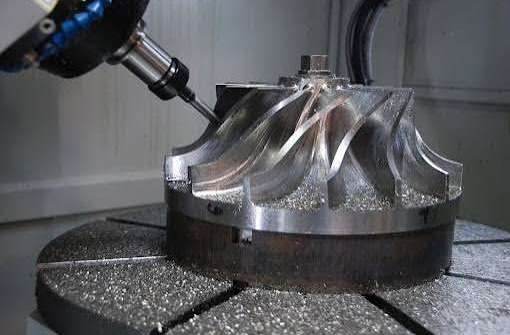
- Complex Geometry in a Single Setup: Multi-axis machining allows the tool to approach the workpiece from virtually any angle without repositioning. This minimizes tolerance stack-up, eliminates errors from multiple setups, and shortens lead times—critical when producing intricate turbine blades or impellers.
- Superior Surface Finish and Part Integrity Optimized tool paths and high-rigidity machines produce Ra finishes as low as 0.2–0.4 µm, reducing stress concentrations and fatigue risk in flight-critical parts.
- Material Efficiency and Waste Reduction Precise stock removal from expensive billets (especially titanium and superalloys) lowers raw material costs and supports sustainability goals in an industry under pressure to reduce environmental impact.
- Full Traceability and Repeatability Digital process records, combined with AS9100-compliant quality systems, ensure every part is identical and fully documented—from raw material lot to final inspection.
These advantages explain why CNC aerospace machining remains the gold standard for structural, engine, and avionics components.
Commonly Used Materials in Aerospace CNC Machining
Aerospace demands materials with exceptional strength-to-weight ratios, heat resistance, corrosion resistance, and fatigue performance. The top three categories:
- Aluminum Alloys (e.g., 2024, 6061, 7075) Lightweight, excellent machinability, good strength. Primary uses: airframe structures, fuselage skins, wing spars. 7075-T6 offers high strength but requires careful machining to avoid cracking.
- Titanium Alloys (primarily Ti-6Al-4V / Grade 5) Roughly 45% lighter than steel with comparable strength, outstanding corrosion resistance, and performance up to ~400–600°C. Challenges: low thermal conductivity → heat buildup → rapid tool wear. Requires sharp carbide tools, high-pressure coolant, and conservative speeds/feeds. Common applications: landing gear, engine mounts, compressor blades, structural fittings.
- Nickel-Based Superalloys (e.g., Inconel 718, Hastelloy, Waspaloy) Maintain strength and oxidation resistance above 700–1000°C. Extremely difficult to machine: work hardening, abrasive, and high cutting forces. Typical uses: turbine blades, combustor liners, exhaust systems, hot-section components.
Other materials occasionally appear: stainless steels (17-4PH, 316), magnesium alloys (rare due to flammability), and emerging composites/hybrids.
| Material | Strength-to-Weight | Heat Resistance | Machinability | Typical Tolerance Achievable |
|---|---|---|---|---|
| Aluminum 7075 | Excellent | Moderate | Good | ±0.0005 in |
| Ti-6Al-4V | Outstanding | High | Poor | ±0.0002–0.0005 in |
| Inconel 718 | Very High | Extreme | Very Poor | ±0.0001–0.0003 in |
5-Axis and 7-Axis CNC Machining Processes
5-axis CNC machining has become the industry benchmark for complex aerospace parts.
- Simultaneous 5-axis movement (X/Y/Z + A/C or B/C rotary axes)
- Advantages: single-setup machining of undercuts, deep cavities, and compound angles; reduced fixturing; better tool engagement; superior surface finish.
Typical aerospace applications: blisks (bladed disks), impellers, turbine casings, and structural frames with intersecting features.
7-axis CNC machining adds further linear or rotary axes (often on Swiss-type lathes or advanced mill-turn centers), enabling even more simultaneous motion.
- Benefits over 5-axis: dramatically reduced setups (sometimes 60–80% fewer), minimized tolerance stack-up, and faster cycle times for very intricate parts.
- Drawbacks: significantly higher machine cost, programming complexity, and limited availability.
- Use cases: ultra-precise small-to-medium components with deep features (e.g., fuel nozzles, actuator shafts).
In 2026, most aerospace shops rely on 5-axis for the majority of work, reserving 7-axis for niche, high-value applications.
Tolerances, AS9100 Standards, and Quality Requirements
Tolerances in aerospace CNC machining vary by component criticality:
- Structural parts: ±0.001 in (±25 µm)
- Engine/hot-section: ±0.0002–0.0005 in (±5–12 µm)
- Critical features (e.g., bearing journals): ±0.0001 in (±2.5 µm) or tighter
AS9100 (currently Revision D / 2016, transitioning toward IA9100 in 2026–2027) builds on ISO 9001:2015 with ~105 aerospace-specific clauses. Key requirements relevant to CNC machining:
- Risk-based thinking throughout processes
- Product safety emphasis
- Counterfeit parts prevention
- Configuration management (traceability from design to delivery)
- Critical characteristic identification and control
- First Article Inspection (FAI) per AS9102
- Full material certification and lot traceability
- Calibration of all measuring equipment
- Supplier oversight and flow-down of requirements
Many programs also require Nadcap accreditation for special processes (e.g., heat treatment, NDT).
Non-compliance risks: part rejection, program disqualification, or catastrophic failure.
Real-World Case Studies
Case 1: Turbine Blade Family (Inconel 718) A major engine OEM transitioned from 3-axis + extensive secondary operations to simultaneous 5-axis machining. Result: cycle time reduced 42%, surface finish improved to Ra 0.3 µm, and scrap rate dropped below 1.5%. Tool life increased 3× with optimized high-pressure coolant strategies.
Case 2: Titanium Landing Gear Bracket Using Ti-6Al-4V on a 5-axis mill-turn center: Single-setup machining eliminated 4 prior fixtures, achieving ±0.0003 in true position across 18 features. Full FAI and AS9102 documentation passed on first submission.
Case 3: Satellite Structural Panel (Aluminum 7075) The lightweighting program required thin-wall pockets and complex rib patterns. 5-axis roughing and finishing in one clamping produced parts 28% lighter than previous designs while maintaining ±0.001 in flatness across large surfaces.
These examples highlight how modern aerospace CNC machining balances precision, efficiency, and compliance.
Frequently Asked Questions (FAQ)
Q: What is the typical tolerance for aerospace CNC parts?
A: It depends on the feature—structural ±0.001 in, engine-critical ±0.0002–0.0005 in, ultra-precision ±0.0001 in.
Q: Why is titanium so hard to machine for aerospace?
A: Low thermal conductivity causes heat to concentrate at the tool tip, accelerating wear. It also work-hardens rapidly.
Q: Is AS9100 mandatory for all aerospace suppliers?
A: Almost always yes for Tier 1 and critical component suppliers. Many primes require it contractually.
Q: What’s new in aerospace CNC for 2026?
A: Increased adoption of AI for toolpath optimization, hybrid additive+CNC workflows, deeper digital thread traceability, and IA9100 transition preparations.
Q: How do I choose an aerospace CNC machining partner?
A: Verify current AS9100 certification, Nadcap (if needed), experience with your materials, 5-axis capability, and strong FAI/traceability processes.
Aerospace CNC machining continues to evolve rapidly in 2026, driven by demands for lighter, stronger, and more efficient aircraft and spacecraft. Partnering with experienced, certified providers ensures components meet the extreme requirements of modern flight.

Ryan Wang
Ryan Wang is the CNC Machining Expert at Cncpioneer, with over 15 years of hands-on experience as a CNC programmer, process engineer, senior machinist, and precision manufacturing specialist. He has helped companies in aerospace, automotive, medical, and electronics sectors achieve micron-level tolerances and scale from prototypes to high-volume production. Ryan is also an experienced instructor in advanced CNC techniques, particularly five-axis machining and challenging materials.