In-house CNC machines are incredibly capable for everyday prototyping, small-batch production, and standard components. However, certain advanced machining challenges demand far more: ultra-rigid 5-axis (or higher) platforms, sub-micron thermal compensation, sophisticated simultaneous multi-axis control, specialized high-performance tooling, vibration-damped environments, real-time adaptive machining strategies, and years of accumulated process expertise. Attempting these tasks on typical shop-floor equipment often leads to excessive setup time, frequent tool breakage, unacceptable scrap rates, part distortion, or outright failure to meet specifications.
Below are 20 complex CNC machining tasks that frequently require professional-grade facilities, advanced CAM programming, and deep manufacturing know-how.
Ultra-Tight Tolerances
Holding ±0.0005″ (±0.012 mm) or tighter across multiple features, requiring exceptional machine thermal stability, precision fixturing, and constant tool offset monitoring.
True Simultaneous 5-Axis Milling
Machining complex undercuts, compound curves, and freeform surfaces in one setup using full simultaneous 5-axis motion.
Mirror-Finish & Optical-Quality Surfaces
Achieving sub-Ra 0.1 μm mirror-polished or near-optical surfaces on contoured geometry, often with specialized tool path strategies and controlled cutting conditions.
Exotic & Superalloy Machining
Processing titanium alloys, Inconel, Hastelloy, hardened tool steels, or other high-temperature alloys with severe tool wear, heat, and cutting-force challenges.
Ultra-Thin-Wall Structures
Machining walls ≤0.5 mm (often down to 0.2–0.3 mm) without chatter, deflection, or thermal distortion using adaptive toolpaths and rigid damping.
High-Volume Precision Repeatability
Producing thousands of parts with near-zero variation through automated tool-life management, in-process gauging, and statistical process control.
Deep & Complex Internal Cavities
Creating long-reach, deep pockets, blind features, or intricate internal geometries with difficult chip evacuation and limited cutter access.
Micro-Machining & Sub-Millimeter Features
Fabricating features <0.5 mm (including micro-holes, fine slots, or delicate ribs) using ultra-precise spindles and near-zero runout tooling.
Specialized & Micro-Thread Forms
Milling non-standard, high-precision, or micro-threads with accurate pitch, flank form, and excellent surface finish.
Seamless High-Speed Contour Blending
Executing rapid, multi-surface 5-axis contouring with invisible blend lines between adjacent toolpaths.
Multi-Tool & Multi-Operation Synchronization
Coordinating simultaneous or tightly sequenced operations with multiple tools for maximum efficiency on highly complex parts.
Advanced Multi-Step Fixturing & Probing
Designing and precisely aligning elaborate custom fixtures with in-process touch probing and coordinate transformations to eliminate cumulative error.
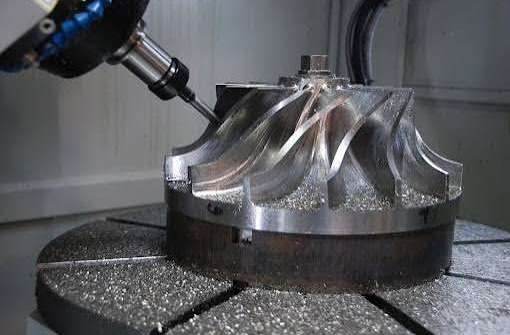
Impellers, Blisks & Turbomachinery Components
Machining shrouded/unshrouded impellers, blisks, or turbine blades with intricate aerofoil geometry and tight profile tolerances.
Deep Undercuts & Overhung Features
Accessing features impossible with 3-axis approaches, requiring repeated 4-/5-axis indexing or long-reach tooling.
Deep-Hole Drilling & Precision Boring
Producing long, straight, accurately positioned deep holes with excellent cylindricity, roundness, and surface finish.
High-Accuracy Gear & Spline Profiles
Directly machining precise involute gears, splines, or serrations with correct tooth form and minimal backlash.
Aspheric & Optical Mold Surfaces
Generating sub-micron form accuracy on reflectors, lens molds, or freeform optics with extremely low surface roughness.
Precision Finishing of Near-Net-Shape Parts
Machining critical datums and features on castings, forgings, or additively manufactured blanks while maintaining tight positional relationships.
Pressure-Tight & Hermetic Components
Producing valve bodies, manifolds, enclosures, or fittings that must withstand high-pressure leak testing without distortion or sealing flaws.
Patient-Specific & Organic Medical Components
Fabricating custom implants, prosthetics, or surgical guides with freeform/organic shapes, extreme precision, and biocompatibility requirements.
Summary
While a well-equipped in-house CNC setup excels at routine and moderately complex work, the tasks above represent the frontier where capability gaps become costly—through scrapped material, extended lead times, inconsistent quality, or outright inability to produce the part correctly. Recognizing these boundaries allows smarter decision-making: reserve in-house capacity for what it does best, and partner with specialized high-end CNC providers when extreme precision, exotic materials, intricate geometry, or production-scale consistency are non-negotiable. This approach minimizes risk, accelerates time-to-market, and ensures parts meet the most demanding specifications the first time.

Ryan Wang
Ryan Wang is the CNC Machining Expert at Cncpioneer, with over 15 years of hands-on experience as a CNC programmer, process engineer, senior machinist, and precision manufacturing specialist. He has helped companies in aerospace, automotive, medical, and electronics sectors achieve micron-level tolerances and scale from prototypes to high-volume production. Ryan is also an experienced instructor in advanced CNC techniques, particularly five-axis machining and challenging materials.