In today’s fast-evolving manufacturing world, choosing between CNC machining and conventional machining (also known as traditional or manual machining) can make or break your project’s success, cost, and lead time.
CNC machining uses computer-controlled precision to deliver unmatched accuracy and efficiency, while conventional machining relies on skilled operators for hands-on flexibility.
This in-depth 2025 guide breaks down the differences between CNC machining and conventional machining, their pros/cons, real-world applications, and how emerging trends like AI-assisted CAM, 5-axis dominance, and hybrid manufacturing are shifting the balance. Whether you’re prototyping, scaling production, or repairing parts—you’ll know exactly which method fits best.
What is CNC Machining?
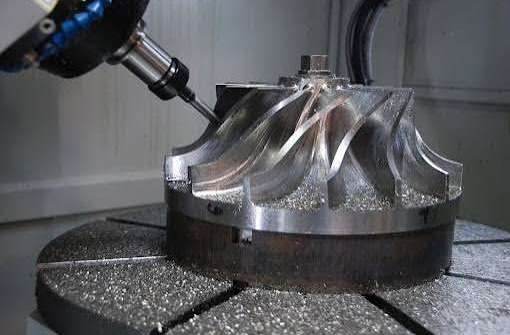
CNC (Computer Numerical Control) machining is a subtractive process where pre-programmed software (G-code from CAD/CAM) directs multi-axis tools to precisely remove material from blocks of metal, plastic, composites, and more.
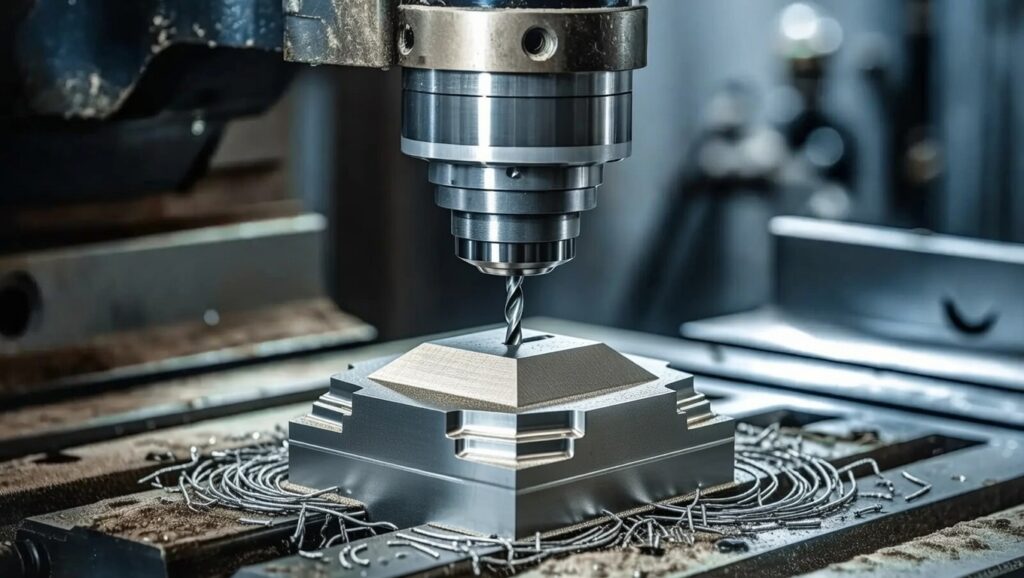
Modern workflow:
- Create 3D CAD model
- Generate toolpaths in CAM software
- Simulate → Post-process to G-code
- Load into CNC mill, lathe, or 5-axis center → automatic execution
In 2025, many shops now use AI-optimized toolpaths and real-time monitoring to further boost speed and reduce waste.
Key Advantages of CNC Machining
- Ultra-high precision & tight tolerances — commonly ±0.005 mm to ±0.001 mm (some reach ±0.0005 mm)
- Excellent repeatability — identical parts batch after batch
- Handles complex geometries effortlessly (undercuts, deep pockets, freeform surfaces via 4/5-axis)
- Ideal for medium to high-volume production (50–10,000+ pcs) with lower per-part cost
- Better safety — enclosed machines, less operator exposure
- Wide material support — titanium, Inconel, hardened steels, PEEK, carbon fiber composites
Disadvantages of CNC Machining
- High upfront costs (machines, software, fixtures)
- Programming/setup time hurts very small runs (<20 pcs)
- Requires skilled programmers/CNC operators
What is Conventional (Manual) Machining?
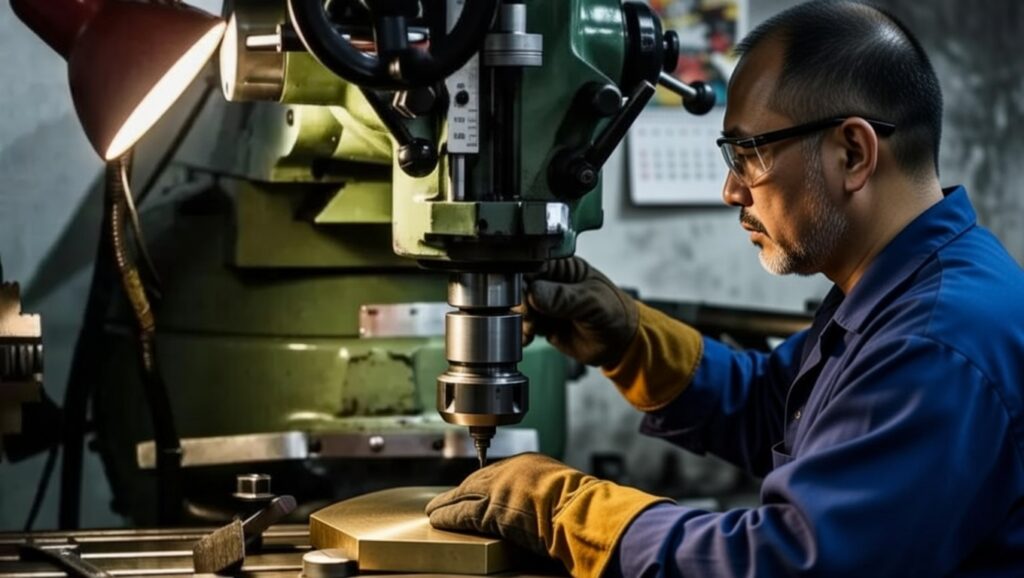
Conventional machining uses manually operated tools—lathes, milling machines, grinders, and drill presses—controlled directly by experienced machinists who adjust feeds, speeds, and depths in real time.
It remains essential for quick fixes, one-offs, and teaching core machining principles.
Key Advantages of Conventional Machining
- Low entry cost—machines and tools far cheaper than CNC centers
- Maximum flexibility for prototypes, repairs, and on-the-fly design tweaks
- Fast setup for simple jobs — no programming needed
- Ideal for very low-volume or one-off custom parts
Disadvantages of Conventional Machining
- Lower precision — typically ±0.05–0.2 mm, heavily skill-dependent
- Poor repeatability across multiple parts (operator fatigue, variations)
- Slower for anything beyond simple shapes
- Harder on tough/hard materials (tool wear, breakage risk)
- Higher labor costs and safety risks in long runs
CNC Machining vs Conventional Machining: 2025 Side-by-Side Comparison
| Feature | CNC Machining | Conventional Machining |
|---|---|---|
| Precision | ±0.001–0.005 mm (up to ±0.0005 mm possible) | ±0.05–0.2 mm (skill-dependent) |
| Repeatability | Near-perfect across thousands of parts | Variable — changes with operator/shift |
| Part Complexity | High (5-axis undercuts, intricate 3D features) | Low–medium (basic shapes, multiple setups needed) |
| Best Production Volume | 50–10,000+ pcs (economies of scale kick in) | 1–50 pcs (prototypes, repairs) |
| Setup / Programming Time | Longer initial (but reusable) | Very fast for simple jobs |
| Per-Part Cost (high vol) | Much lower | Higher (labor-intensive) |
| Per-Part Cost (1–10 pcs) | Higher | Usually lower |
| Material Versatility | Excellent (hard alloys, composites, ceramics) | Limited (softer metals preferred) |
| Operator Skill Required | CAM programming + CNC operation | High manual machining expertise |
| Safety | High (enclosed, interlocks) | Moderate (direct tool contact) |
| 2025 Trend Edge | AI optimization, IoT monitoring, hybrid AM+CNC | Still vital for ultra-low vol & teaching |
Which is Better—CNC or Conventional Machining in 2025?
It depends entirely on your needs:
Choose CNC machining when you need:
- Tight tolerances and superior surface finishes
- Complex, multi-sided parts (5-axis shines here)
- Consistent quality in medium–high volumes
- Scalability for growing orders
Choose conventional machining when you need:
- 1–20 pieces with frequent design iterations
- Immediate turnaround without programming delay
- Extremely low budget (no big machine investment)
- On-site repairs or very custom one-offs
2025 reality check: The break-even point has shifted. With cloud CAM, AI-assisted programming, cheaper 5-axis access via services, and falling outsourcing prices, CNC often wins even at 20–100 piece runs. Hybrid approaches (CNC + additive for near-net shapes) further widen CNC’s advantage.
Why Most Companies Now Outsource CNC Instead of Buying Machines
Owning industrial CNC equipment (especially 5-axis) costs $100k–$500k+ upfront, plus ongoing maintenance, training, and software.
Smart manufacturers turn to professional CNC machining services for:
- Instant quotes & free DFM feedback (hours, not days)
- 3–5 axis milling & turning capabilities
- Broad material stock (metals, engineering plastics, exotics)
- Tolerances as tight as ±0.005 mm
- No capital tied up — pay only for parts produced
Frequently Asked Questions (FAQ)
What is the biggest difference between CNC and conventional machining?
CNC is automated/computer-controlled for superior precision, speed, and consistency; conventional is manual/operator-driven, offering flexibility at the cost of repeatability.
Is CNC machining more expensive than traditional machining?
For 1–20 pieces — often yes (setup/programming overhead). For 50+ pieces — usually no, thanks to automation and reduced labor.
Can manual machining match CNC precision?
Rarely. Even top machinists struggle to hold ±0.01 mm consistently across batches; CNC does it reliably.
Which is better for rapid prototyping in 2025?
Very simple/fast tweaks → conventional. Functional prototypes needing tight fits/complex features → outsource CNC.
Will conventional machining disappear because of CNC?
No. It remains irreplaceable for ultra-low volume, field repairs, education, and situations needing instant human judgment.
Ready to move your project forward?
Whether it’s a single prototype or a production run—get expert support, top precision, and competitive pricing.