In precision manufacturing, achieving accurate internal features is essential for components that require tight fits, high load-bearing capacity, or reliable performance under extreme conditions. CNC boring plays a pivotal role by enlarging and refining pre-existing holes to achieve tight tolerances, superior surface finishes, and precise geometries. Unlike initial hole-making processes, CNC boring emphasizes quality, repeatability, and error correction, making it indispensable in high-stakes industries.
At CNC Pioneer, we provide expert CNC machining services incorporating advanced boring techniques for prototypes and production volumes. This guide draws from scholarly research and industry standards to cover CNC boring in detail—its definition, advantages, step-by-step process, machine types, key considerations, applications, and comparisons to related methods like drilling.
What is CNC Boring?
CNC boring is a subtractive machining process governed by computer numerical control (CNC) systems. It employs a single-point boring bar or adjustable boring head to enlarge, straighten, true, or finish an existing hole in a workpiece. The operation typically begins with a rough hole from casting, forging, drilling, or rough milling, followed by controlled material removal to meet exact specifications.
The CNC element automates tool paths, speeds, feeds, and movements via CAD/CAM-generated G-code, ensuring consistency and minimizing errors. This enables complex features such as stepped bores, tapers, or counterbores.
Boring differs fundamentally from drilling: while drilling creates initial holes with moderate accuracy (often ±0.05–0.1 mm), boring refines them to tolerances as tight as ±0.005–0.01 mm or better, improving roundness, straightness, concentricity, and surface finish—vital for bearing seats, cylinder bores, or precision housings. Research highlights boring’s role in correcting geometric errors in processes like line boring for engine blocks.
Advantages of CNC Boring Technique
CNC boring delivers critical benefits for precision applications, supported by academic and industry analyses:
- Exceptional Precision and Accuracy — Tolerances of ±0.0005″ to ±0.001″ (±0.0127–0.0254 mm) are achievable, ensuring perfect assembly fits. Studies on geometric error compensation in line boring emphasize boring’s ability to minimize deviations in position and form.
- Superior Surface Finish — Controlled, low-speed cuts reduce chatter, yielding smooth bores (Ra 0.4–1.6 μm or better), often eliminating secondary operations like honing. Research on boring parameters using Taguchi methods shows optimized feeds and speeds enhance finish while maintaining tolerances.
- High Repeatability — CNC automation produces identical results across batches, lowering scrap and inspection demands in volume production.
- Versatility for Complex Geometries — Supports multi-diameter, tapered, or grooved features in a single setup on multi-axis machines.
- Improved Material Removal Control — Thin, uniform cuts extend tool life and reduce thermal distortion, as noted in precision machining reviews.
These advantages reduce costs in fit-critical applications. For combined operations, see our CNC turing and milling services.
How Does CNC Boring Work? Step-by-Step Procedure
The process follows a structured sequence for reliable outcomes:
- CAD/CAM Design and Programming — Import 3D models, specify dimensions, and generate tool paths/G-code.
- Workpiece Preparation—Fixture the part; ensure a rough hole (typically 0.010″–0.050″ undersized).
- Tool and Holder Selection — Rigid boring bars or adjustable heads with carbide/PCD inserts; vibration-dampened for deep holes.
- Parameter Setup — Set spindle speed (100–800 RPM), low feed (0.001″–0.005″/rev), and light cuts; use coolant.
- Machine Setup—Align, clamp, offset tools, and zero workpiece.
- Dry Run and Simulation — Verify paths to prevent collisions.
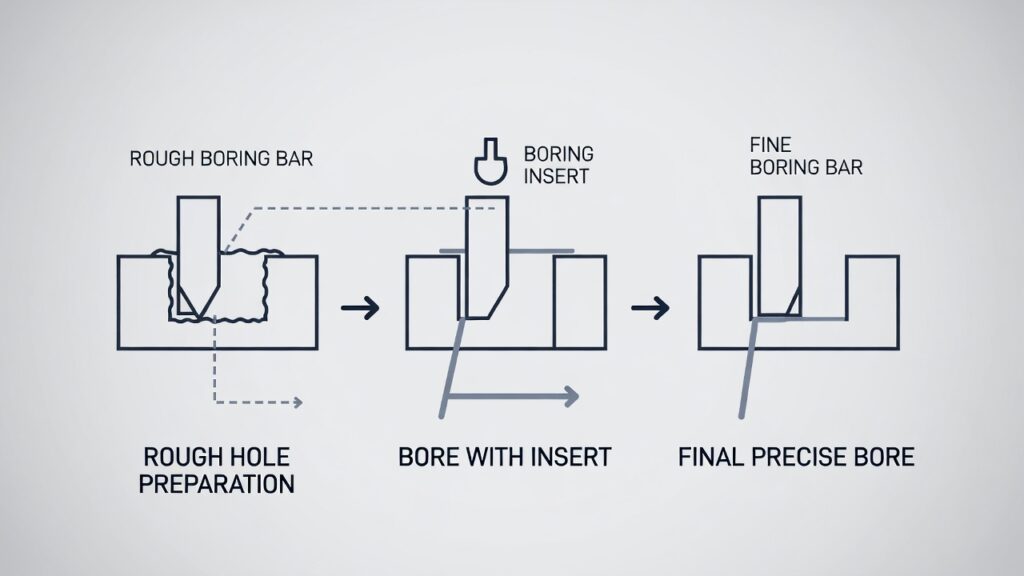
- Boring Operation — Tool enters, rotates, advances axially (with optional orbiting); multiple passes achieve final diameter.
- Inspection and Finishing — Use bore gauges/CMM; deburr as needed.
Real-time monitoring on modern systems minimizes defects, aligning with closed-loop precision manufacturing principles.
[Insert Image: Diagram illustrating CNC boring process steps, from rough hole preparation to final precise bore with tool path visualization.]
Bonus Tips: Important Considerations for Accurate CNC Boring
To achieve optimal results:
- Tool Selection—Adjustable heads for tuning; carbide for metals, PCD for non-ferrous/composites (per Sandvik Coromant guidelines on ISO 13399 parameters).
- Speed/Feed Optimization — Lower speeds minimize chatter; use Taguchi-optimized parameters for steel or alloys.
- Coolant Application — Through-tool or flood coolant prevents heat/chip issues in steels/titanium.
- Vibration Control—Short overhangs, dampened bars, or steady rests for depths >5x diameter.
- Fixturing—Rigid clamping ensures stability.
These practices, drawn from tool manufacturer recommendations and scholarly optimization studies, extend tool life and hold tolerances.
Key Components of a CNC Boring Machine
Essential elements include:
- CNC Control Panel — For programming/monitoring.
- High-Rigidity Spindle — Variable speed for stability.
- Boring Tools/Heads — Adjustable single/multi-insert.
- Rotary/Indexing Table—Multi-angle access.
- Multi-Axis Drives — 3–5+ axes for complexity.
- Coolant System — High-pressure delivery.
- Automatic Tool Changer — Multi-operation efficiency.
- Probes/Sensors — In-process measurement.
These support precision on large/intricate parts, per ISO standards for machining centers (e.g., ISO 10791 series).
Types of CNC Boring Machines
Configurations vary by application:
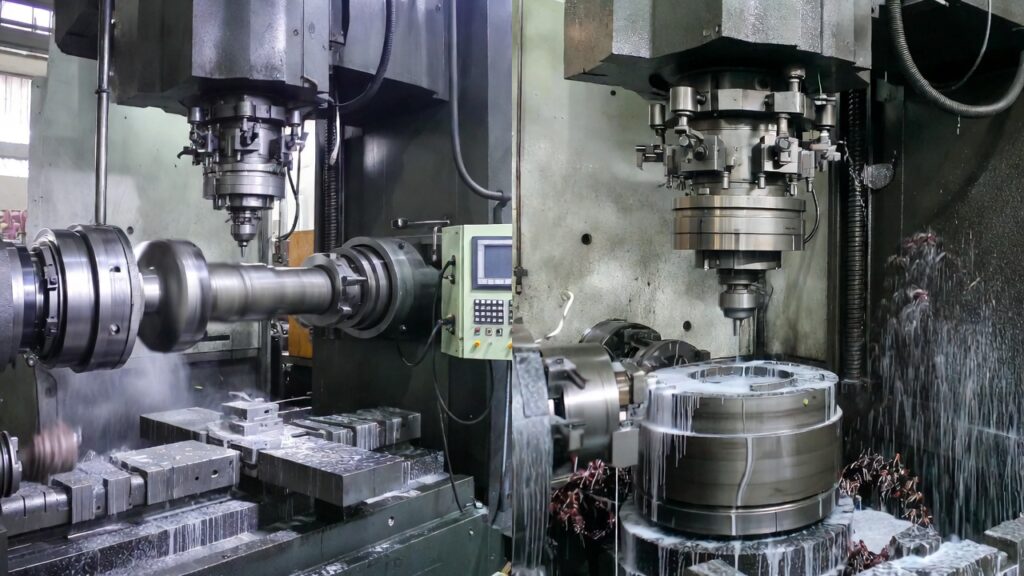
- Horizontal Boring Mills (HBM)—For large/heavy parts (e.g., engine blocks); horizontal spindle, rotary table.
- Vertical Boring Mills (VBM)—For tall cylindrical components; vertical orientation.
- Jig Borers — Ultra-precise for tool/die work; high accuracy on small/medium parts.
- CNC Machining Centers with Boring—Versatile 4/5-axis for milling/drilling/boring integration.
- Line Boring Machines — For aligned multi-hole features in frames.
Selection aligns with part size/geometry/tolerances, as in ISO 3070 standards for boring/milling machines.
Specific Examples of CNC Bored Components
CNC boring creates critical features in:
- Automotive — Engine block cylinder bores for piston fit.
- Aerospace — Turbine casings/landing gear housings for alignment.
- Oil & Gas — Valve bodies/pump liners for pressure sealing.
- Medical — Implant sockets/surgical tools.
- Heavy Machinery — Gearbox/hydraulic cylinder bores.
These demand the precision boring provides.
CNC Boring vs. CNC Drilling: Key Differences
| Feature | CNC Drilling | CNC Boring |
|---|---|---|
| Primary Purpose | Create initial holes | Enlarge/refine existing holes |
| Tool Used | Multi-flute drill bits | Single-point boring bars/heads |
| Precision/Tolerance | Moderate (±0.05–0.1 mm typical) | High (±0.005–0.01 mm or better) |
| Surface Finish | Fair (Ra 3.2–6.3 μm) | Excellent (Ra 0.4–1.6 μm) |
| Speed | Fast | Slower, controlled |
| Position Correction | No | Yes (corrects location/straightness) |
| Typical Use | Rough hole creation | Finishing for fit/function |
Drilling suits initial holes; boring refines for accuracy. Projects often sequence drilling then boring. See our CNC drilling guide.
FAQs
What tolerances can CNC boring achieve?
Typically ±0.005–0.01 mm, down to ±0.0127 mm with optimized setups and fine tools.
Can CNC boring create threaded holes?
Prepares the bore; threading follows via tapping/single-point methods.
How deep can CNC boring go?
Up to 10x diameter or more with anti-vibration tooling.
Is boring limited to metals?
No—effective on plastics, composites, and exotics with suitable tooling.
Conclusion
CNC boring is foundational to precision machining, converting rough holes into accurate, high-quality features that ensure component reliability. Its tight tolerances, excellent finishes, and repeatability make it essential across demanding sectors.
At CNC Pioneer, our advanced CNC boring equipment handles your toughest projects. Whether prototypes or production, we’re equipped to deliver.
Start Your CNC Boring Project Today — Upload designs for a quick quote and DFM review.