Holes are among the most common features in machined parts, serving critical functions in assembly, fastening, fluid transfer, and weight reduction. In modern manufacturing, achieving precise, repeatable, and high-quality holes at scale requires advanced automation. CNC drilling stands out as one of the most reliable and widely adopted subtractive machining processes for this purpose.
Computer Numerical Control (CNC) drilling uses programmed instructions to guide a rotating drill bit into a stationary workpiece, creating cylindrical holes with exceptional accuracy and consistency. Compared to manual or conventional drilling, CNC drilling delivers tolerances as tight as ±0.005 mm, significantly reduced cycle times, and the ability to produce complex hole patterns without operator fatigue or variability.
This guide provides a complete overview of CNC drilling—from fundamentals and step-by-step execution to machine types, tooling, parameters, real-world applications, advantages, limitations, and comparisons with related processes. Whether you’re designing parts, programming machines, or evaluating manufacturing partners, understanding CNC drilling will help optimize quality, cost, and lead time.
For related machining processes, see our guides on CNC Milling and CNC Turning.
What is CNC Drilling?
CNC drilling is a computer-controlled machining process that creates round holes in a workpiece by advancing a rotating cutting tool (drill bit) along the Z-axis while the workpiece remains fixed. The entire operation—spindle speed, feed rate, depth, peck cycles, tool changes, and positioning—is governed by G-code generated from CAD/CAM software.
Unlike manual drilling, which depends on operator skill and is limited in repeatability, CNC drilling achieves:
- Positional accuracy typically ±0.01–0.05 mm
- Consistent hole diameters and depths
- Complex multi-hole patterns with minimal setup changes
It is especially valuable in industries requiring high precision, such as aerospace (rivet and fastener holes), automotive (engine blocks), electronics (PCB vias), and medical devices (implant features).
For a foundational reference on numerical control principles, see Wikipedia: Numerical Control.
Advantages of CNC Drilling Technique
CNC drilling offers compelling benefits over traditional methods:
Precision and Accuracy in Drilling
Modern CNC machines maintain positional and repeatability tolerances down to ±0.001–0.005 mm, far surpassing manual capabilities. This level of accuracy is essential for interference fits, bearing seats, and aligned fastener patterns.
Increased Efficiency and Productivity
Automation enables continuous operation, rapid tool changes via automatic tool changers (ATC), and optimized toolpaths that minimize air cutting and idle time. Batch production of hundreds or thousands of identical parts becomes economical.
Ability to Handle Complex Drilling Tasks
CNC systems easily execute angled holes, deep-hole peck cycles, multi-diameter features (via step drills or tool changes), and integration with reaming, countersinking, or tapping in a single setup on multi-function machining centers.
These advantages collectively reduce scrap rates (often <2%), shorten lead times, and lower per-part costs in medium-to-high volumes.
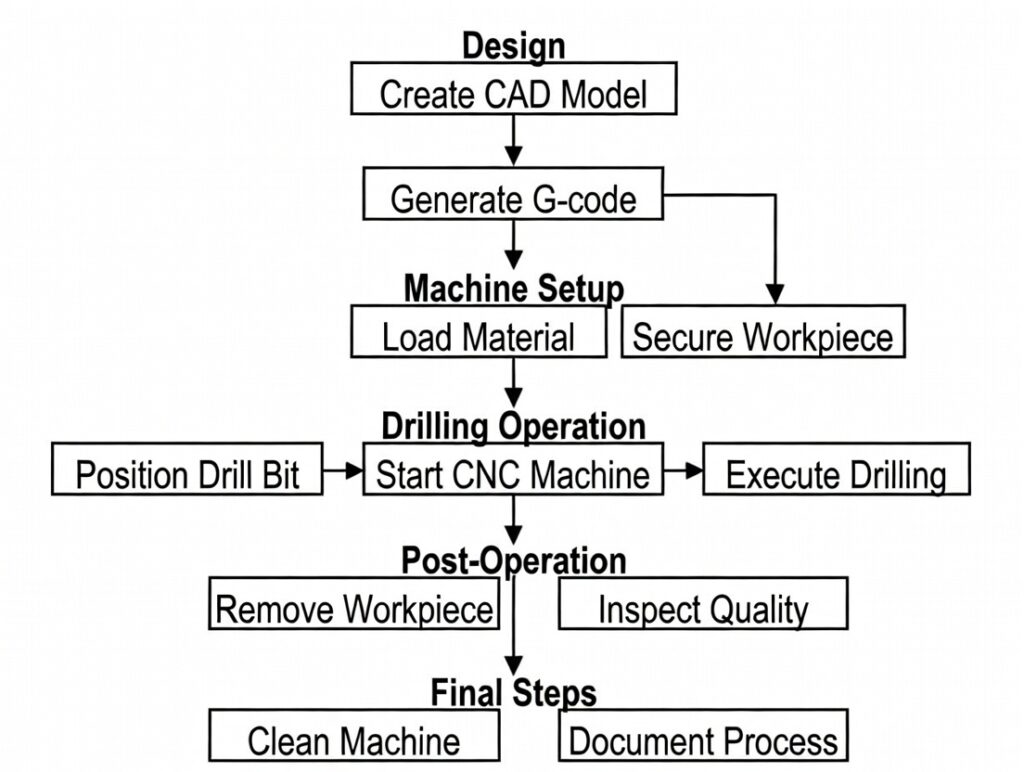
How Does CNC Drilling Work? Step-by-Step Procedure
The CNC drilling workflow is systematic and repeatable:
Step 1: Creating the Workpiece Geometry
Engineers design the part in CAD software (SolidWorks, Fusion 360, etc.), specifying exact hole locations, diameters, depths, and any chamfers or countersinks.
Step 2: Choosing the Appropriate Drilling Cycle
Common G-code cycles include:
- G81 – Basic drilling cycle (feed to depth, rapid retract)
- G83 – Deep-hole peck drilling (periodic retraction to clear chips)
- G73 – High-speed peck / chip-breaking cycle
- G84 – Tapping cycle (for threaded holes)
Cycle selection depends on hole depth-to-diameter ratio and material.
Step 3: Choosing the Suitable Tool and Tool Holder
Select drill bits (twist, carbide, indexable, etc.) and secure them in collet, hydraulic, or shrink-fit holders for runout <0.005 mm.
Step 4: Determining the Appropriate Tool Parameters
Calculate spindle speed (RPM), feed rate (mm/rev or mm/min), and peck depth using material-specific data from sources like the Machinery’s Handbook or manufacturer catalogs.
Step 5: Setting up the CNC Drilling Machine
Fixture the workpiece securely (vises, clamps, or vacuum tables); establish work offsets (G54–G59); and perform tool length offsets.
Step 6: Programming the CNC Drilling Machine
Use CAM software (Mastercam, Fusion 360, or PowerMill) to generate toolpaths and output verified G-code.
Step 7: Actual Drilling Process
The machine executes the program: the spindle starts, the tool rapids to position, feeds into material, retracts (peck if needed), and repeats for all holes.
Step 8: Quality Check and Post-Processing
Inspect hole diameters, depths, and positions using calipers, bore gauges, or a CMM. Deburr edges and apply finishes as required.
[Insert Image: Flowchart illustrating the 8-step CNC drilling process from design to inspection]
Bonus Tip: Important Considerations for Creating Accurate Drilling Holes
Achieving high-quality holes requires attention to detail:
Tip 1: Choose the Right Drill Bit
| Drill Bit Type | Typical Point Angle | Best For | Key Characteristics |
|---|---|---|---|
| Twist Drill | 118°–135° | General metals, plastics | Helical flutes for chip evacuation |
| Center Drill | 60° | Starting holes for lathe work | Short, rigid |
| Step Drill | Varies | Sheet metal, multi-diameter holes | Conical steps reduce tool changes |
| Indexable Drill | 140°–180° | Large-diameter, high-volume | Replaceable inserts, cost-effective |
| Gun Drill | Special | Deep holes (>20×D) | Internal coolant channels |
Tip 2: Optimize Spindle Speed and Feed Rate
Use conservative starting values (e.g., 200–600 SFM for aluminum, 80–150 SFM for steel) and adjust based on tool feedback, chip appearance, and surface finish.
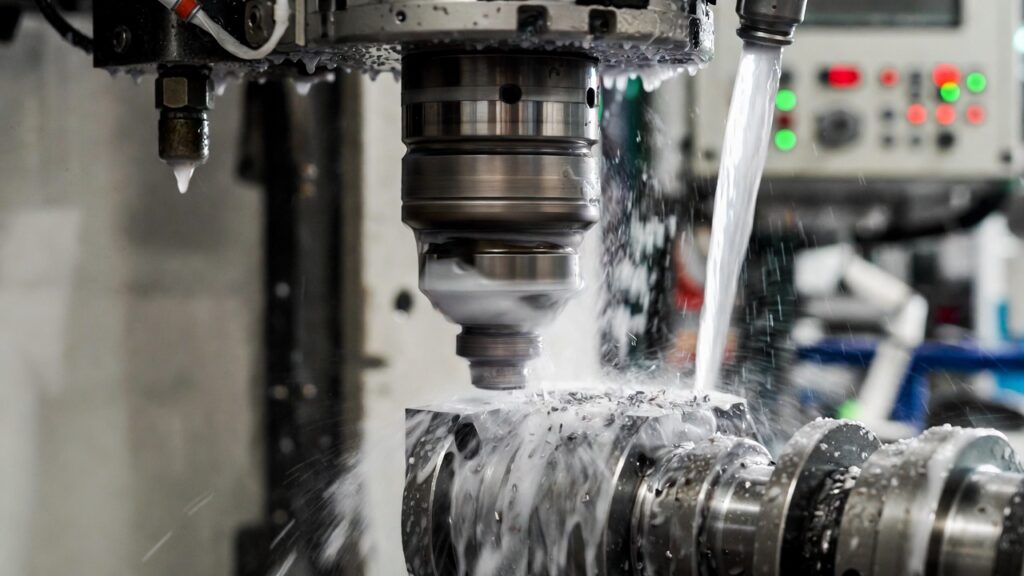
Tip 3: Use Appropriate Coolants or Lubricants
Flood coolant for metals, mist for composites, or dry machining with air blast for certain plastics. Coolant prevents built-up edge, reduces heat, and improves chip evacuation.
Tip 4: Securely Clamp the Workpiece
Prevent vibration and movement with adequate fixturing. Use soft jaws or custom fixtures for delicate or irregular parts.
Key Components of a CNC Drilling Machine
Essential elements include:
- Control Panel – Interface for program input and monitoring
- Spindle – High-precision rotating assembly (belt-driven or direct-drive)
- Drill Bits & Holders – Matched for minimal runout
- Worktable / Axes – T-slotted or grid plate with linear guides
- Motors & Drives – Servo motors for precise positioning
- Coolant System – Pump, nozzles, filtration
- Automatic Tool Changer – Increases throughput
- Chip Management – Conveyor or auger
- Frame & Base – Rigid cast iron or polymer concrete
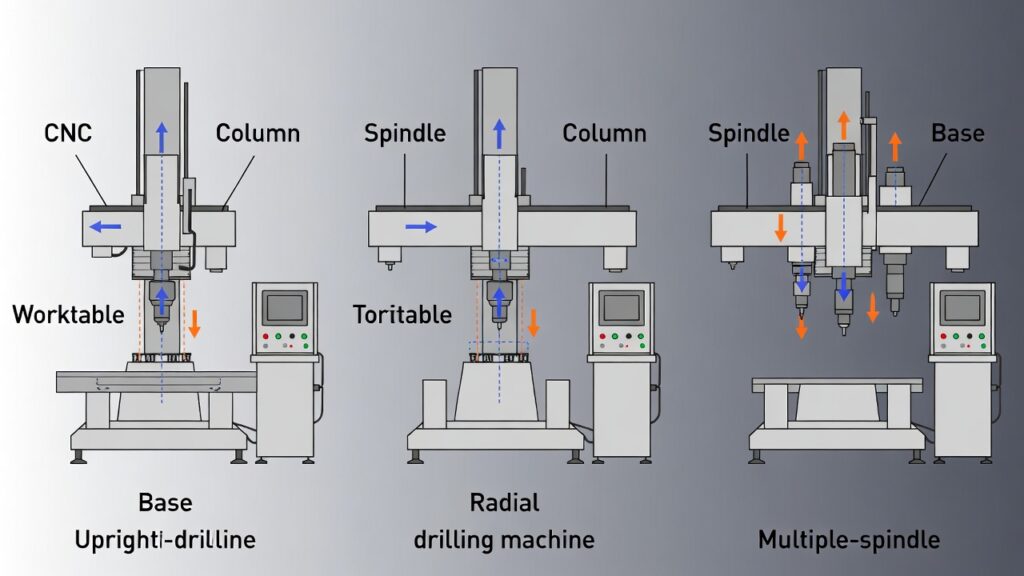
Types of CNC Drilling Machine
Common configurations include:
- Multiple Spindle Drilling Machine—Simultaneous drilling for high-volume production
- Micro Drill Press – Ultra-precise for holes <1 mm (electronics, medical)
- Upright CNC Drill Press – Vertical, general-purpose
- Radial Arm CNC Drill Press—Extended reach for large workpieces
- Turret-type Drilling Machine – Quick tool indexing
- Gang Drilling Machine – Parallel spindles for repetitive patterns
For deep-hole or portable needs, specialized variants exist (see also our earlier coverage of machine types).
[Insert Image: Side-by-side photos or diagram comparing upright, radial, and multiple-spindle CNC drilling machines]
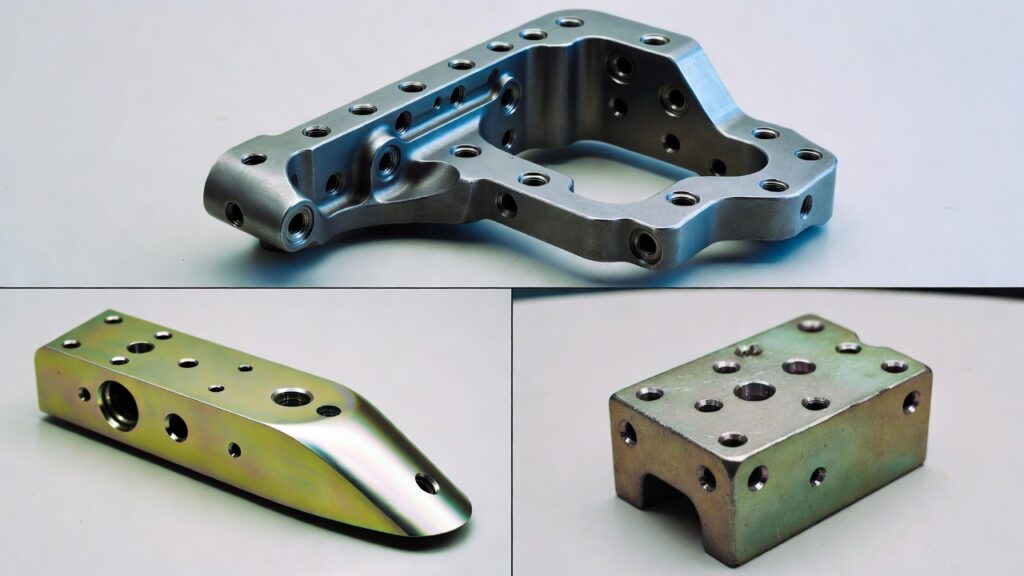
Specific Examples of CNC Drilled Components
CNC drilling produces critical features across industries:
- Automotive — Engine block oil passages, cylinder head bolt holes, suspension mounts, wheel hubs
- Aerospace — Fuselage skin rivet holes, engine mount brackets, control surface hinges
- Electronics — Connector ports, enclosure mounting holes, PCB standoffs
- Medical Devices — Prosthetic alignment holes, surgical instrument handles, dental implant features
- Industrial Machinery — Flange bolt circles, hydraulic manifold ports
- Energy Sector — Turbine blade root holes, pipeline flange patterns
[Insert Image: Collage or table-style montage showing real CNC-drilled parts from automotive, aerospace, and medical sectors]
What are the Main Differences Between CNC Milling and CNC Drilling?
- CNC Drilling—Primarily creates cylindrical holes using axial feed; tool rotates and advances linearly.
- CNC Milling — Removes material in X/Y/Z directions to produce complex contours, pockets, slots, and 3D surfaces; uses end mills and other multi-flute tools.
Drilling is faster and more efficient for hole-making, while milling handles broader geometry.
What are the Main Differences between CNC Lathes and CNC Drilling?
- CNC Drilling — Workpiece stationary; rotating tool creates holes.
- CNC Lathe — Workpiece rotates; stationary or live tooling performs turning, facing, grooving, and sometimes drilling/tapping.
Lathes excel at cylindrical parts; drilling machines focus on hole features in prismatic components.
FAQs
What level of accuracy can CNC drilling achieve?
Typically ±0.01–0.05 mm positional and ±0.005–0.02 mm diameter—depending on machine class, tooling, and setup.
How do you drill perfectly straight holes?
Use spot drilling to start, rigid tooling, proper feeds/speeds, peck cycles for deep holes, and secure fixturing.
Can CNC drilling create threaded holes?
Yes—by following a drilling operation with a G84 rigid tapping cycle or separate tapping tool.
What is the maximum practical hole depth?
Standard twist drills: 5–10× diameter. With peck or gun drilling: 20–100× diameter.
Conclusion
CNC drilling remains a cornerstone of precision manufacturing, delivering the accurate, repeatable holes required for reliable assembly across virtually every industry. By mastering tooling selection, parameter optimization, cycle programming, and machine setup, manufacturers can maximize quality while minimizing cost and lead time.
Ready to start your next project? Explore our CNC machining services or contact us for instant quotes on custom drilling and multi-process parts.