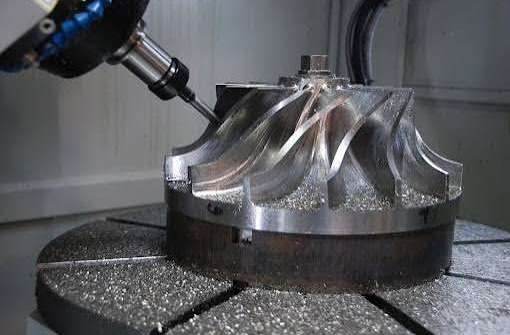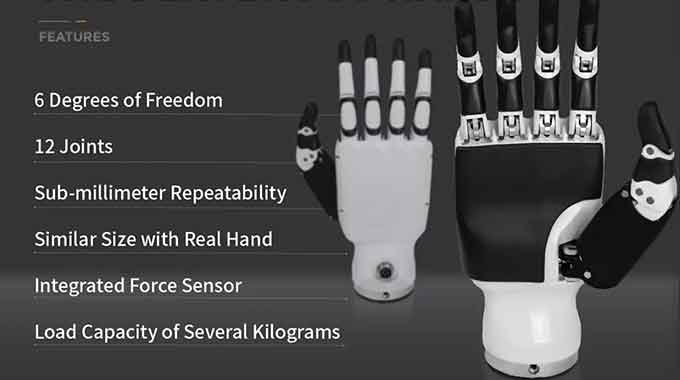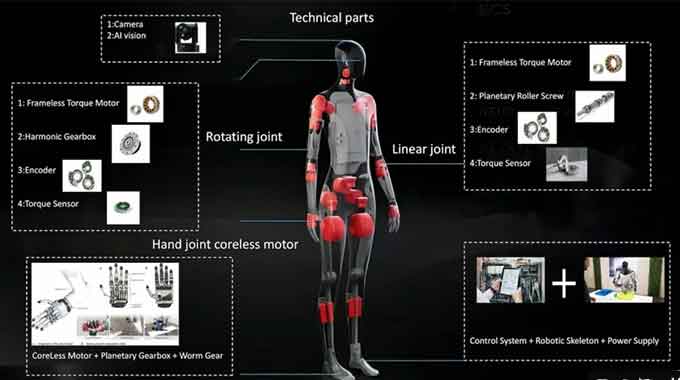
At CNC Pioneer, we are a professional precision machining company headquartered in Shenzhen, China, specializing in CNC turning and milling, Swiss-type machining, and rapid prototyping services. With ISO 9001 and AS9100D certifications, we operate state-of-the-art 3–5 axis machining centers from DMG MORI, Mazak, Haas, and other leading brands, supported by advanced CMM inspection, real-time monitoring, and full traceability. We serve global clients in aerospace, defense, medical devices, automotive & EV, consumer electronics, semiconductor, oil & gas, and more, delivering prototypes in as little as 3 days and cost-effective production runs with secure IP protection and seamless international logistics.
This comprehensive guide explains CNC milling from the ground up — its definition, history, working principles, machine components, types, applications, advantages, disadvantages, and frequently asked questions — while demonstrating why many engineers, startups, and procurement teams worldwide choose experienced Chinese manufacturers like CNC Pioneer for high-precision, fast-turnaround, and competitively priced CNC services.
If you’re completely new to CNC processes, begin with our What is CNC article
What Is CNC Milling?
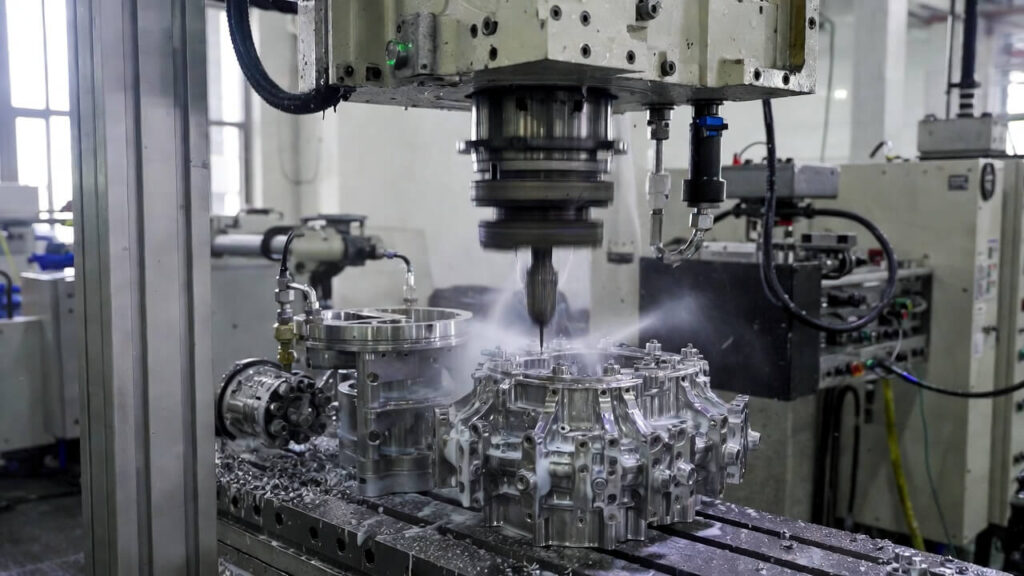
CNC milling, or Computer Numerical Control milling, is a subtractive manufacturing technology that uses computer-programmed rotating cutting tools (end mills, face mills, ball mills, drills, etc.) to precisely remove material from a solid block of raw stock, producing custom parts that exactly match a digital 3D CAD model.
In simple terms:
- An engineer creates a detailed 3D model in CAD software (SolidWorks, Fusion 360, Onshape, etc.), specifying dimensions, tolerances, surface finishes, and features.
- CAM software (Mastercam, Fusion 360 CAM, Siemens NX, etc.) analyzes the model and generates optimized toolpaths, calculating roughing, semi-finishing, and finishing strategies.
- The resulting G-code — a standardized numerical language — is loaded into the CNC controller.
- The machine automatically executes the code, moving multiple axes while the spindle rotates at high speed, delivering tolerances commonly between ±0.01 mm and ±0.002 mm, and surface finishes from Ra 3.2 µm down to Ra 0.4 µm or better.
CNC milling differs fundamentally from CNC turning, where the workpiece rotates against a stationary tool. Milling excels at creating flat surfaces, deep pockets, slots, complex contours, 3D free-form shapes, threaded holes, and intricate features across a wide range of materials, including aluminum alloys, stainless steel, titanium, Inconel, PEEK, nylon, brass, copper, and composites.
In 2026, leading Chinese CNC facilities integrate AI-driven toolpath optimization, real-time adaptive feed/speed adjustment, predictive tool wear monitoring, and Industry 4.0 connectivity, achieving higher efficiency, reduced cycle times, and improved consistency — advantages that make outsourcing to China increasingly attractive for global projects.
For a direct comparison, see CNC Milling vs Laser Cutting and CNC vs Conventional Machining.
A Brief History of CNC Milling
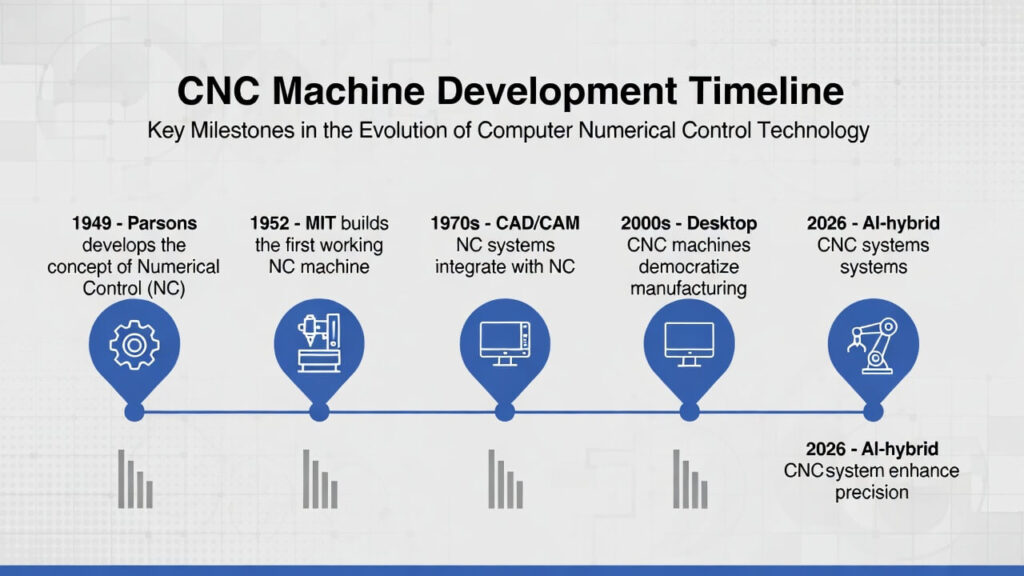
The origins of CNC milling date back to the late 1940s and early 1950s, driven by U.S. defense and aerospace needs for repeatable, high-accuracy parts. In 1949, engineer John T. Parsons developed the first numerical control (NC) system using punched cards to automate machine tool movements for helicopter rotor blades — a project funded by the U.S. Air Force. In 1952, researchers at MIT demonstrated the world’s first NC milling machine, a retrofitted Cincinnati Hydrotel controlled by punched tape.
The 1960s replaced vacuum tubes with transistors, making systems more reliable and compact. The 1970s introduced CAD (Computer-Aided Design) and CAM (Computer-Aided Manufacturing) software, enabling digital design-to-code workflows and standardizing G-code. By the 1980s, multi-axis machines (4- and 5-axis) became commercially viable, while the 1990s brought graphical user interfaces, simulation software, and widespread adoption in industry.
The 2000s democratized access with affordable desktop CNC mills, and the 2010s–2020s saw explosive growth in China, which became the world’s largest producer, consumer, and exporter of CNC machine tools and machined components. Today, AI-native machining, digital twins, hybrid additive-subtractive processes, and cloud-based monitoring are standard in top-tier Chinese shops.
For foundational references, consult Wikipedia: Numerical Control
(Image suggestion: Detailed timeline infographic illustrating key milestones — 1949 Parsons NC concept, 1952 MIT prototype, 1970s CAD/CAM emergence, 2000s desktop CNC, and 2026 AI-hybrid systems — with emphasis on China’s manufacturing leadership since the 2010s.)
How CNC Milling Works: Step-by-Step Process
The CNC milling workflow is systematic and repeatable:
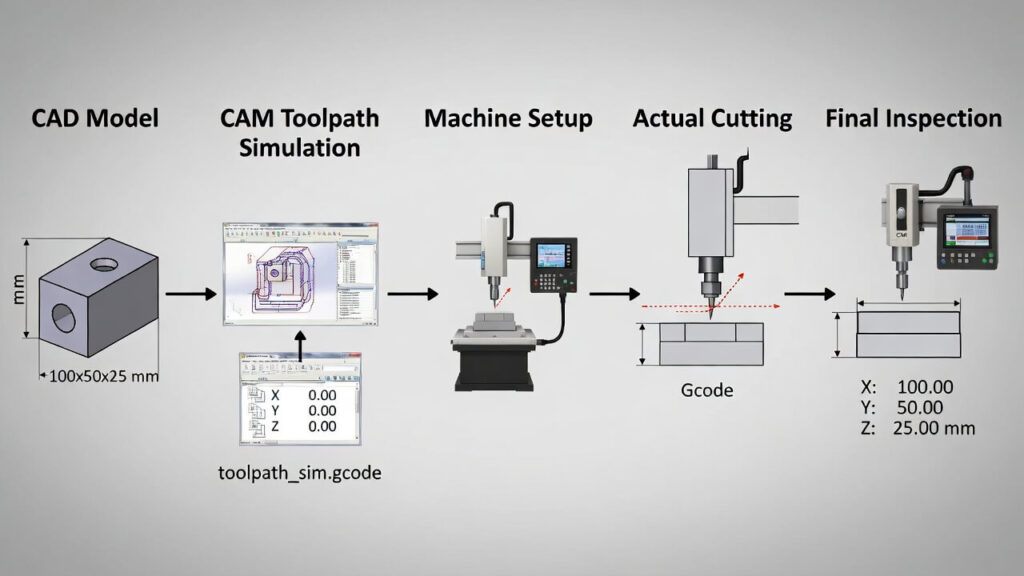
- CAD Design Phase Engineers build a precise 3D model, defining geometry, critical dimensions, GD&T tolerances, surface finish requirements (Ra values), and material specifications.
- CAM Programming Phase The model is imported into CAM software, where toolpaths are calculated for roughing (high material removal), semi-finishing, and finishing passes. Strategies include facing, pocketing, contouring, slotting, drilling, boring, and thread milling. G-code is generated, incorporating spindle speeds, feed rates, depth of cut, stepover, tool changes, and coolant commands.
- Machine Setup Phase The raw material (stock) is securely fixtured using vises, clamps, vacuum tables, or custom soft jaws. Tools are loaded into the spindle or ATC carousel. The machine is homed, work offsets (G54–G59) are established, and tool lengths are measured (manual or automatic probe).
- Machining Execution Phase The CNC controller interprets G-code and coordinates motion: the spindle rotates at programmed RPM (commonly 8,000–24,000 for finishing), while X, Y, Z (and A/B rotary) axes move simultaneously. Coolant or mist lubricates the cut, cools the tool/workpiece, and flushes chips away to prevent recutting and thermal distortion.
- Post-Processing & Quality Inspection Phase Parts are deburred, cleaned, and inspected using coordinate measuring machines (CMM), optical comparators, surface roughness testers, or on-machine probing systems to verify dimensions, form, and finish.
Critical machining parameters include spindle speed, feed rate, depth of cut, stepover percentage, tool engagement angle, and coolant type/pressure. Top Chinese facilities routinely achieve tolerances below ±0.005 mm and mirror-like finishes on demanding materials.
(Image suggestion: Step-by-step annotated flowchart showing CAD model → CAM toolpath simulation → machine setup → actual cutting → final inspection with CMM measurement.)
Core Components of a CNC Milling Machine
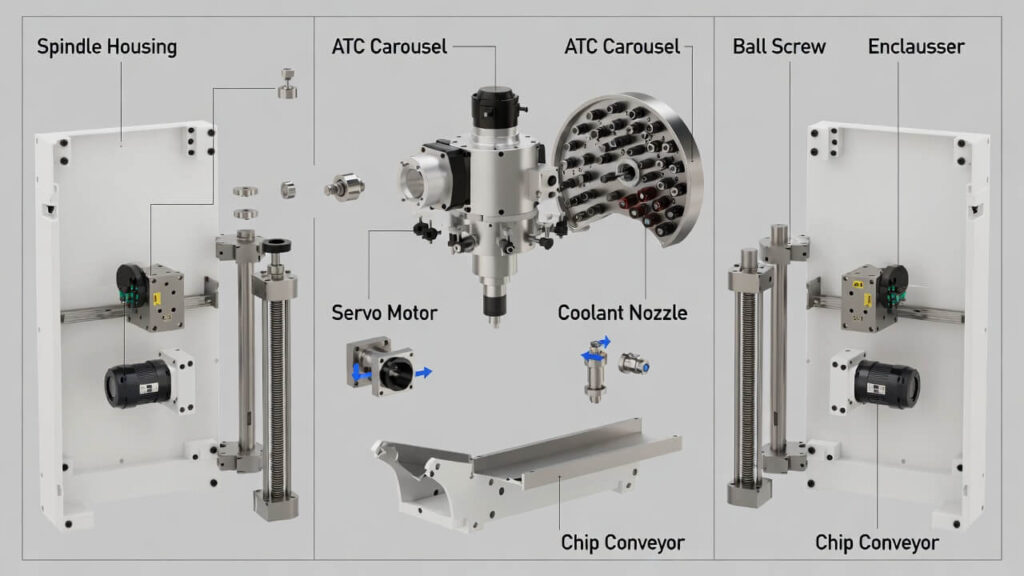
A modern CNC mill consists of several integrated high-precision components:
- Machine Base & Column — Heavy cast iron or polymer concrete to absorb vibration and maintain geometric stability.
- Spindle Assembly — High-rigidity, high-speed motor (direct-drive or belt-driven) with tool-holding taper (BT40, HSK63, CAT50). Speeds range from 6,000 to 30,000+ RPM.
- Linear Axes (X, Y, Z) — Precision ground ball screws or linear motors driven by AC servo motors with closed-loop encoder feedback for sub-micron positioning.
- Rotary Axes (4th/5th) — Trunnion or swivel heads for multi-angle machining on 5-axis machines.
- Automatic Tool Changer (ATC) — Side-mount or umbrella-style carousel storing 20–120 tools, enabling automatic swaps in 2–5 seconds.
- CNC Controller — Industrial-grade systems (Fanuc 0i/31i, Siemens 840D, Mitsubishi, Heidenhain) that interpret G-code, manage motion control, and interface with sensors.
- Coolant & Chip Management System — High-pressure flood coolant, mist systems, through-spindle delivery, and chip conveyors/scrapers to maintain thermal stability and surface quality.
- Enclosure & Safety Features — Full guarding, interlocks, emergency stops, and chip containment for operator safety.
(Image suggestion: High-resolution exploded-view illustration with clear labels for spindle, ATC carousel, ball screws, servo motors, coolant nozzles, chip conveyor, and enclosure.)
Types of CNC Milling Machines
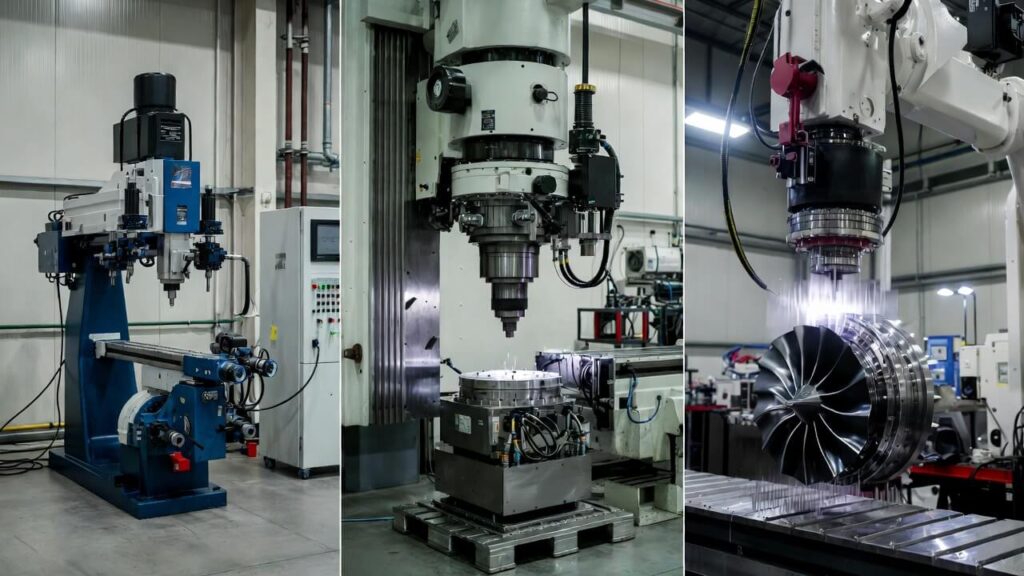
CNC mills are classified by configuration and capability:
| Type | Typical Axes | Key Advantages | Main Limitations | Typical Applications |
|---|---|---|---|---|
| Vertical Machining Center (VMC) | 3–5 | Easy workpiece loading, cost-effective | Less optimal for very heavy/large parts | General parts, molds, prototypes |
| Horizontal Machining Center (HMC) | 3–5 | Superior chip evacuation, multi-pallet systems | Larger footprint, higher initial cost | Automotive blocks, heavy castings |
| 5-Axis / Simultaneous Multi-Axis | 5+ | Complex geometries machined in one setup | Expensive, steeper programming curve | Aerospace blades, medical implants, turbines |
| Desktop / Benchtop Mill | 3 | Affordable, small footprint | Limited power, rigidity, and envelope | Education, hobby projects, small batches |
Chinese manufacturers often deploy a balanced mix of imported high-end 5-axis machines and cost-effective domestic units, providing flexibility for both prototype and production needs.
For deeper comparison, read 5-Axis CNC Milling Guide and CNC Lathe vs Mill.
Applications of CNC Milling
CNC milling is the go-to process for high-precision components across multiple industries:
- Aerospace & Defense — Turbine blades, structural brackets, engine mounts, satellite frames, missile components (see Aerospace CNC Machining and CNC Machining Defense).
- Automotive & Electric Vehicles — Cylinder heads, transmission cases, battery trays, motor housings, suspension parts, custom performance components (see Automotive Machining and CNC EV Motor Housings).
- Medical & Dental — Orthopedic implants, surgical instruments, prosthetics, dental abutments, endoscopic components (see Medical CNC Machining and Precision Medical Machining).
- Electronics & Semiconductor — Heat sinks, enclosures, connectors, PCB fixtures, robotic joints (see Electronics Machining and Connector Machining).
- Oil & Gas / Energy — Valve bodies, pump housings, downhole tools, renewable energy fittings (see Oil and Gas Machining).
- Other Sectors — Railway wheels & components, consumer electronics housings, musical instruments, custom jewelry, furniture hardware, UAV parts.
Material-specific examples include Aluminum CNC Machining, Stainless Steel CNC Machining, and Titanium CNC Machining.
Advantages and Disadvantages of CNC Milling
Advantages
- Superior Precision & Repeatability — Achieves tolerances as tight as ±0.002 mm and consistent surface finishes (Ra 0.4–1.6 µm typical), ideal for tight-assembly parts.
- Capability for Complex Geometries — 5-axis simultaneous machining allows undercuts, deep cavities, and organic shapes in a single setup, reducing handling errors and lead time.
- Broad Material Compatibility — Processes aluminum alloys (6061, 7075), stainless steel (304, 316, 17-4PH), titanium, Inconel, brass, copper, engineering plastics (PEEK, POM, nylon, ABS), composites, and more (see full list in CNC Machining Materials).
- Scalability from Prototype to Production — Efficient for 1–10 piece prototypes, 100–10,000 piece batches, and higher volumes (see Low-Volume CNC Machining and Rapid CNC Prototyping).
- Significant Cost & Time Advantages via Chinese Services — 30–50% lower pricing compared to North American or European shops, thanks to efficient supply chains, skilled labor, massive scale, and advanced equipment density in Shenzhen. Top providers like CNC Pioneer offer 3–7 day prototype turnaround, full material certification, English communication, secure file handling, and reliable global shipping/customs support.
- Fast Design Iteration — Digital workflow enables rapid modifications and quick re-runs without tooling changes.
- High Automation — Reduces labor dependency and human error for consistent quality in production runs.
Disadvantages
- Material Waste — Subtractive nature generates scrap (though most metals are recyclable and chips can be reclaimed).
- Initial Programming & Setup Time — Complex geometries require skilled CAM engineers (easily outsourced to professional services).
- High Capital Cost for In-House Ownership — Advanced 5-axis machines are expensive; mitigated by using contract manufacturers.
- Size & Weight Limitations — Very large or extremely heavy parts may require gantry-style or specialized machines (we handle envelopes up to 2,000 × 1,000 × 800 mm).
Market insights and cost benchmarks are available in Precedence Research CNC Milling Machines Market Report
Frequently Asked Questions (FAQ)
What does CNC milled mean? A part that has been accurately shaped and finished using a CNC milling process, typically implying high dimensional accuracy and good surface quality.
What is the difference between CNC milling and turning?
Milling uses a rotating tool to cut a stationary or linearly moving workpiece; turning rotates the workpiece against a stationary or linearly moving tool. See CNC Turning and Milling.
What materials can be CNC milled?
Aluminum, stainless steel, titanium, Inconel, brass, copper, PEEK, nylon, POM, ABS, composites, and many others.
Why choose a Chinese CNC milling service provider in 2026?
Significant cost reduction (30–50%), fast lead times (3–7 days for prototypes), access to advanced 5-axis and micro-machining equipment, strict international certifications, English-speaking support, secure IP handling, and reliable global logistics.
How fast can prototypes be delivered from Shenzhen?
Most qualified shops offer 3–7 working days for standard prototypes, depending on material availability, complexity, and finishing requirements.
What surface finishes can be achieved?
From as-machined (Ra 3.2 µm) to mirror-polished (Ra 0.2 µm) with additional post-processing. See Surface Finish Chart and Machining Surface Finish.
Conclusion
CNC milling is one of the most versatile and precise manufacturing technologies available today, powering innovation from rapid prototypes to high-volume production of critical components. By partnering with an established Shenzhen provider like CNC Pioneer, you gain access to world-class equipment, rigorous quality systems, competitive pricing, rapid turnaround, and hassle-free international delivery.
Ready to start your project? Upload your CAD files for an instant quote today. We support everything from material selection and machining to surface finishing, assembly, and global shipping.