If you’re involved in manufacturing, prototyping, or engineering, you’ve probably heard the terms CNC turning and CNC milling thrown around a lot.
But here’s the deal: These two processes are the backbone of modern precision machining. Choosing the wrong one for your project can lead to wasted time, higher costs, and parts that just don’t perform.
In this guide, I’m breaking down everything you need to know about CNC turning and milling—including what they are, how they differ, and which one is best for your next project.
Let’s dive in.
What Is CNC Turning and Milling?
CNC (Computer Numerical Control) turning and milling are subtractive manufacturing processes that use computerized controls to remove material from a workpiece and create precise parts.
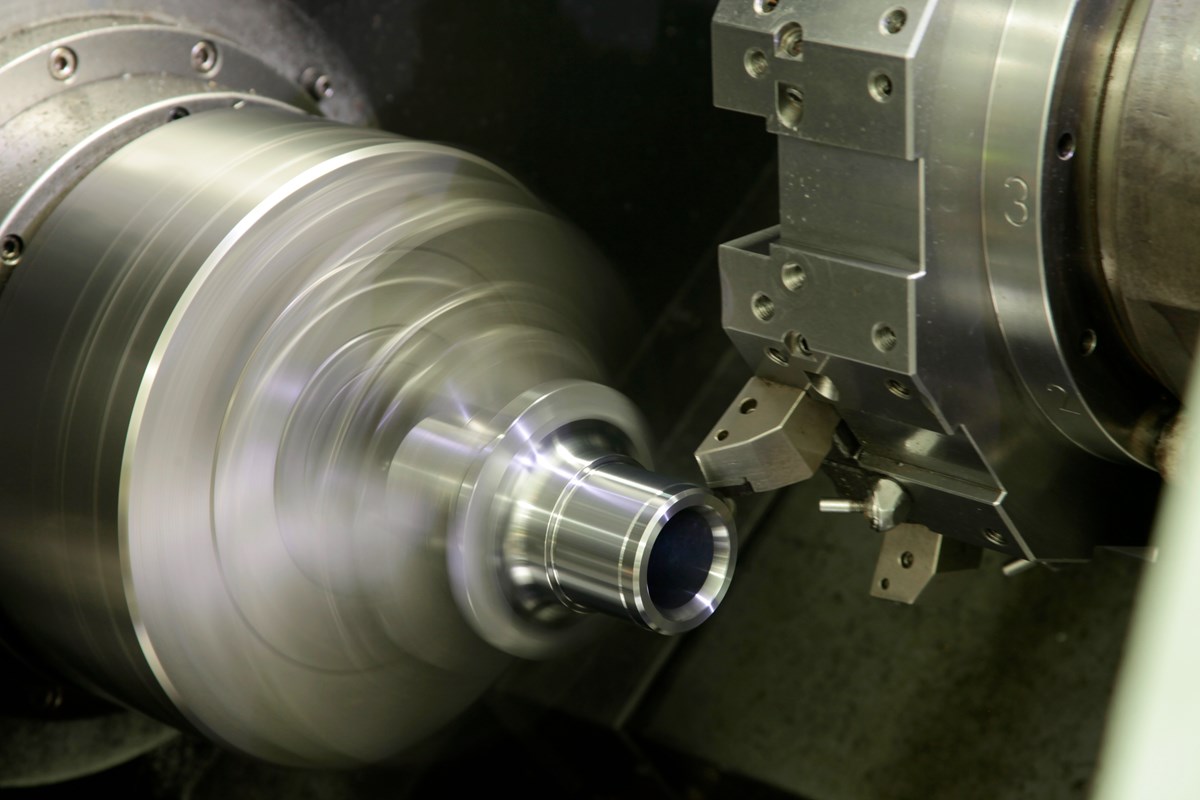
CNC turning involves rotating the workpiece at high speed on a lathe while a stationary cutting tool shapes it. This is perfect for creating cylindrical or symmetrical components like shafts, pins, and bushings.
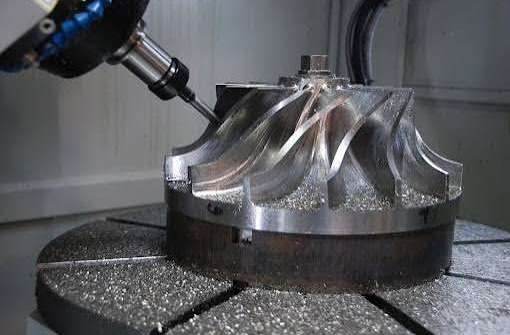
On the flip side, CNC milling keeps the workpiece stationary while a rotating multi-point cutting tool moves across multiple axes to carve out complex features like slots, pockets, and contours.
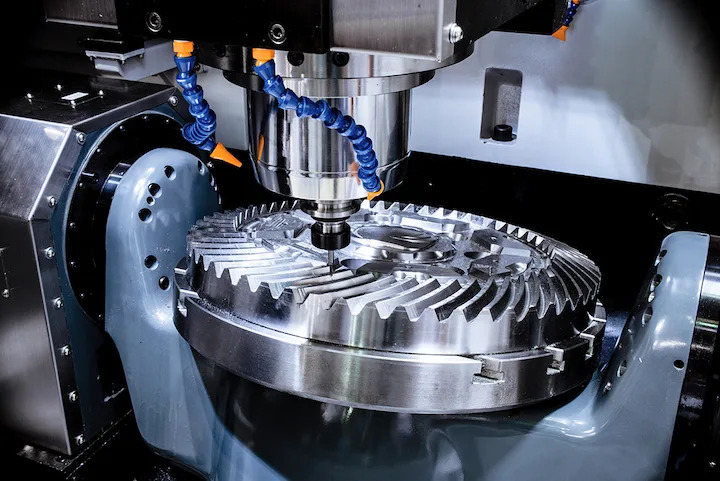 Both methods deliver incredible accuracy (often down to ±0.001 inches), repeatability, and efficiency compared to manual machining.
Why Understanding the Difference Matters
Here’s a quick story: I once saw a prototype shop quote a complex cylindrical part using only milling. The result? Triple the machining time and double the cost—because they ignored turning’s strengths.
Knowing the differences helps you:
- Choose the fastest, most cost-effective process
- Achieve better surface finishes and tolerances
- Minimize setups and secondary operations
- Scale from prototypes to high-volume production
Without further ado, let’s look at the key differences.
CNC Turning vs. CNC Milling: Key Differences
The core distinction boils down to motion:
- Turning: The workpiece spins; the tool stays mostly fixed.
- Milling: The tool spins; the workpiece stays fixed.
This leads to very different strengths.
Here’s a side-by-side comparison:
| Aspect | CNC Turning | CNC Milling |
|---|---|---|
| Primary Motion | Workpiece rotates | Cutting tool rotates |
| Best For | Cylindrical, round, symmetrical parts (e.g., shafts, bolts) | Complex, prismatic, flat features (e.g., enclosures, brackets) |
| Typical Axes | 2-4 axes (with live tooling up to 5+) | 3-5 axes (common for intricate work) |
| Production Speed | Faster for high-volume round parts | More versatile but slower for details |
| Surface Finish | Excellent on diameters | Superior on flat surfaces and contours |
| Cost for Volume | Lower for rotational symmetry | Higher for non-round complexity |
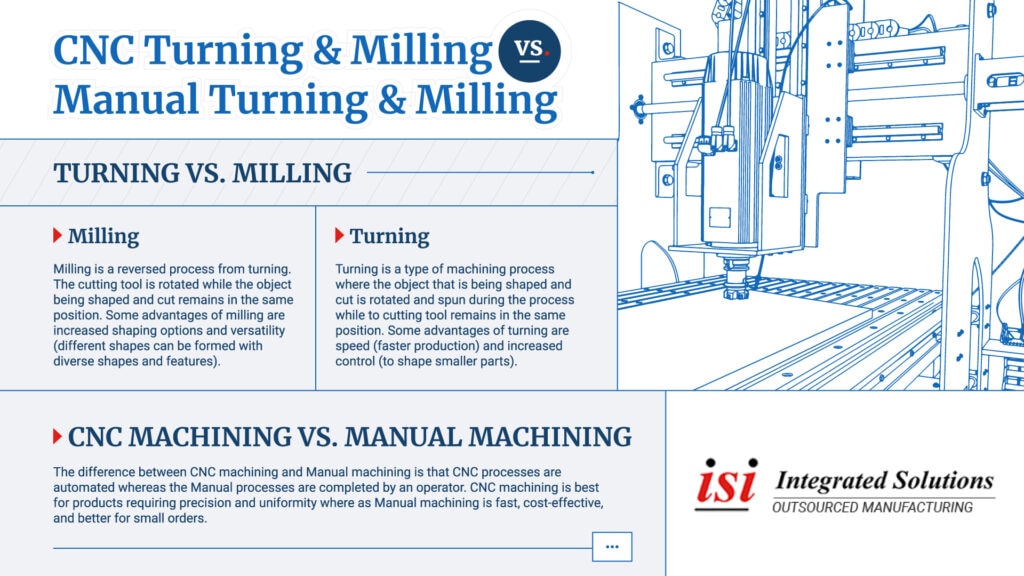 CNC Turning and Milling vs. Manual Turning and Milling
Pro Tip: If your part is mostly round with some milled features, consider a mill-turn machine (more on that later).
When to Use CNC Turning
Go with turning when:
- Your part has rotational symmetry
- You need high-volume production of cylindrical components
- Tight tolerances on diameters are critical
- Material removal is primarily along the axis
Common applications:
- Automotive: Pistons, axles, valves
- Aerospace: Turbine shafts, landing gear components
- Medical: Surgical instruments, implants
When to Use CNC Milling
Choose milling for:
- Complex geometries with pockets, holes, and threads
- Flat surfaces or angular features
- Low-to-medium volume custom parts
- Prototyping with frequent design changes
Common applications:
- Electronics: Housings, heat sinks
- Tooling: Dies, molds, fixtures
- Defense: Structural brackets, weapon components
The Rise of Mill-Turn Machines
Modern shops are increasingly turning to mill-turn centers (also called multitasking machines). These combine turning and milling in one setup—with live tooling, multiple spindles, and up to 9 axes.
Benefits:
- Fewer setups = less error and faster throughput
- Complete parts in one machine (done-in-one)
- Ideal for complex aerospace and medical parts
If your project involves both round and prismatic features, mill-turn is often the smartest choice.
Final Thoughts
CNC turning and milling aren’t competitors—they’re complementary tools in precision manufacturing.
Pick turning for speed and efficiency on cylindrical parts.
Opt for milling when you need versatility for complex shapes.
And for the best of both worlds? Go with a mill-turn setup.
The right choice depends on your part geometry, volume, tolerances, and budget. When in doubt, consult a machining expert early in the design phase—it’ll save you big in the long run.
What’s your next machining project? Drop a comment if you have questions about turning vs. milling!