A CNC lathe is a precision machine tool that automates the turning process to create cylindrical parts with high accuracy. By rotating the workpiece against a stationary cutting tool, it removes material to form shapes like shafts, bushings, and pipes. CNC stands for Computer Numerical Control, meaning the machine follows digital instructions for consistent results. These lathes are essential in industries requiring rotational symmetry, handling materials such as metals, plastics, and composites. This guide covers how CNC lathes work, their types, differences from other machines, applications, design tips, and more. For instant insights into related services, check our CNC Machining Services.
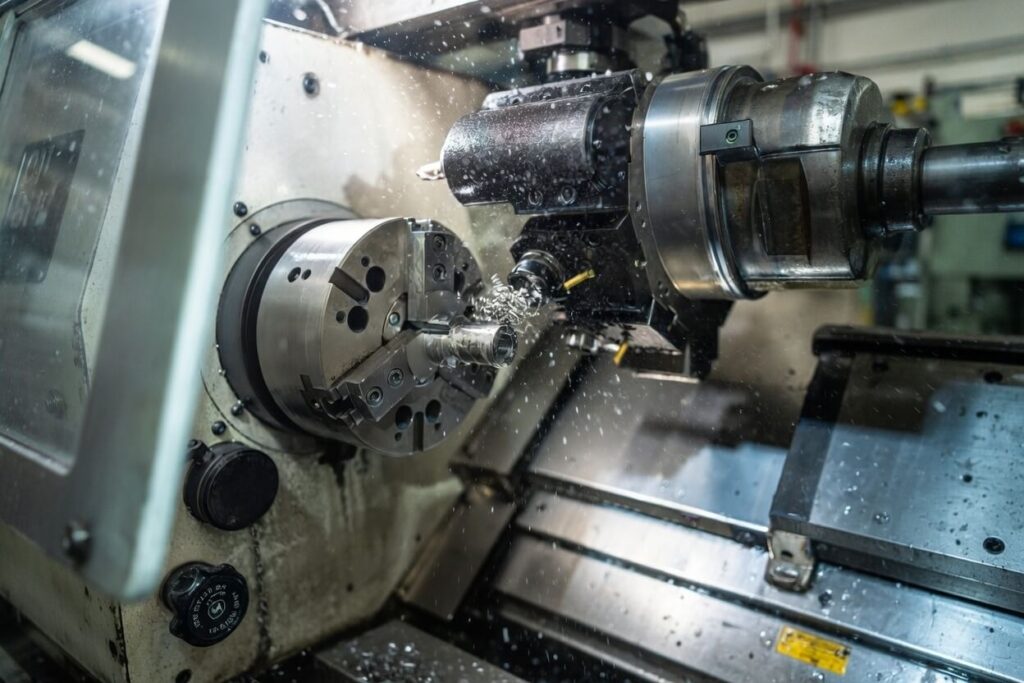
This photo depicts a typical CNC lathe actively machining a metal workpiece, with visible coolant spray and chip removal, highlighting the spindle chuck and cutting tool in close-up action.
How do CNC lathes work?
CNC lathes operate through a combination of software and mechanical components to shape materials precisely. The process typically involves four key steps:
- Create a CAD model: Design the part using Computer-Aided Design (CAD) software, specifying dimensions and features.
- Convert to CNC program: Use Computer-Aided Manufacturing (CAM) software to generate G-code or M-code that dictates tool paths, speeds, and feeds.
- Set up the machine: Secure the workpiece in the chuck or collet, load tools into the turret, and input the program into the CNC controller.
- Begin machining: The spindle rotates the workpiece while the tool moves along axes to perform operations like turning, facing, or threading.
During operation, sensors provide feedback for adjustments, and coolant systems manage heat. Advanced models incorporate live tooling for additional milling. For programming details, see our CNC Programming Basics .
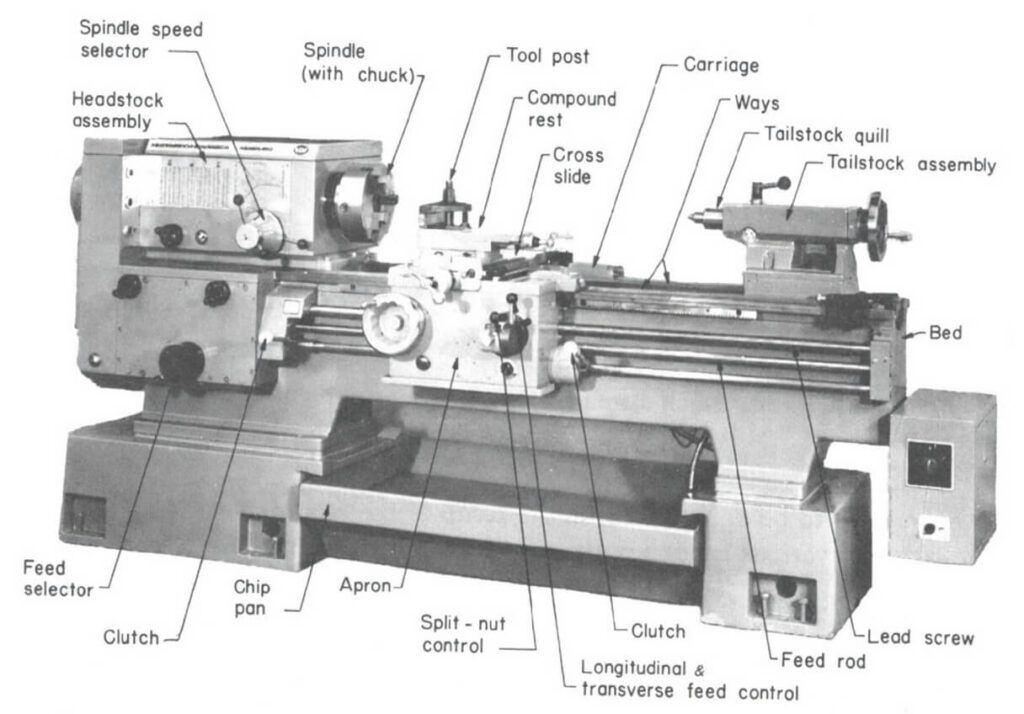
This detailed schematic labels essential parts of a lathe, including the headstock assembly, carriage, tailstock, bed, and feed mechanisms, providing a clear overview of the machine’s structure.
What’s the difference between a CNC lathe and CNC milling?
While both are CNC processes, lathes and mills differ in workpiece movement and applications. CNC lathes rotate the material against a fixed tool, ideal for cylindrical parts like rods or tubes. In contrast, CNC mills rotate the tool against a stationary workpiece, suited for flat or irregular shapes like brackets or enclosures. Lathes excel in symmetry and threading, while mills handle complex 3D contours. For more on milling, explore What is CNC Milling?.
CNC lathes also contrast with manual lathes: manuals require operator skill for each adjustment, leading to variability, whereas CNC offers automation for repeatability and efficiency.
What are the types of CNC lathes?
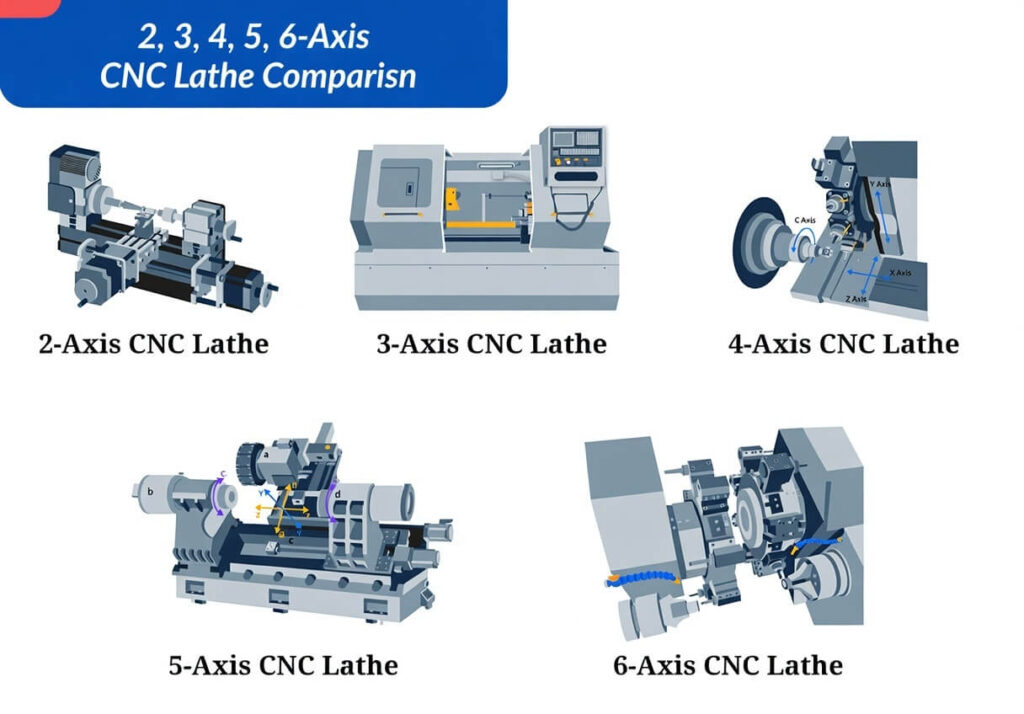
CNC lathes vary by axis configuration and design to suit different complexities.
2-axis CNC lathes: Basic models controlling X (radial) and Z (longitudinal) axes for simple operations like turning and facing. Cost-effective for high-volume cylindrical parts.
3-axis CNC lathes: Add a C-axis for spindle rotation, enabling milling with live tools for slots or off-center holes.
4-axis CNC lathes: Include a Y-axis or dual turrets for off-axis work and simultaneous machining, enhancing productivity.
5-axis and multi-axis CNC lathes: Feature additional axes like B or sub-spindles for intricate geometries in one setup, common in aerospace.
Other variants include horizontal CNC lathes for standard use, vertical CNC lathes for large diameters, Swiss-type lathes for precision slender parts, and multi-spindle lathes for mass production. For specialized options, visit Swiss CNC Lathes.
This infographic illustrates a variety of CNC machines, including lathes, milling machines, routers, and more, with labeled images showcasing different types and their configurations.
What kinds of parts can you make with CNC lathes?
CNC lathes produce a wide array of parts, especially those with rotational features.
- Aerospace components like turbine shafts and landing gear pins.
- Automotive parts such as engine pistons, axles, and gears.
- Medical devices including implants, surgical instruments, and prosthetics.
- Electronics hardware like connectors, housings, and threaded pins.
- Oil and gas equipment such as valves, flanges, and drill bits.
- General manufacturing items from prototypes to furniture spindles.
These machines handle materials like aluminum, steel, titanium, plastics, and wood. Limits include workpiece length (up to several meters on large models) and diameter, with tolerances down to ±0.001 mm. They’re versatile for prototyping and production.
How do you design parts for CNC lathes?
Effective design optimizes machinability, cost, and quality. Key guidelines include the following:
- Minimize setups: Design for single-sided access to reduce repositioning and errors.
- Incorporate radii: Add fillets at internal corners to accommodate tool diameters, avoiding sharp edges.
- Avoid thin walls: Maintain wall thicknesses above 0.8 mm to prevent vibration and breakage.
- Standardize features: Use common thread sizes and hole depths for faster tooling.
- Consider material: Softer metals like aluminum machine quicker; harder ones, like stainless steel, require slower feeds.
- Part size limits: Ensure dimensions fit machine envelope, typically up to 500 mm diameter.
- Software tips: Use CAD features like revolves for symmetry and simulate in CAM to check tool paths.
These practices lower costs by 20-50% and speed production.
How do you get the most out of CNC lathes with CNC Pioneer?
To maximize efficiency, focus on streamlined designs and smart material choices. Simplify geometries to shorten cycle times, select cost-effective alloys, and batch similar parts for economies of scale. Integrate automation like bar feeders for unattended operation. Regular maintenance and tool calibration ensure precision. At CNC Pioneer, our network offers rapid quotes and expert advice to optimize your projects. Explore AI CNC machining for more.
Frequently asked questions
What is the history of CNC lathes?
Originating from ancient turning tools, modern CNC evolved in the 1950s with numerical control, advancing to multi-axis systems today.
What are the key components of a CNC lathe?
Include headstock, spindle, bed, carriage, tool turret, tailstock, and control panel for coordinated operation.
What advantages do CNC lathes offer?
High precision, efficiency, versatility, cost savings, and safety over manuals
What are future trends in CNC lathes?
AI integration, hybrid manufacturing, IoT, and multi-axis enhancements for smarter production.
How do CNC lathes compare to manual ones?
CNC provides automation and repeatability, while manuals suit one-offs but demand more skill