The Short Answer
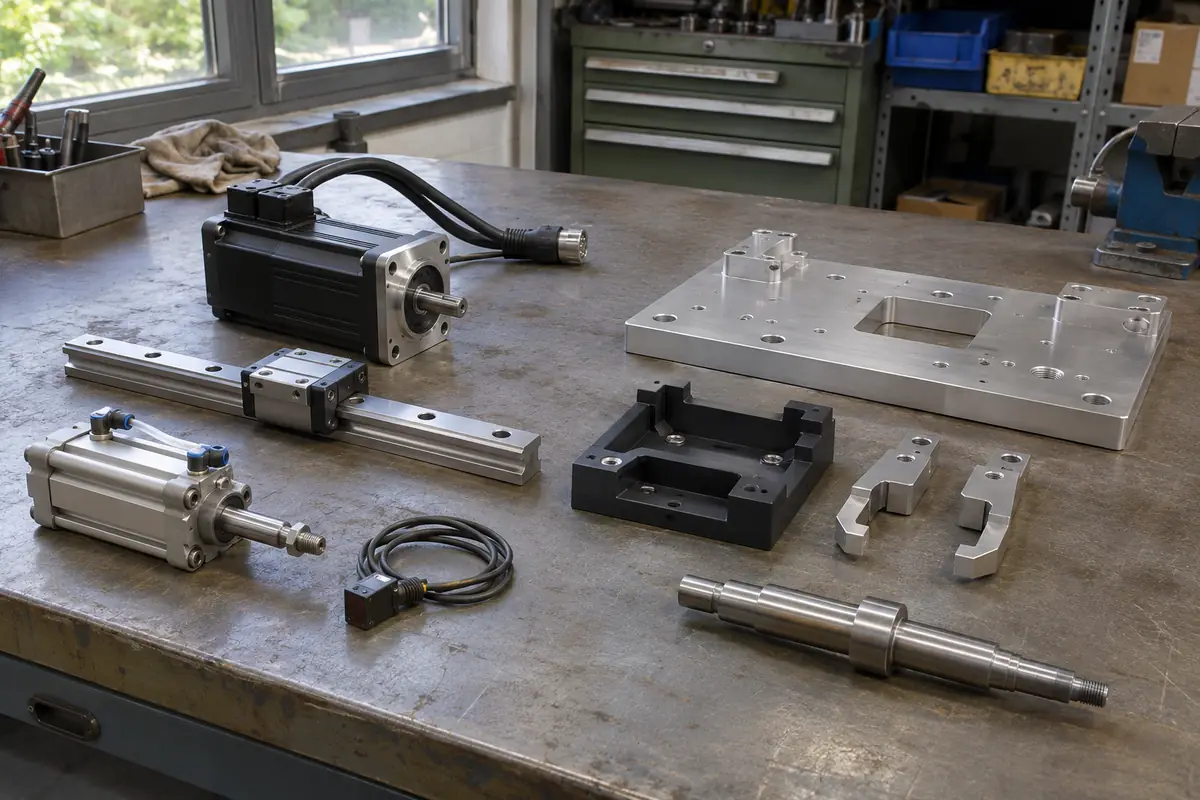
In a special purpose machine, the parts that move, sense, control or fasten are usually bought. The parts that hold the product, locate the components and give the machine its shape are machined or fabricated for that one machine.
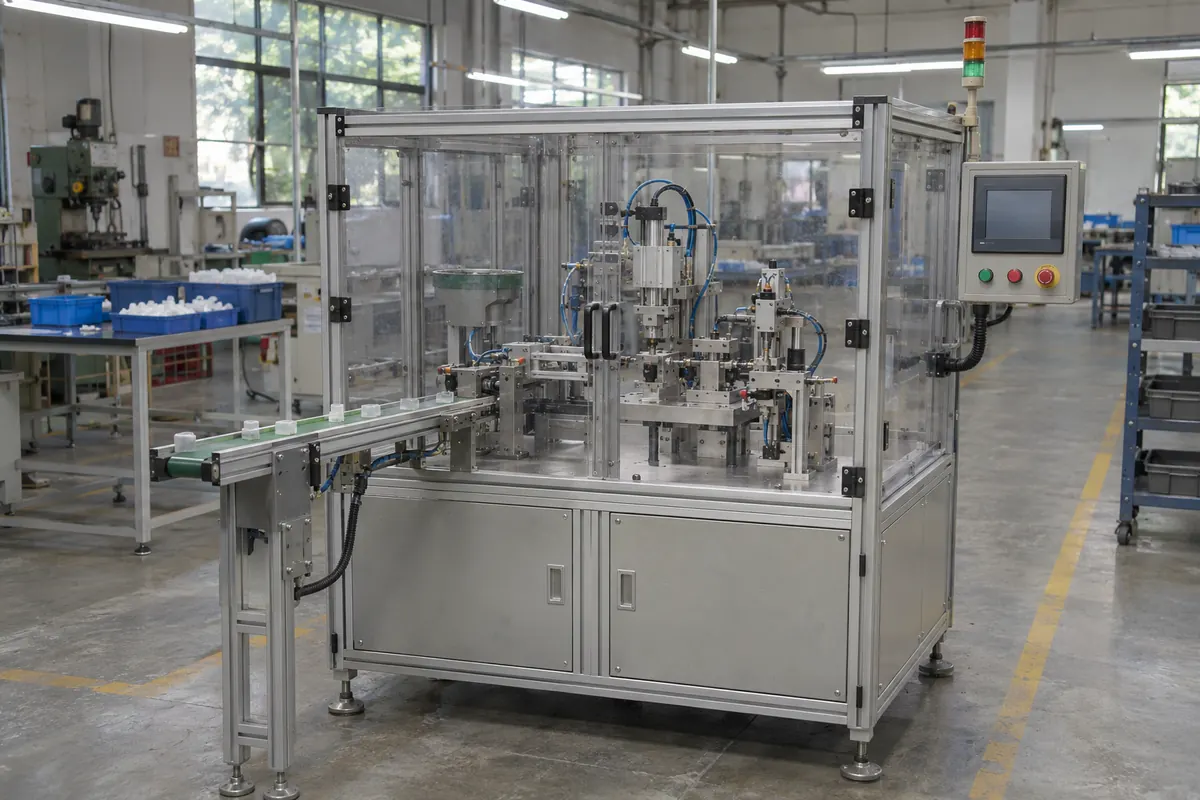
A special purpose machine, or SPM, is built for one production task on one product: pressing a bearing into a particular housing, testing a particular valve body, stacking a particular battery cell. Because nobody else needs exactly that machine, it cannot be bought ready-made. It can, however, be assembled largely from standard components, and that is what nearly every builder does.
The result is a BOM with two very different halves. One half is a list of catalogue part numbers from motor, pneumatics, sensor and fastener suppliers. The other half is a stack of drawings, each describing a plate, bracket, shaft or nest that exists only for this machine. On many SPMs the drawn half drives much of the build schedule, while the catalogue half carries much of the cost.
Knowing where the line falls, and why, saves time in design, in purchasing and years later when a part wears out.
What Gets Bought
Builders buy anything a specialist manufacturer already makes better, cheaper or with a warranty attached. In practice that covers most of the machine's working components.
| Category | Typical items | Why it is bought |
|---|---|---|
| Motion | Servo and stepper motors, gearboxes, linear guides, ball screws, linear modules, rotary indexers | Ground, hardened and matched in plants built for it; accuracy and preload classes are specified by the maker |
| Pneumatics and vacuum | Cylinders, valves, valve terminals, filter-regulators, fittings, vacuum ejectors and cups | Standardized sizes, sealed assemblies, quick replacement |
| Power transmission | Couplings, timing belts, pulleys, chains, clutches | Rated for torque and life by the maker |
| Sensing and vision | Proximity, fiber and photoelectric sensors, encoders, cameras, force sensors | Specialist electronics, calibration and documentation |
| Control and electrical | PLCs, drives, HMIs, power supplies, cables, connectors | Software ecosystems, certification, spare parts worldwide |
| Safety | Light curtains, door interlocks, safety relays and controllers, emergency stops | Documented safety performance; suitability still needs validation in the machine |
| Structure | Aluminum extrusion profiles and their brackets, leveling feet, casters | Fast to build and modify, cut to length to order |
| Standard hardware | Screws, dowel pins, bearings, retaining rings, springs, handles | Made in huge volumes to ISO and DIN standards |
The motion components deserve a closer look, because they are where a builder is most tempted to make something itself and usually regrets it. A linear guide rail is hardened, ground and sorted into accuracy and preload classes. A ball screw is rolled or ground to a lead accuracy class. A machine shop can cut a good shaft, but it cannot match a rail and carriage set at the price a guide maker sells one.
Standard hardware follows the same logic. Hardened dowel pins to ISO 8734 and socket head cap screws to ISO 4762 are widely available with defined dimensional requirements. Specify the material, hardness and strength class where needed. A custom pin may still be appropriate, with material certification and inspection requirements agreed when ordering.
What Gets Machined
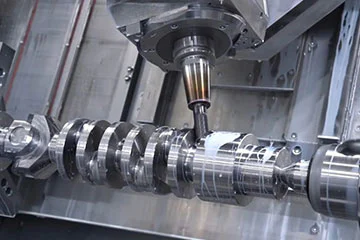
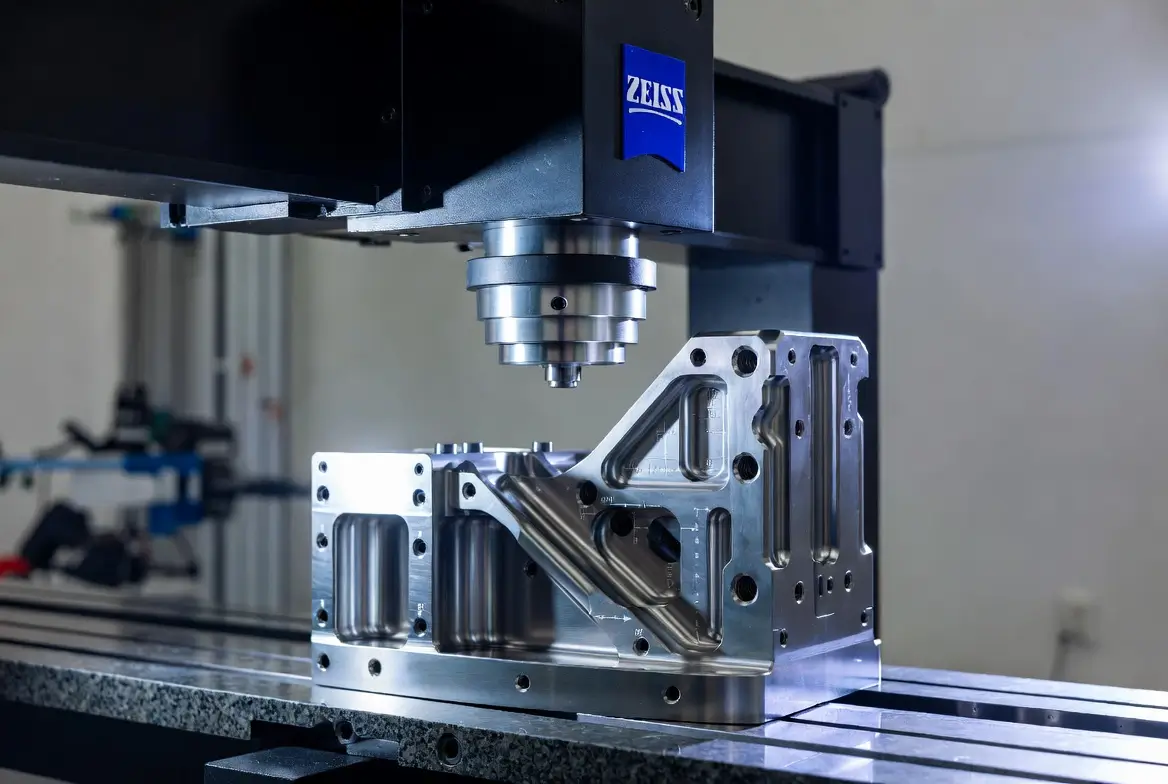
Machined parts are the ones whose shape is set by this machine and this product. Nobody stocks them, because nobody else needs them.
Most of them fall into a few groups. Base plates and tooling plates carry the whole mechanism and set its alignment. Mounting plates, risers and brackets put each bought component at the right height and angle: a riser under a linear guide, a bracket for a cylinder, a plate that joins a carriage to a gripper. Motor mounts and bearing housings hold rotating parts on their axes. Shafts appear wherever a catalogue shaft has the wrong length, step or end feature.
Then there are the parts that touch the product. Nests, fixtures, gripper fingers, press tooling and test adapters are shaped around the customer's part, and they are the most machine-specific items on the drawing list. Manifolds that bring air or vacuum close to the tooling, and adapter flanges between a robot wrist and its gripper, round out the usual set.
Almost every one of these parts is an interface. Its job is to connect a bought component to the frame, or the product to the machine, and its critical dimensions come from whatever it connects. That is why machined parts on an SPM tend to have a handful of tight features and many loose ones, and why they are usually machined to drawing in small quantities from aluminum, steel or engineering plastic.
Fabricated parts: made, but not machined
A third group is often forgotten when the BOM is split into make and buy. Welded steel frames, sheet-metal guards, cable trays, polycarbonate windows and electrical cabinet panels are made for the machine but not on a milling machine. They go to fabrication shops, laser cutters and sheet-metal benders, and they need their own drawings and their own suppliers. A welded frame that carries precision components is often welded first and then machined on its mounting faces, so it belongs to both worlds.
The Gray Zone: Parts That Can Go Either Way
Some parts sit on the line between bought and machined, and the answer changes from machine to machine. Configurable component catalogues have moved this line a long way. A designer can now order a shaft, pin, spacer or simple bracket by choosing dimensions and end features from a menu, and receive it as a standard item.
| Part | Bought when | Machined when |
|---|---|---|
| Shafts | A configurable shaft offers the diameter, tolerance, length and end features needed | Several steps, keyways, odd lengths or a special material are required |
| Locating pins and bushings | A standard size and tip shape will do | The shoulder, length or tip has to suit a particular fixture |
| Spacers and standoffs | A standard length works | The spacer also locates something or needs a non-standard height |
| Brackets and angle plates | A configurable bracket fits the space | The bracket has to hold several components in fixed relation to each other |
| Linear axes | A complete linear module meets the stroke, load and accuracy | Size, stiffness or packaging calls for an axis built from rails, a screw and machined plates |
| Frames | Loads are light and the layout may change | Stiffness, vibration or precision calls for a welded or machined plate frame |
| Manifolds | A standard valve terminal or manifold block fits | Many ports are needed in a tight space right next to the tooling |
The trade-off is usually the same. A catalogue part ships quickly, costs little and can be reordered by part number years later. A machined part fits the space exactly and can combine several functions in one piece, which cuts assembly time and the number of joints that can come loose. Where a single machined bracket replaces three catalogue parts and their screws, machining often wins even on cost.
How Machine Builders Decide Make or Buy
A useful working rule fits in one line: buy what moves, senses and protects; make what holds, locates and connects. The harder cases get settled by a few questions, roughly in this order.
- Does a specialist already make it? Guides, screws, motors, sensors and safety devices are bought even when a shop could make something similar, because the bought item comes with rated performance, manufacturer documentation and, where applicable, certification.
- Is the shape set by the product? Nests, fingers, fixtures and press tooling follow the customer's part, so they are made.
- Which is faster right now? Configurable parts usually ship faster than a drawn part. The reverse also happens: when a catalogue item is on backorder, a machined replacement can arrive first where the required material, geometry and performance can be verified.
- Will it wear out? Wear parts such as pads, fingers and stops are replaced over the machine's life. Bought wear parts reorder by number; machined ones need a drawing on file and ideally a few spares shipped with the machine.
- How many machines will be built? A drawing costs design and checking time once. Spread over several copies it costs little; for a one-off, a configurable part that needs no drawing can be cheaper overall.
- Who maintains the machine afterwards? A plant's maintenance team can replace a catalogue component from a local distributor. For machines shipped abroad, builders often choose component brands that are stocked in the customer's country for this reason.
The last question is easy to overlook during design and expensive to get wrong. A machine that stops for a sensor nobody can buy locally is down for as long as shipping takes.
Bought Parts That Get Machined Anyway
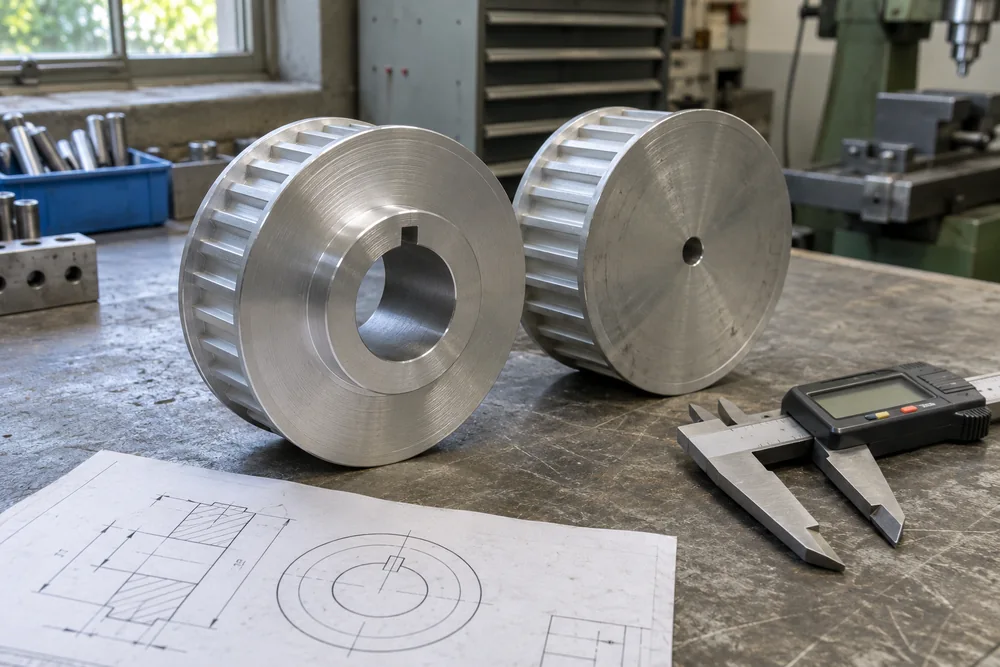
A fair number of SPM parts start as catalogue items and finish in the machine shop. They are easy to miss when the BOM is split, because they appear on both lists.
Pulleys and sprockets are a common case. Many are sold with a small pilot bore, and the builder bores them to the shaft size and adds a keyway or set-screw holes. Aluminum extrusion arrives cut to length but still needs tapped ends and drilled holes for connectors, and sometimes a milled pocket for clearance. Hardened and ground linear shafting is bought as bar and then has its ends turned, threaded or drilled, which takes more care than ordinary steel because of the hard case. Gripper makers sell blank fingers, often called soft jaws, that are machined to the product's profile after delivery.
These parts need their own part number and their own drawing. The drawing names the catalogue item as the starting material and shows only the added features, for example "make from pulley XX-123, bore Ø12 H7, keyway to DIN 6885". Treated that way, the part can be reordered and remade years later. Treated as a plain catalogue item, it turns up as a pulley with the wrong bore on the day it is needed.
How the Split Shows Up in the BOM and Spare Parts
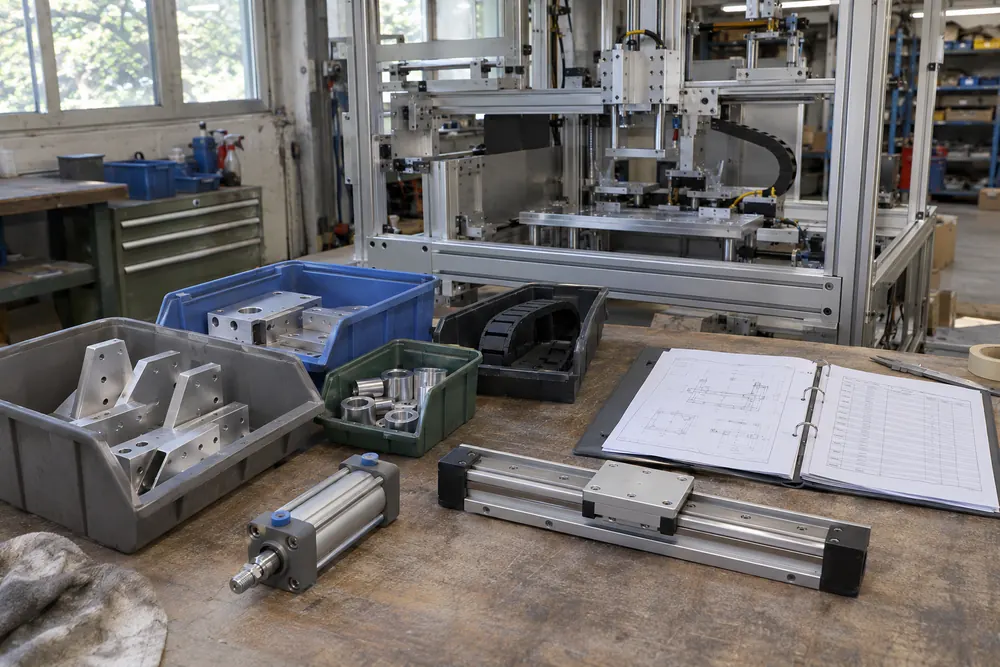
The make-or-buy split shapes the paperwork as much as the machine. A well-kept SPM BOM records the two halves differently.
Bought items are identified by manufacturer and manufacturer part number, with the supplier and quantity alongside. Machined and fabricated items are identified by drawing number and revision, plus material, finish and quantity. Modified catalogue parts carry a drawing number of their own and reference the catalogue item they start from. Mixing these conventions, for instance listing a machined bracket by description only, is how wrong parts get ordered for the second machine.
The spare-parts list draws from both halves. Bought wear items such as vacuum cups, belts, seals and cylinder repair kits are listed by catalogue number. Machined wear items such as nests, gripper fingers and wear pads are listed by drawing number, and builders often ship a set with the machine because they cannot be bought off a shelf. Long-lead bought items that would stop the machine, a servo drive for example, are worth listing even if they rarely fail.
Over the life of the machine the two halves age differently. Bought components get discontinued, and the maintenance team has to find replacements that fit the same mounting and connections. Machined parts can often be reproduced from retained drawings, provided the material, process and inspection requirements remain available and clearly specified. For a machine expected to run for many years, the archive of STEP models and revised PDF drawings is one of the most valuable things a builder hands over, and the drawings should reflect the machine as it was finally built, not as first designed.
FAQ
What is a special purpose machine (SPM)?
An SPM is a machine designed for one production task on one product, such as pressing, assembling, testing or marking a particular part. It is built once or a few times, unlike a standard machine sold from a catalogue. Suppliers in China often call the same category non-standard automation equipment.
What share of an SPM is bought and what share is machined?
There is no fixed ratio. A machine built around a robot and a standard linear module may be mostly bought, while a press or test fixture with heavy custom tooling may be mostly machined. Counting part numbers and counting cost also give very different answers, since a few bought items such as robots and servo systems can carry much of the price.
Are aluminum extrusion frames bought or made?
Both. The profiles and connectors are bought, cut to length by the supplier, and then drilled, tapped or milled for the specific layout. Welded steel frames are fabricated, and their mounting faces are often machined after welding.
Are gripper fingers bought or machined?
The gripper body is bought. The fingers are usually machined to the product's shape, either from bar stock or from blank fingers the gripper maker supplies for that purpose.
Can catalogue parts replace machined parts to cut cost?
For simple round parts and plain brackets, often yes, and configurable catalogues make this easy. Where one machined part replaces several catalogue parts and their fasteners, the machined part is often the cheaper option once assembly time is counted.
Which SPM parts most often delay a build?
Long-lead bought items such as robots and servo systems, and machined parts whose drawings were released late. The machined parts released last are usually the ones that hold the build up. Experienced builders release the plates and brackets that carry long-lead components first, and finish detailing the product-contact tooling while those first parts are already being cut.