What Automation Equipment Means
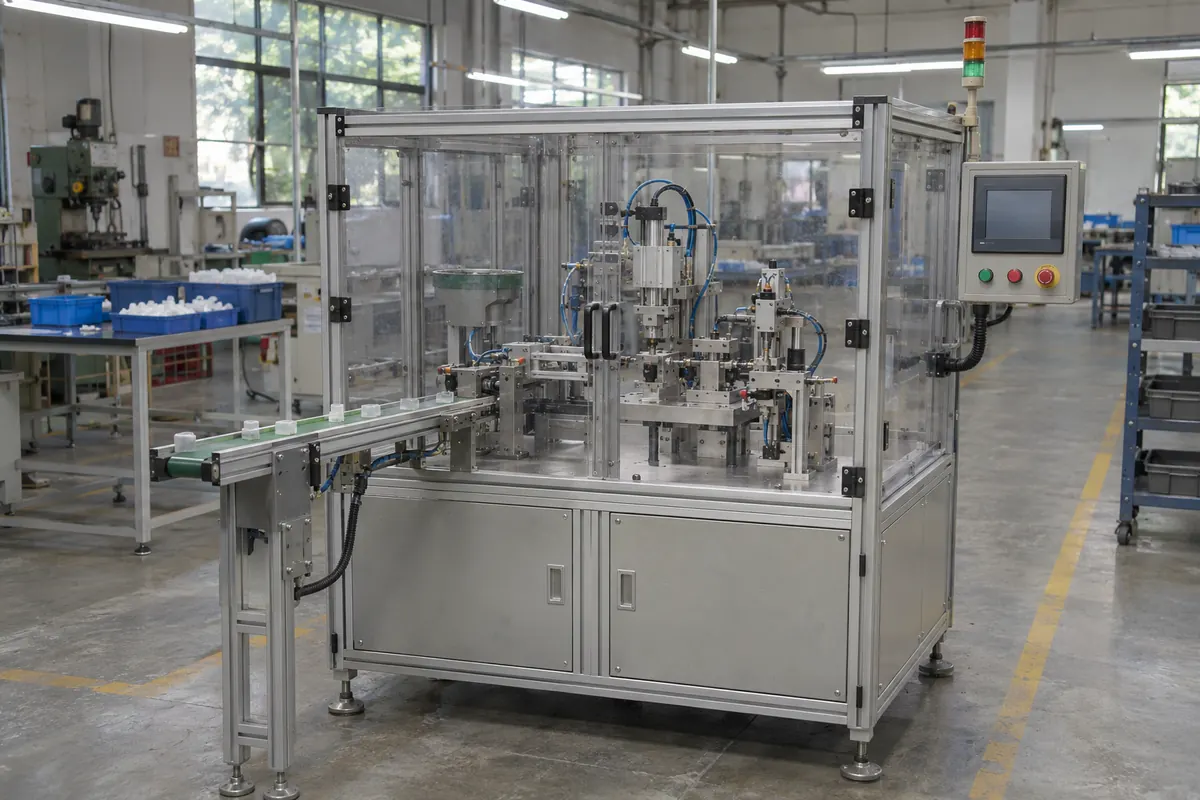
Automation equipment is any machine that carries out a production step, such as moving, joining, testing or packing a product, with little or no hand work from an operator. It covers everything from a single pneumatic press behind a light curtain to an assembly line several dozen metres long.
The common thread is a controller deciding what happens next. A drill press worked by an operator is a machine tool. Once the same drilling head sits behind a conveyor, with a cylinder clamping the part and a PLC starting the cycle when a sensor sees it, the result is automation equipment.
Machines are often described by how much the operator still does. At a semi-automatic station the operator loads the part and presses two start buttons, and the machine does the rest. A fully automatic machine is fed by a conveyor, a bowl feeder or a robot, and keeps running until a bin is empty or a fault stops it.
Industrial robots are the most visible part of the picture. The International Federation of Robotics counted 542,000 new robot installations worldwide in 2024 and an operational stock of 4,664,000, according to its World Robotics 2025 press release. Plenty of automation equipment contains no robot at all, though. Feeders, indexing tables, presses, test fixtures and conveyors do much of the work on a typical line.
Fixed, Programmable and Flexible Automation
Textbooks split automation into three kinds according to how easily the equipment switches to a different product. The split is worth knowing mainly because it predicts what a machine will cost and how long it stays useful.
Fixed automation does one job, with the sequence built into the hardware: cams, dedicated tooling, a transfer line moving one part design through a set of stations. It is fast and cheap per part, and very hard to change. A capping machine that has run the same bottle for years is a typical case.
Programmable automation can be set up for a new product by changing the program and some of the tooling. CNC machine tools, industrial robots and PLC-controlled stations with selectable recipes belong here. Each changeover takes time, so this kind of equipment suits batch production.
Flexible automation goes a step further and runs a mix of variants with little or no changeover loss. The machine typically reads which variant is arriving, from a barcode or an RFID tag, and calls up the matching program and tooling on its own. A robot cell with a tool changer that welds several bracket variants in any order is a good example.
| Type | Switching to a new product | Best suited to | Examples |
|---|---|---|---|
| Fixed | Rebuild or new tooling | One product at very high volume | Transfer lines, cam-driven assembly machines, capping machines |
| Programmable | New program and tooling, with downtime | Batches of different products | CNC machines, robot cells, recipe-driven test stations |
| Flexible | Automatic, little or no downtime | Mixed variants on one line | Robot cells with tool changers, vision-guided handling |
Real machines rarely sit neatly in one column. A battery module line might use fixed mechanics for pressing, programmable servo axes for positioning and a vision system that adapts to each cell. Some authors also add a fourth category, integrated automation, for whole plants coordinated by software.
The more flexible the equipment, the more of its value sits in software rather than dedicated tooling. That shifts where a machine builder spends effort. A flexible cell needs quick-change nests and well-kept recipes, while fixed equipment needs hardware that survives an enormous number of identical cycles.
Standard vs Custom Automation Equipment
A second way to sort automation equipment is by who it was designed for. Standard machines are built in series and sold from a catalogue: labelers, cartoners, SMT pick-and-place machines, CNC machining centers, standard conveyors. Custom machines, also called special purpose machines or non-standard automation, are designed around one customer's product and process and usually built once or a few times.
| Aspect | Standard equipment | Custom equipment |
|---|---|---|
| Designed for | A process many factories share | One product and one process |
| Fit to the product | Adapted with change parts and settings | Built around the product from the start |
| Lead time | Shorter, since the design already exists | Longer, since design, build and debugging all happen for this machine |
| Technical risk | Low; the design is proven | Higher, especially on the first machine |
| Spare parts and support | Stocked by the maker | Depends on the builder's documentation and records |
| Typical buyer | Plants with a common process step | Plants with a product no standard machine handles |
The choice usually makes itself. If a standard machine can handle the product with a change kit, it is often cheaper and faster. Custom equipment earns its place when the product has an awkward shape, a process step nobody sells a machine for, or a takt time and footprint that standard machines cannot meet.
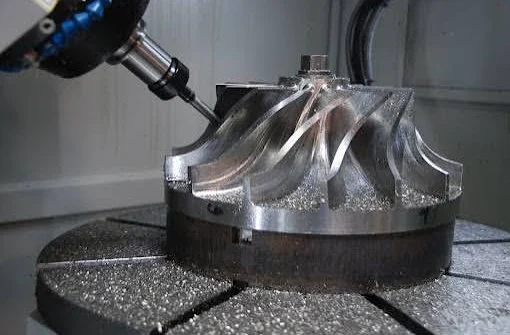
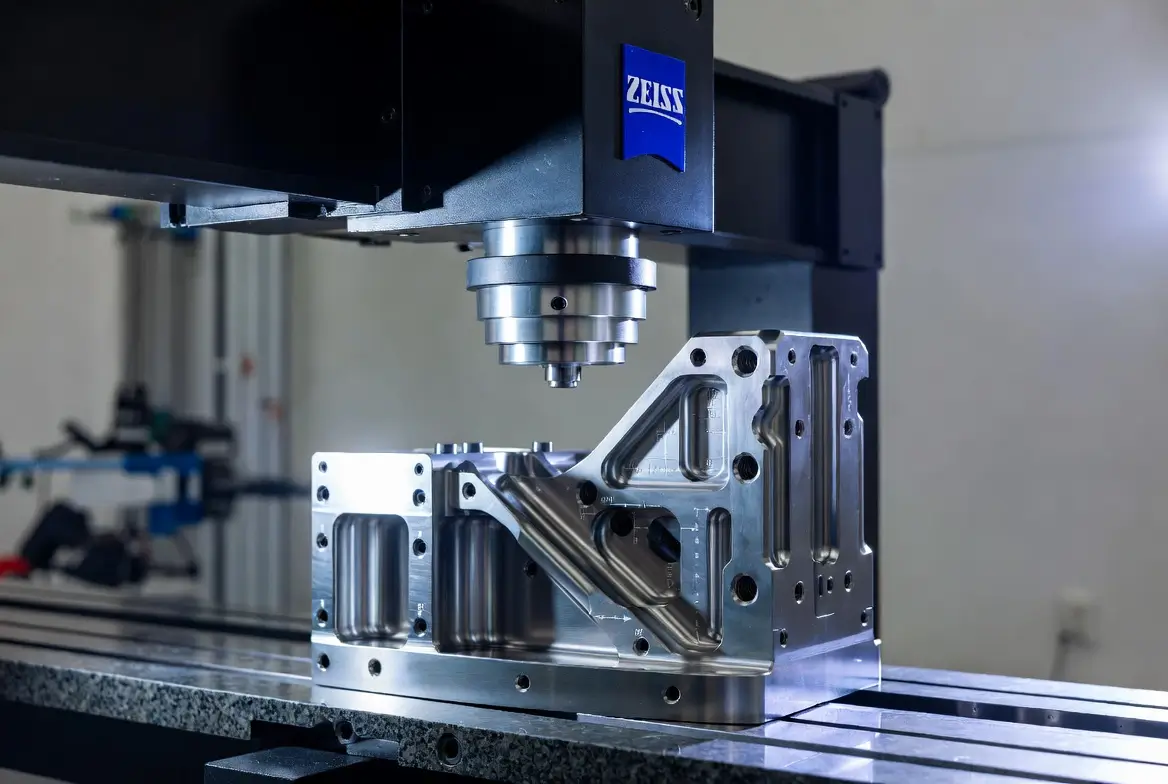
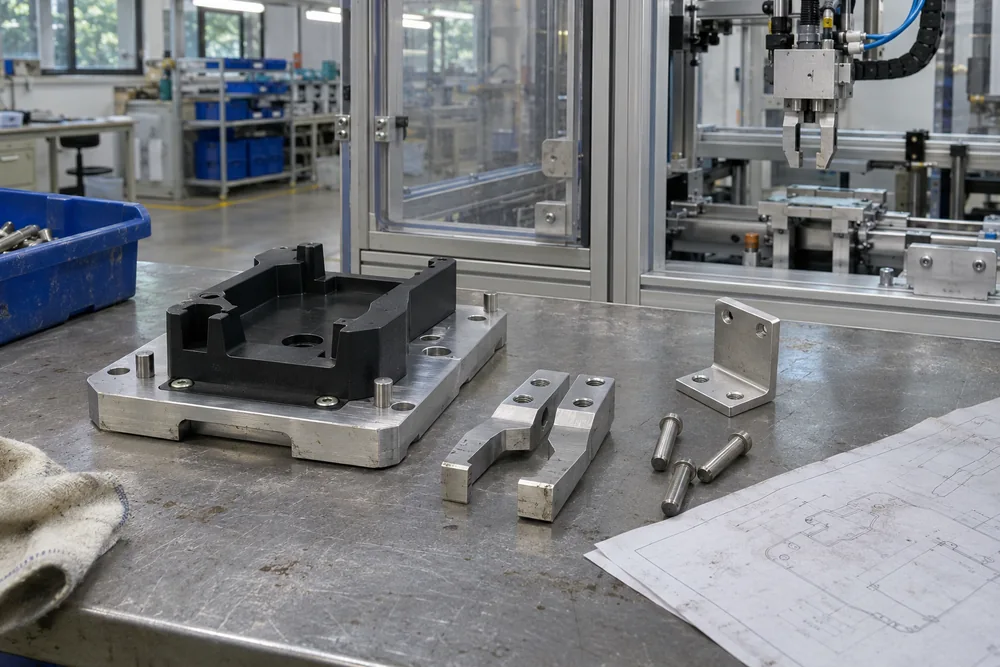
Most real lines mix the two. Standard machines handle the generic steps, and custom stations handle whatever is specific to the product. The custom content tends to cluster around the product itself: nests that hold it, grippers that pick it up, fixtures that clamp it for pressing or testing. Most of that product-specific hardware consists of custom machined parts drawn for the one machine, which is why custom automation keeps machine shops busy in a way standard equipment does not.
What Is Inside an Automation Machine
Behind the guards of almost any automation machine, the same handful of subsystems appears. What changes from machine to machine is the product-specific tooling in the middle.
| Subsystem | Its job | Typical hardware |
|---|---|---|
| Frame and base | Carries everything and keeps it aligned | Aluminum extrusion frames, welded steel frames, machined base plates |
| Motion | Moves the product or the tooling | Servo and stepper axes, linear modules, pneumatic cylinders, rotary indexers, conveyors |
| Handling tooling | Holds and locates the product | Nests, grippers, vacuum cups, fixtures |
| Process tooling | Does the actual work | Press heads, nutrunners, dispensing valves, welding heads, test probes |
| Sensing and vision | Confirms what happened | Proximity and fiber sensors, encoders, cameras, force sensors |
| Control | Runs the sequence | PLC, motion controller, HMI, industrial PC |
| Safety | Keeps people out of harm's way | Fixed guards, interlocked doors, light curtains, safety relays or safety PLC |
| Utilities | Feeds air, vacuum and power | Filter-regulators, valve terminals, cable chains, power distribution |
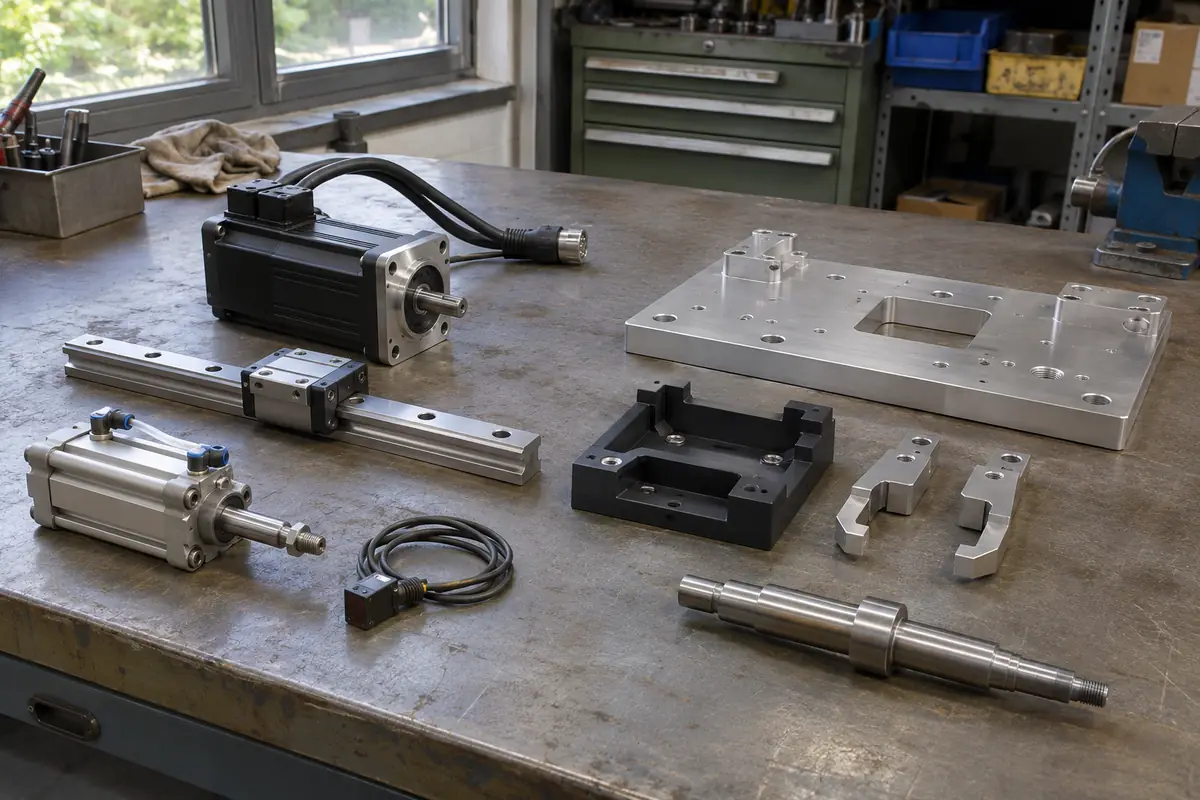
In a custom machine, nearly all the motion, sensing and control hardware is bought from catalogues. The frame plates, brackets and handling tooling are mostly made for the job. That split explains why two machines from different builders can use identical PLCs and servos and still behave very differently: the difference is in the mechanics around the product.
A few design choices come up on almost every machine. Pneumatic cylinders are the cheap answer for a move between two fixed positions. Servo axes take over when the position changes from product to product, or when force and speed have to be controlled through the stroke. Position feedback can confirm that a cylinder reached its end position rather than leaving the PLC to assume that it did; the sensing arrangement depends on the process and risk assessment.
Safety is designed in from the first concept, not bolted on at the end. Builders typically work through a risk assessment along the lines of ISO 12100, then design the safety-related parts of the control system to a required performance level under ISO 13849-1. Guard openings, door interlocks and light curtain positions all follow from that assessment.
Common Types of Automation Equipment by Task
Most automation equipment can be named by the job it does on the product. The same factory might run six of these side by side.
Assembly machines
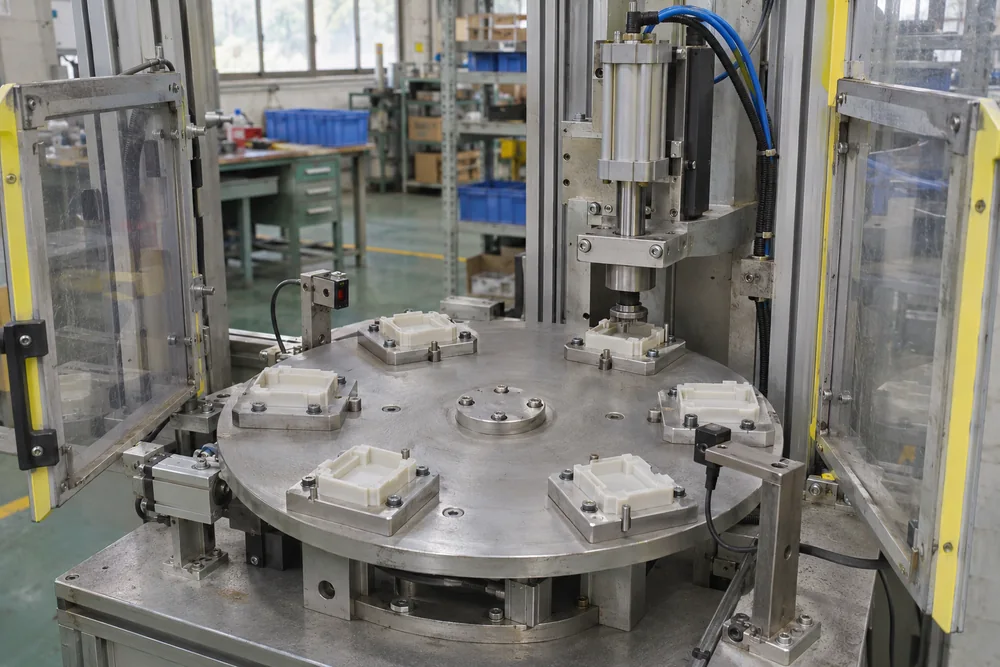
Assembly machines press-fit, screw, rivet, snap or weld parts together. Small parts are often built on a rotary index table, where a dial carries the part past a ring of stations. A dial is compact and quick, but the number of stations is fixed by its diameter. Larger or longer assemblies usually ride on pallets along a linear transfer system, which makes it easy to add a station later and lets a slow station work without holding up the rest.
Material handling equipment
Handling equipment moves product between places and orientations: conveyors, pick-and-place units, bowl feeders, palletizers, and mobile robots carrying totes. It rarely adds value to the product itself, yet many line stoppages start here, usually with a jam at a feeder or a transfer point.
Testing and inspection equipment
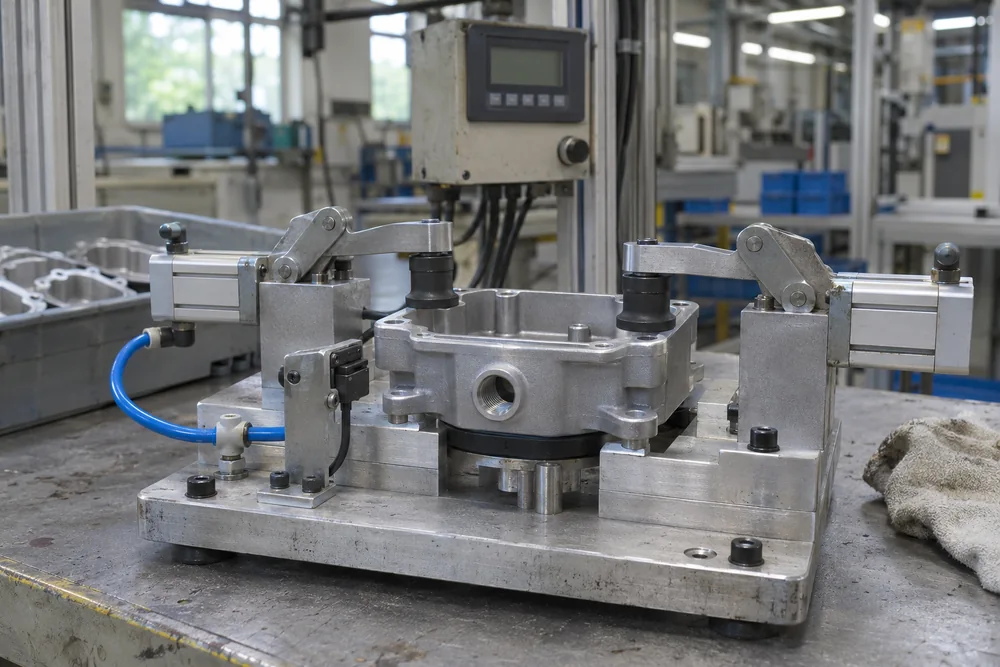
Leak testers, end-of-line electrical testers, vision inspection stations and gauging fixtures decide whether a product leaves the factory. They are often the most product-specific machines on a line, because the fixture that seals or contacts the part has to match it exactly.
Packaging equipment
Cartoners, case packers, labelers and wrappers are mostly standard machines adapted with change parts. Packaging is where buying from a catalogue makes the most sense.
Machine tending cells
A tending cell uses a robot, often a collaborative one, to load and unload a CNC machine, press or molding machine. The robot is standard; the gripper, part stands and the fixture in the machine are made for the part.
Dispensing, welding and joining
Glue and sealant dispensing, ultrasonic welding, laser welding and soldering all need tight control of position and process parameters. These stations combine a bought process unit with a custom fixture that holds the part in exactly the same place every cycle.
How Custom Automation Equipment Is Built
A custom machine goes through roughly the same stages at every builder, from the first specification to the day it runs production at the customer's plant.
- Requirements. The customer writes a user requirement specification covering the product and its variants, target cycle time, yield, footprint, available utilities and the safety standards that apply.
- Concept and proposal. The builder proposes a layout and a cycle time estimate and names the process steps it considers risky. A risky step, such as a new press-fit or a difficult vision check, is often proven on a test rig before the order is placed.
- Design. Mechanical, electrical and pneumatic design happen in parallel and end in a design review with the customer.
- Procurement. Catalogue components are ordered and custom parts go out for machining. Robots, servo systems and some sensors have long lead times, so they are ordered as early as the design allows.
- Build and debug. The machine is assembled, wired and programmed, then run dry and with real parts until it holds cycle time.
- Factory acceptance test (FAT). The customer sees the machine run at the builder's site, with production parts, against agreed criteria such as cycle time, yield and safety functions.
- Installation and site acceptance test (SAT). The machine is shipped, installed and tested again at the customer's plant, then ramped up to full production. Documentation and a spare-parts list are handed over at the end.
On many projects the schedule is set by stages 4 and 5. Machined parts often arrive in waves, and every missing part leaves a hole in the assembly. Debugging then exposes interferences and clearances that the CAD model did not catch, which is why drawings revised during build are normal on a first machine. A second machine built from the corrected drawings usually goes together much faster.
When Automation Equipment Pays Off
Automation pays off when the same task repeats often enough, for long enough, on a product that does not keep changing. Most investment cases are judged on a simple payback period:
Simple payback (years) = Equipment cost ÷ (Annual labor and quality savings − Annual running cost)
This estimate assumes positive annual net savings and excludes financing, taxes and the time value of money.
The formula hides the factors that actually decide the result. Equipment tends to justify itself where:
- The product design will stay stable for most of the machine's life
- Volume is high enough to keep the machine busy across shifts
- A quality step needs consistency people struggle to give, such as press-force monitoring, torque traceability or full inspection of every part
- The task is heavy, repetitive or hazardous, or the plant has trouble staffing it
It struggles with frequent product changes, uncertain volumes and materials that do not hold their shape, such as cables, fabrics and soft packaging. Tasks that rely on judgment, like sorting cosmetic defects without a clear standard, are hard to automate well.
The requirement most often missed is the consistency of incoming parts. An operator quietly compensates for a burr, a bent tab or a part at the edge of its tolerance. A feeder or gripper does not, and it jams instead. Before a manual step is automated, the tolerances of the parts feeding it usually need a second look, because they were set for human hands.
FAQ
What is the difference between automation equipment and a robot?
A robot is one kind of programmable motion device. Automation equipment is the whole machine. A robot welding cell counts as automation equipment, and so does a cam-driven press that contains no robot at all.
What are some examples of automation equipment?
Conveyors, rotary index assembly machines, leak testers, vision inspection stations, robot welding cells, case packers and CNC machine tending cells are all common examples.
What is non-standard automation equipment?
It is another name for custom automation equipment or special purpose machines: equipment designed around one customer's product and process instead of being sold from a catalogue. The term is especially common among suppliers in China.
What is the difference between FAT and SAT?
The factory acceptance test happens at the builder's site before shipping, with the customer present and production parts on the machine. The site acceptance test repeats the key checks at the customer's plant after installation, under real utilities and real production conditions.
How long does it take to build custom automation equipment?
It depends on the machine's complexity and on lead times for robots, servo systems and machined parts. A copy of a machine that has already been debugged goes together far faster than the first one.
What should a manufacturer prepare before requesting custom automation?
Product samples and drawings, the full list of variants, target cycle time and yield, expected volumes, available floor space and utilities, and the standards the machine must meet. The tolerances of the incoming parts belong on that list too. A machine can only be as consistent as the parts it is fed.