
EV Components
Manufacturing
CNCPioneer is a precision EV components manufacturing company and certified China electric vehicle components machining specialist delivering custom EV components machining programs — electric motor housing bodies, motor end cap assemblies, rotor shaft and output shaft programs, stator housing precision bore machining, battery pack structural end plates, battery module housing bodies, cooling plate and liquid cold plate machining, power electronics inverter housing bodies, on-board charger (OBC) housing assemblies, DC-DC converter housing bodies, busbars and high-current conductor elements, differential housing and reduction gear components, e-axle structural bodies, and complete EV powertrain component sets.
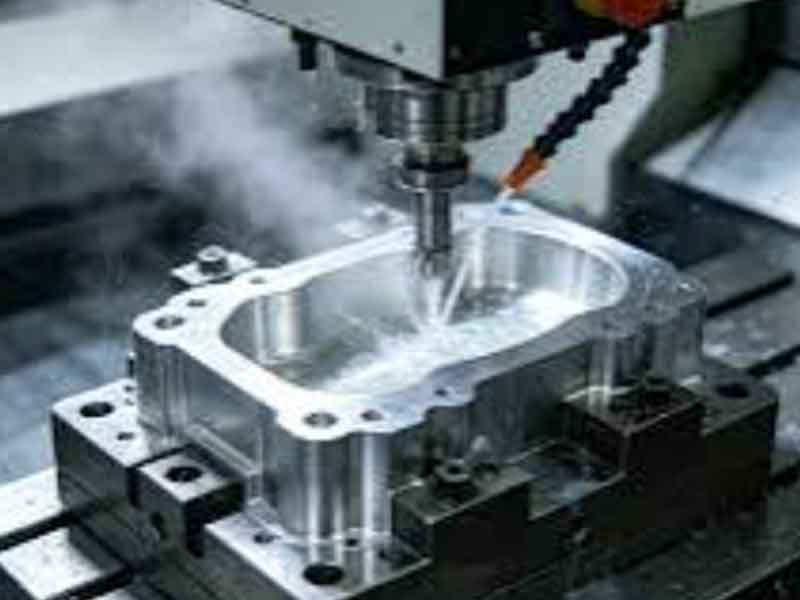
What Is EV Components
Manufacturing?
EV components manufacturing is the precision CNC machining, surface treatment, and quality documentation process — executed on multi-axis MAZAK mill-turn centers, 5-axis simultaneous machining platforms, Swiss CNC turning systems, and wire EDM — that produces the structural, mechanical, and thermal management hardware of battery electric vehicles (BEVs), hybrid electric vehicles (HEVs), and plug-in hybrid electric vehicles (PHEVs): motor housings that locate and thermally manage the traction motor stator; battery structural components that contain, protect, and thermally regulate the lithium-ion cell stack; power electronics enclosures that house the inverter, OBC, and DC-DC converter; drivetrain reduction gear and differential housings that transmit traction motor torque to the wheels; and the complete network of cooling, structural, and interface components that integrate these subsystems into a functional electric powertrain.
EV components machining differs from conventional automotive machining in four ways that define the technical requirements CNCPioneer's EV components manufacturing programs address. First, dimensional precision at motor integration: the electric traction motor stator bore must be machined to ±0.005mm diameter with ±0.002mm cylindricity to achieve uniform thermal contact conductance between stator and housing. Second, thermal management complexity: EV battery packs and power electronics generate heat at power densities of 2–30 W/cm² that must be extracted through precision-machined liquid cooling channels and cold plates. Third, EV powertrain mass criticality: every kilogram in an EV powertrain directly reduces driving range — components must achieve structural performance with minimum mass. Fourth, IATF 16949 production quality: EV components require PPAP Level 3 qualification, Cpk ≥1.67 on critical characteristics, SPC in real-time production, and full traceability from raw material to assembled vehicle.
-
Single-setup MAZAK mill-turn stator bore precision Stator bore diameter ±0.005mm, cylindricity ±0.002mm/50mm, and Ra 0.8μm contact surface finish from single-setup MAZAK mill-turn programs that machine stator bore, both bearing seats, and encoder pocket without rechucking — holding all coaxiality relationships by machine positioning accuracy rather than chuck re-registration error.
-
Liquid cooling channel machining as thermal performance discipline Channel bore position ±0.100mm, O-ring groove ±0.020mm, and coolant port thread ±0.005mm, with 100% pressure decay leak testing at 1.5× rated coolant pressure before any EV component leaves the facility — preventing coolant ingress to battery cells, motor windings, and power electronics.
-
Topology-optimized wall machining with mass verification EV components must achieve structural performance and sealing integrity simultaneously with minimum mass from topology-optimized aluminum alloy castings and billet machined to ±0.050mm wall uniformity — every kilogram in an EV powertrain directly reduces driving range.
-
40–60% China EV components cost advantage 40–60% below US/European EV component suppliers at identical IATF 16949 production quality, dimensional accuracy, and PPAP documentation — the cost advantage enabling EV OEMs and Tier 1 powertrain suppliers to achieve Bill of Materials targets for competitive EV pricing.

Why CNCPioneer — EV Components
Manufacturing Company
Key advantages establishing CNCPioneer as the preferred EV components machining supplier — from motor stator bore precision as the primary EV powertrain machining quality, through liquid cooling channel machining as a thermal performance discipline, to complete EV powertrain component portfolio from one manufacturing relationship.
Motor Stator Bore as Primary EV Powertrain Quality
The traction motor stator bore is the most functionally critical precision feature in EV components manufacturing — governing motor thermal performance, electromagnetic performance, and structural alignment. CNCPioneer's EV motor housing machining programs achieve ±0.005mm stator bore diameter, ±0.002mm/50mm cylindricity, and Ra 0.8μm contact surface finish from single-setup MAZAK mill-turn programs without rechucking.
Liquid Cooling Channel Machining Discipline
Every EV motor housing, battery cold plate, and power electronics enclosure contains precision-machined liquid cooling channels. CNCPioneer's programs achieve channel bore position ±0.100mm, O-ring groove ±0.020mm, and coolant port thread ±0.005mm, with 100% pressure decay leak testing at 1.5× rated coolant pressure before any EV component leaves the facility.
IATF 16949 Automotive Production Infrastructure
Full IATF 16949:2016 with PPAP Level 3, PFMEA-driven control plans, SPC with Cpk ≥1.67 on critical characteristics, MSA Gage R&R on all measurement systems, and documented corrective action response within 24 hours. Not an aspirational quality program but a verified, audited production infrastructure that automotive OEM and Tier 1 supplier quality organizations routinely audit and approve.
Complete EV Powertrain Portfolio — One Relationship
Motor housing, battery structural end plates, cooling plates, inverter housing, OBC enclosure, rotor shaft, reduction gear housing, e-axle body, and resolver housing — all from one IATF 16949 quality system. This eliminates inter-supplier dimensional tolerance accumulation that occurs when EV powertrain components are sourced from multiple machining suppliers.
5-Axis EV Component Machining
Modern e-axle structures, motor-gearbox integrated housings, and battery tray structural members have compound-angle mounting interfaces and non-orthogonal bearing bore arrangements. CNCPioneer's MAZAK VARIAXIS 5-axis programs machine compound-angle EV component features at ±0.020° angular accuracy — maintaining motor axis-to-gearbox axis angular relationship that governs driveline vibration and NVH performance.
China Cost Advantage — 40–60% Below US/EU
40–60% below equivalent EV components machining from US, European, and Japanese automotive precision machining facilities at identical IATF 16949 production quality, dimensional accuracy, and PPAP documentation. Engineering DFM review, thermal analysis, PPAP documentation, and coating allowance planning are included in program pricing without surcharges.
EV Components Manufacturing
Complete Product Portfolio
CNCPioneer's EV components manufacturing programs cover the complete precision-machined architecture of the modern battery electric vehicle powertrain — from electric motor housings and battery structural components through power electronics enclosures, drivetrain housings, and thermal management hardware.

Electric Motor Housing & End Cap Programs
Traction motor stator housing body: stator bore ±0.005mm diameter within H6/H7 tolerance class; bore cylindricity ±0.002mm/50mm; bore surface finish Ra 0.8μm; rotor bearing seats ±0.002mm diameter with ±0.001mm roundness; bearing seat coaxiality to stator bore ±0.005mm; liquid cooling jacket channel width ±0.100mm with 100% pressure decay test; housing-to-gearbox mating face flatness 0.010mm. Motor end caps (front + rear): rotor shaft output bearing seat ±0.002mm H6 class; shaft seal bore ±0.003mm; encoder stator mounting bore ±0.005mm. Materials: 6061-T6 or 6063-T5 aluminum standard; 6063-T5 provides 200 W/m·K thermal conductivity improving stator heat extraction by 20%.

Battery Pack Structural Components
Battery module end plates: face flatness 0.010mm/300mm; face parallelism 0.010mm; bolt hole true position ±0.010mm; material 6061-T6 aluminum standard (1/3 density of steel), anodized for corrosion protection. Battery tray and pack housing: module mounting pad flatness 0.020mm per zone; pack sealing face flatness 0.020mm/300mm for IP67 sealing; O-ring groove ±0.020mm width and depth; 100% pressure decay leak test at IP67 rating. Battery cold plate: plate top face flatness 0.010mm/300mm; internal coolant channel width ±0.100mm; wall thickness between channels ±0.050mm; 100% pressure decay leak test at 1.5× rated coolant pressure.

Power Electronics Housing Programs
Traction inverter housing: power module mounting surface flatness 0.005mm for maximum thermal conductance from 150–200°C silicon junction to coolant; mounting bolt holes ±0.010mm true position; DC bus bar interface bores ±0.020mm; AC phase output bus bar seats ±0.020mm; cooling jacket channel ±0.100mm; EMC shielding continuity Alodine Class 3 MIL-DTL-5541 with contact resistance ≤5 mΩ/cm². On-board charger (OBC) housing: transformer core seating pocket ±0.050mm; AC input connector boss ±0.050mm for SAE J1772 or IEC 62196; cooling jacket with 100% pressure decay test. DC-DC converter housing: winding core pocket ±0.050mm; 12V output busbar threaded boss ±0.010mm; thermal interface surface flatness 0.010mm.

Drivetrain & E-Axle Components
Single-speed reduction gearbox housing: input shaft bearing bore pair ±0.002mm each with bore-to-bore concentricity ±0.005mm; input-to-output shaft center distance ±0.010mm; inter-shaft angular relationship ±0.005°; housing-to-motor mating face flatness 0.010mm with pilot register ±0.005mm. E-axle integrated housing: motor stator bore ±0.005mm; gearbox bearing bore pairs ±0.002mm; motor-to-gearbox bore angular relationship ±0.020° controlled by 5-axis simultaneous machining; all critical bore pairs machined from single 5-axis setup preserving motor-to-gearbox-to-differential coaxiality chain. Rotor shaft: rotor stack mounting OD ±0.005mm k5 class; front and rear bearing journals ±0.002mm with concentricity ±0.002mm single-setup; gear input coupling spline ±0.002mm tooth spacing by wire EDM; high-speed dynamic balance residual unbalance ≤1 g·mm per plane at ISO 1940 G1.0.

Rotor Shaft & Output Shaft Programs
Rotor shaft for EV traction motor: 42CrMo4 through-hardened HRC 28–34 standard; 17-4PH H900 for corrosion-combined high-strength programs. Rotor stack mounting OD ±0.005mm k5 class for rotor lamination stack press fit; Ra 0.4μm. Front bearing journal ±0.002mm; Ra 0.1μm. Rear bearing journal ±0.002mm; concentricity to front journal ±0.002mm single-setup machining. Hollow through-bore ±0.005mm concentricity to OD journals for cable routing. Resolver target mount or encoder disc seat ±0.003mm TIR to bearing journals. Output shafts and stub shafts: transmit differential torque to wheels through CV joint interfaces; spline or key coupling ±0.002mm tooth spacing.

EV Thermal Management Machined Components
Coolant manifold bodies: main bore diameter ±0.050mm; branching port bore positions ±0.050mm; connection thread G1/4, G3/8, G1/2 BSP or 1/4"-18 NPT ±0.005mm; O-ring groove at all port interfaces ±0.020mm width and depth; 100% pressure decay test at 3× rated system pressure. Heat pump and chiller housing components: refrigerant circuit porting SAE J513 or DIN 477 flare or O-ring fitting bores ±0.010mm; compressor mounting interface ±0.010mm; expansion valve seat ±0.005mm bore; 100% helium leak test at rated refrigerant pressure. Heat exchanger end caps: close shell-and-tube or plate heat exchanger fluid sides with inlet/outlet connection precision.
Industries & Applications
CNCPioneer's EV components manufacturing serves every industry in the electric vehicle ecosystem — from passenger EV OEMs and commercial vehicle producers through powertrain Tier 1 suppliers, battery pack integrators, and EV charging infrastructure manufacturers.

Electric Vehicle
Complete EV components manufacturing programs for battery electric vehicle powertrains — motor housing, battery structural components, power electronics housings, rotor shafts, gearbox bodies, and e-axle integrated structures — as a single EV components manufacturing company relationship with APQP, IATF 16949 PPAP Level 3, and volume production economics aligned to EV program production ramp.
EV Powertrain
IATF 16949 certified EV components machining for electric axle, integrated motor-inverter, and battery system Tier 1 suppliers — motor housing and end cap programs with stator bore ±0.005mm; e-axle compound-bore 5-axis programs; battery cold plate with pressure decay certification; and inverter housing with EMC-compliant Alodine Class 3 treatment.

Electric Motor
Traction motor housing, end cap, and rotor shaft manufacturing for dedicated electric motor OEMs — stator bore machining from customer-supplied castings or billet; bearing seat concentricity ±0.005mm; cooling jacket with 100% leak test; and PPAP Level 3 production for automotive motor assembly line supply.
Battery Pack
Battery module end plate, battery tray structural component, and cold plate manufacturing for battery pack system integrators — matched bilateral end plate pairs ±0.010mm flatness differential; cold plate 100% pressure decay certification per module; and battery tray sealing surface machining to IP67 specification.
Power Electronics
Inverter, OBC, and DC-DC converter housing machining for EV power electronics Tier 1 and Tier 2 suppliers — power module mounting surface flatness 0.005mm; EMC bonding surface treatment; connector boss precision positioning; and IATF 16949 production for automotive electronics assembly line supply.
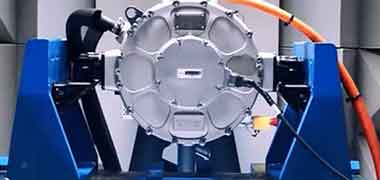
Commercial EV & Heavy-Duty EV
Large-format motor housings (Ø300–500mm stator bore) and high-current gearbox housings for commercial electric truck, bus, and construction equipment programs — larger VTC and MAZAK heavy-duty turning capacity; high-torque shaft programs in 42CrMo4; and scaled cooling system components for commercial EV thermal management.
EV Components Machining
Process & Capabilities
CNCPioneer's EV components manufacturing process runs on 66+ MAZAK Integrex and Quick Turn mill-turn centers, MAZAK VARIAXIS 5-axis platforms, and 78+ Swiss CNC lathes — thermal-stabilized spindles maintaining ±0.005mm diameter compliance across multi-hour production runs, sub-spindle transfer for single-setup completeness, and live tooling for milling, drilling, and threading operations within the same turning setup.
24-Hour APQP & DFM Engineering Review
Every EV components manufacturing inquiry receives engineering APQP and DFM review within 24 hours: stator bore tolerance class adequacy for motor stator OD fit and thermal contact; bore concentricity chain feasibility from single-setup vs. multi-setup analysis; cooling jacket pressure rating from minimum wall thickness FEA; anodize allowance in stator bore and bearing seat dimensions; 6061-T6 vs 6063-T5 thermal performance comparison for continuous torque requirement; cold plate channel geometry thermal resistance calculation; and material selection guidance per component against torque class, corrosion environment, and mass target.
MAZAK Mill-Turn Single-Setup Programs
Single-setup program for EV motor housing: face and center → stator bore rough → rotor bearing seat rough → cooling jacket rough → 30-minute thermal stabilization → stator bore finish ±0.005mm → bearing seats finish ±0.002mm → cooling jacket finish ±0.100mm → C-axis features (coolant ports, phase lead exits, mounting bolt circles). Thermal expansion management: 6061-T6 aluminum CTE = 23.6 ppm/°C; a Ø250mm stator bore at 10°C above ambient is 0.059mm oversize — consuming the entire ±0.005mm tolerance budget 12×. Mandated 30-minute thermal stabilization verified by in-process temperature probe before finish boring.
5-Axis EV Component Machining
MAZAK VARIAXIS 5-axis simultaneous machining for compound-geometry EV components: e-axle integrated housing with all bore pairs (motor + gearbox + differential) from progressive 5-axis setups with inter-bore angular relationships ±0.020°; battery tray freeform structure with 5-axis simultaneous roughing and finish machining of sealing faces and module mounting pads from one datum; cold plate complex channel routing with 5-axis end mill following complex internal channel paths for maximum coolant path length in minimum plate volume.
Cooling Channel & Cold Plate Machining
Cold plate channel machining sequence: plate face rough mill both sides → residual stress relief at 175°C × 3 hours for 6061-T6 → channel rough mill → in-process CMM measurement at minimum wall zones → channel finish mill ±0.100mm width and depth → face finish grind top face flatness 0.010mm/300mm Ra 0.8μm → port machining with O-ring grooves ±0.020mm → 100% pressure decay leak test at 1.5× rated coolant pressure, 30-second hold, zero decay acceptance before shipment.
In-Process Control & Final Inspection
First-off air gauge and CMM verification before batch release. Adaptive offset correction for tool-wear diameter drift maintaining ±0.005mm stator bore compliance without operator intervention. Roundness measurement after finish-turning on all bearing-interface journals. In-process CMM probe at 3 axial positions confirming cylindricity before proceeding. SPC Cpk ≥1.67 on IATF special characteristics: stator bore diameter, bearing seat concentricity, cold plate flatness, and gearbox bearing bore center distance. 100% pressure decay leak test on all coolant components.
IATF 16949 / AS9100D Documentation
Certificate of Conformance · Air gauge stator bore records per lot · CMM dimensional report (concentricity, perpendicularity, face flatness, bolt circles, groove positions) · Roundness tester form verification · Profilometer surface finish records · 100% pressure decay leak test records per serial number · Material certifications with heat lot traceability · Heat treatment and coating certifications · PPAP Level 3 for volume programs · FAIR per AS9102 for aerospace/defense · All records retained 20 years.
Materials for EV Components
Manufacturing
EV components manufacturing material selection is governed by thermal conductivity for motor housing heat extraction, structural yield strength for drivetrain loading, mass sensitivity for range optimization, and corrosion resistance for coolant and road salt environments. 6061-T6 aluminum dominates motor housings; 6063-T5 provides 20% better thermal conductivity for thermally-governed designs.
Aluminum 6061-T6
167 W/m·K thermal conductivity · 2.70 g/cm³ · 310 MPa UTS · Standard material for motor housings, inverter housings, battery trays, and end plates. The workhorse aluminum alloy for EV components machining — excellent machinability at ±0.005mm tolerance, good corrosion resistance, and adequate strength for most EV structural applications. Type II clear anodize standard for corrosion protection in coolant and condensation environments.
Aluminum 6063-T5
200 W/m·K thermal conductivity · 2.70 g/cm³ · 186 MPa UTS · Thermal-priority motor housings and cold plate base material. The 20% improvement in thermal conductivity over 6061-T6 translates to approximately 8–12°C lower stator temperature at rated continuous power — enabling either 8–12% higher continuous torque or extended motor service life. CNCPioneer's DFM review recommends 6063-T5 for thermally-governed designs and 6061-T6 where structural loading at mounting interfaces governs.
Aluminum 7075-T6
130 W/m·K · 2.80 g/cm³ · 572 MPa UTS · High-strength EV structural brackets and rotor shaft applications where 6061-T6 strength is insufficient. Standard for high-strength EV structural brackets; also used for motor end caps requiring maximum structural rigidity. Hard anodize Type III (HV 400+) for wear resistance at sliding interfaces.
Aluminum A356-T6 (Cast)
155 W/m·K · 2.68 g/cm³ · 228 MPa UTS · High-volume cast motor and gearbox housings — customer-supplied castings precision machined at CNCPioneer for critical bore pairs and mating faces. Cast A356-T6 from customer-supplied castings for high-volume production programs where billet machining economics are uncompetitive. All critical bores and faces machined to ±0.005mm after casting.
Aluminum ADC12 (Die-Cast)
96 W/m·K · 2.74 g/cm³ · 310 MPa UTS · Complex-geometry die-cast gearbox housing bodies — machined at CNCPioneer for critical bore pairs and mating faces. ADC12 die-cast aluminum for complex-geometry gearbox housing bodies where casting enables near-net-shape production; precision machining restricted to bearing bore pairs, sealing faces, and mounting interfaces. Standard for high-volume gearbox housing production.
Steel 42CrMo4 QT
42 W/m·K · 7.85 g/cm³ · 1,000 MPa UTS · Standard rotor shafts, gear shafts, and high-strength drive components. Through-hardened to HRC 28–34; toughness-first choice for high-torque output shafts where impact loading requires resistance to crack propagation. Finish-turning after heat treatment with laser micrometer diameter and roundness tester verification.
Steel 20CrMnTi (Case-Hard)
38 W/m·K · 7.85 g/cm³ · Surface HRC 60–62 · EV gearbox gear shafts and differential gears — case-carburized and hardened for gear tooth root fatigue resistance. Machined before case hardening in single-setup programs; case hardening adds HRC 60–62 surface at 0.8–1.5mm case depth; final journal finishing restores ±0.002mm accuracy post-hardening.
Stainless 316L
16 W/m·K · 7.99 g/cm³ · 485 MPa UTS · Coolant manifolds in aggressive coolant environments — mandatory passivation ASTM A967 restores passive oxide layer after machining. Superior corrosion resistance for chemically aggressive coolant formulations and marine-environment EV applications.
Stainless 17-4PH H900
18 W/m·K · 7.75 g/cm³ · 1,310 MPa UTS · High-strength corrosion-resistant EV motor shafts where 42CrMo4 corrosion resistance is insufficient. H900 aging delivers HRC 44–47 with machinability at bearing-quality tolerances without post-machining grinding — eliminating heat treatment dimensional scatter from precision-critical features.
Copper C11000 ETP
391 W/m·K · 8.94 g/cm³ · 220 MPa UTS · HV busbars and current distribution elements — machined from copper billet or bar with precision hole patterns and connection features for battery pack and inverter busbar assemblies. Highest thermal and electrical conductivity in the EV components material set.
Titanium Ti-6Al-4V
7 W/m·K · 4.43 g/cm³ · 950 MPa UTS · Weight-critical EV structural fasteners and non-magnetic mounts. Specific strength delivers mass reduction in weight-critical applications where steel mass penalty is unacceptable. Non-magnetic property for sensor-adjacent EV components requiring magnetic field transparency.
Magnesium AZ91D
72 W/m·K · 1.81 g/cm³ · 230 MPa UTS · Ultra-lightweight EV cover components and instrument housings — 33% lighter than aluminum with adequate thermal conductivity for non-structural covers. Used for battery pack cover components and visible EV powertrain covers where mass reduction is primary and structural loads are secondary.
Surface Treatments for
EV Components Manufacturing
EV components surface treatment selection addresses corrosion resistance for aluminum motor housings and battery trays in coolant, salt spray, and condensation environments; wear resistance at bearing and sliding interfaces; EMC shielding continuity at power electronics housing seams; and cosmetic protection for visible exterior surfaces — coating allowances are machined-in and verified post-treatment.
Type II Clear Anodize — MIL-A-8625
Corrosion protection for aluminum EV motor housing, inverter housing, battery tray, and cold plate components — 5–15μm clear anodize providing corrosion resistance in coolant, salt spray, and condensation environments without changing dimensional compliance. ASTM E595 TML ≤0.02% for outgassing-sensitive applications. Anodize bore allowance: stator bore and bearing seat bores machined with anodize growth allowance (5–8μm per side for Type II on 6061-T6) as standard; post-anodize bores verified ±0.003mm of specification by 100% air gauge.
Type III Hard Anodize — MIL-A-8625
HV 400+ hardness for aluminum EV component sliding contact surfaces — rotor bearing seat OD wear protection; e-axle housing bore wear protection; battery module guide rail surfaces. Black hard anodize for thermal emissivity management in battery pack interior surfaces. Provides wear resistance at housing-to-bearing interfaces where repeated assembly and service operations would gall uncoated aluminum. Machining allowance: 25–50μm per side incorporated in bore and OD finish dimensions.
Passivation — ASTM A967
Mandatory for 316L stainless coolant manifolds and 17-4PH motor shaft components — restores passive oxide layer after machining. Removes machining free iron, enhances the passive chromium oxide layer for maximum corrosion resistance across EV powertrain service life, and applies zero dimensional change. Passivation liquid penetrates all internal features uniformly including cross-holes, grooves, threads, and bores machined in single-setup programs. Passivation certificates included in standard shipment documentation.
Electroless Nickel — MIL-C-26074
Corrosion protection for aluminum EV component bores and threads in aggressive coolant chemistry environments — Ni-P coating uniform on complex internal features; ±0.003mm plating allowance incorporated in machined dimensions. Mid-phosphorus (8–10% P) or high-phosphorus (10–12% P) formulation for maximum corrosion resistance. Post-plate air gauge verification on all journal diameters confirms bearing interference class compliance before lot release. Critical for seal-contact zones reducing running-in wear.
Alodine Class 3 — MIL-DTL-5541 (EMC Bonding)
Electrically conductive chromate conversion for aluminum EV inverter, OBC, and PDU housing assembly seam interfaces — contact resistance ≤5 mΩ/cm² for EMC shielding continuity at housing joints. EV inverter housing programs require this treatment at all cover mating surfaces for UNECE R10 electromagnetic compatibility compliance. Applied to all housing seam interfaces where electrical continuity between mating aluminum surfaces must be maintained for EMI suppression.
Powder Coat & Zinc-Nickel Electroplate
Powder coat: cosmetic and corrosion protection for battery tray external surfaces and visible EV powertrain component exteriors — color per OEM specification; applied over Alodine pretreatment for maximum adhesion; battery tray bottom UV-resistant powder coat for road environment exposure. Zinc-Nickel: 8–12μm Zn-Ni (12–15% Ni) providing >1,000 hours salt spray resistance per DIN 50021 SS; RoHS-compliant alternative to cadmium plating for European and Chinese market EV programs on steel drivetrain components.
All surface treatments on EV components manufacturing programs — Type II/III anodize, passivation ASTM A967, electroless nickel MIL-C-26074, Alodine Class 3, powder coat, and zinc-nickel electroplate — are documented with treatment certifications and post-treatment dimensional verification. Plating and coating allowances are machined-in to journal and bore dimensions at the CNC machining stage and confirmed post-treatment by air gauge or CMM. Treatment selection guidance and dimensional allowance calculation are included in CNCPioneer's 24-hour DFM review at no additional cost.
Quality Assurance for
EV Components Manufacturing
EV components manufacturing quality assurance addresses motor stator bore precision with 100% air gauge verification, cooling component integrity with 100% pressure decay leak testing, battery structural flatness with CMM verification, and full IATF 16949 PPAP Level 3 documentation for automotive production programs.
Engineering APQP & DFM Review
24-hour DFM review covering: stator bore tolerance class adequacy for motor stator OD fit and thermal contact; bore concentricity chain feasibility from single-setup vs. required multi-setup analysis; cooling jacket pressure rating from minimum wall thickness FEA; anodize allowance in stator bore and bearing seat dimensions; 6061-T6 vs 6063-T5 thermal performance comparison; cold plate channel geometry thermal resistance calculation; and material selection per component against torque class, corrosion, and mass targets.
Material Verification
SII XRF composition confirmation on every EV components material lot — 6061-T6, 6063-T5, 7075-T6, A356-T6, ADC12, 42CrMo4, 20CrMnTi, 17-4PH, 316L, C11000 copper, and Ti-6Al-4V confirmed before machining operations begin. Hardness verification post-aging and post-heat-treatment per lot before final finishing. Bar stock and casting incoming dimensional check before MAZAK loading. Full mill-certificate-to-shipment lot traceability.
In-Process Machining Control
First-off air gauge and CMM verification before batch release. Adaptive offset correction for tool-wear diameter drift maintaining ±0.005mm stator bore compliance without operator intervention. 30-minute thermal stabilization verified by in-process temperature probe before finish boring — the single process discipline most responsible for achieving ±0.005mm stator bore consistency. In-process CMM probe at 3 axial positions confirming cylindricity before proceeding. SPC Cpk ≥1.67 on IATF special characteristics.
Final Inspection — 100% Leak Test & Dimensional Verification
100% air gauge stator bore verification on all motor housing programs. 100% pressure decay leak test at 1.5× rated coolant pressure (minimum 4.5 bar test for 3 bar rated systems) with 30-second hold and zero decay acceptance on all EV cooling components. CMM dimensional report: concentricity, perpendicularity, face flatness, bolt circles, groove positions, and compound bore angular relationships. Roundness tester form verification on bearing journals and bores. Profilometer surface finish verification.
PPAP Level 3 Qualification
PPAP Level 3 qualification for all volume EV components manufacturing programs: design records with engineering change authorization; DFMEA and PFMEA; process flow diagram; control plan (pre-launch and production); MSA Gage R&R ≤10% for all critical gauging; dimensional results on 30-piece sample; initial process study with SPC Cpk ≥1.67; qualified laboratory documentation; appearance approval report; sample production parts; master sample; and part submission warrant.
Documentation Package
Certificate of Conformance · Air gauge stator bore diameter records per lot · CMM dimensional report (concentricity, perpendicularity, face flatness, bolt circles, groove positions, multi-journal concentricity) · Roundness tester form verification · Profilometer surface finish records · 100% pressure decay leak test records per serial number · Material certifications with lot traceability · Heat treatment and coating certifications · PPAP Level 3 for volume programs · FAIR per AS9102 for aerospace/defense · All records retained 20 years.
IATF 16949 Quality System for
EV Components Manufacturing
CNCPioneer's IATF 16949 and AS9100D certified EV components manufacturing quality system addresses the four quality dimensions specific to EV powertrain production: single-setup stator bore precision governance, 100% pressure decay leak testing for thermal management integrity, topology-optimized wall machining verification, and PPAP Level 3 bridge to volume EV OEM supply chain qualification.
Single-Setup Stator Bore Governance
Stator bore ±0.005mm and bearing seat concentricity ±0.005mm are structural guarantees — not outcomes of skilled operators achieving best possible results through multiple setups. CNCPioneer's MAZAK mill-turn single-setup motor housing programs make concentricity a machine-positioning accuracy outcome rather than a rechucking-uncertainty outcome: stator bore, both bearing seats, and encoder pocket share the same spindle axis. This structural guarantee extends through volume production without degradation — the ten-thousandth motor housing is as concentric as the first prototype.
- Stator bore diameter ±0.005mm structural
- Bearing seat concentricity ±0.005mm single-setup
- No rechucking error in concentricity budget
100% Pressure Decay Leak Testing
Every EV component with internal coolant passages receives 100% pressure decay test at 1.5× rated coolant pressure (typically 4.5–7.5 bar for EV systems rated at 3–5 bar operating pressure), 30-second hold minimum, zero pressure decay acceptance criterion. Test pressure traceable to calibrated pressure transducer per ISO 10012. Test record per serial number: date, time, test pressure, hold duration, result, technician. Failed component: tagged, segregated, root cause investigation mandatory before batch release.
- 100% test on all coolant components — no sampling
- 1.5× rated pressure, 30-second hold, zero decay
- ISO 10012 calibrated transducer traceability
Thermal Management & Flatness Protocol
Battery cold plate top face flatness 0.010mm/300mm verified by CMM after residual stress relief heat treatment at 175°C and finish face grinding. In-process CMM measurement at minimum inter-channel wall zones confirms wall thickness above structural minimum before finish machining. Battery end plate face flatness 0.010mm/300mm and parallelism 0.010mm verified on matched bilateral pairs. Inverter power module mounting surface flatness 0.005mm verified by CMM for maximum thermal conductance from silicon junction to coolant.
- Cold plate flatness 0.010mm/300mm post-stress-relief
- End plate bilateral pair matching ±0.010mm
- Inverter baseplate flatness 0.005mm for thermal conductance
PPAP Level 3 & Volume Supply Chain Qualification
PPAP Level 3 qualification for EV OEM and Tier 1 supply chains: design records, process flow (including single-setup sequence documentation), PFMEA covering tool wear diameter drift, thermal distortion failure modes, and leak test escape modes, control plan, MSA Gage R&R on air gauge and CMM measurement systems, initial capability studies (Cpk ≥1.67 on IATF special characteristics: stator bore diameter, bearing seat concentricity, cold plate flatness, pressure decay pass/fail), and part submission warrant. Generated on the same MAZAK programs used in volume production.
- PPAP Level 3 for EV OEM and Tier 1 supply
- Cpk ≥ 1.67 on stator bore / concentricity / flatness
- MSA Gage R&R on air gauge + CMM systems
EV Components Manufacturing FAQ
Common questions from electric vehicle OEMs, EV powertrain Tier 1 suppliers, electric motor manufacturers, battery pack integrators, and power electronics suppliers about CNCPioneer's EV components manufacturing capability, stator bore tolerances, cooling system leak testing, PPAP qualification, and volume production economics.
The ±0.005mm stator bore tolerance for EV traction motor housings governs two simultaneous and equally critical performance parameters. First is thermal performance: the traction motor stator dissipates 5–15 kW of resistive and iron core loss heat at continuous rated power that must be conducted through the stator OD-to-housing bore interface to the water jacket coolant. The thermal contact conductance at this interface scales with contact pressure — and contact pressure is determined by the interference fit between stator OD and housing bore. At ±0.005mm bore diameter, the total interference range is ±0.010mm, producing a contact conductance range of approximately ±25% and corresponding ±2°C winding temperature variation — acceptable for a motor designed with 5°C thermal margin. At ±0.015mm bore diameter, the total interference range is ±0.030mm, producing ±75% contact conductance variation equivalent to ±6°C winding temperature variation that consumes the full thermal margin, causing some motor units to operate at or above insulation temperature limits. Second is motor NVH: stator bore eccentricity to the rotor bearing seats produces non-uniform air gap around the motor circumference, generating electromagnetic forces at twice the electrical frequency. At ±0.005mm bore concentricity, air gap eccentricity is approximately 1.7% of a typical 0.3mm air gap, producing ~3% cogging torque variation. At ±0.015mm, eccentricity reaches 5% of air gap, producing 8–10% cogging torque variation experienced as motor vibration and traction force ripple.
CNCPioneer's 100% pressure decay leak testing uses a precision pressure decay test system where each component is pressurized to 1.5× rated coolant pressure (typically 4.5–7.5 bar for EV systems rated at 3–5 bar operating pressure), sealed, and monitored for pressure decay over a 30-second hold period. Detection sensitivity: at 6 bar test pressure on a 500 cm³ internal volume component with ±0.005 bar pressure measurement resolution, the system detects leaks as small as 8.3×10⁻⁵ bar·L/s — equivalent to approximately 10⁻³ Torr·L/s, a macro-scale leak detectable as visible coolant weeping after assembly and well above the catastrophic failure threshold for battery pack coolant contamination. The 100% test protocol means no statistical sampling risk — every EV cooling component that ships has been individually verified. Test records include component serial number, test date, test pressure, hold duration, initial pressure, final pressure, and pass/fail determination — documentation that EV OEM quality systems require for traceability when a battery thermal event occurs in the field.
The distinction is the systematic quality management infrastructure that governs every production decision — not the machine tool capability alone. The IATF 16949 infrastructure includes: APQP (Advanced Product Quality Planning) — a structured program launch process that identifies critical characteristics, designs the control plan before first production, and qualifies the measurement system before volume production begins. PFMEA (Process Failure Mode and Effects Analysis) — documenting every potential failure mode in the machining, measurement, and handling process with detection controls and reaction plans. SPC (Statistical Process Control) — real-time control charts on critical dimensions with Cpk ≥1.67 maintained by adaptive CNC offset correction before any process drift reaches the control limit. MSA (Measurement System Analysis) — verifying that every gauging system contributes less than 10% of tolerance variation (Gage R&R ≤10%). PSW (Part Submission Warrant) — a signed commitment that the production process is capable and controlled before volume production begins. This infrastructure is what makes CNCPioneer an EV components manufacturing company qualified for automotive Tier 1 and OEM supply rather than a precision machining job shop.
Prototype lead times: 6061-T6 motor housing body (Ø180–250mm stator bore, cooling jacket, all features) — 10–14 business days; 42CrMo4 rotor shaft — 8–12 business days; 6061-T6 battery module end plates — 5–8 days; battery cold plate with channel machining and pressure decay test — 8–12 days; inverter housing body — 10–14 days; e-axle integrated housing (5-axis compound bore) — 14–21 days. Surface treatment additions: anodize +2–3 days; Alodine +1–2 days; powder coat +4 days. Development quantities (25–200 units): 2–3 weeks per batch with 25–40% per-unit reduction. PPAP Level 3 qualification: 6–8 weeks from pilot completion. Volume production: 2-week monthly blanket releases with dedicated MAZAK capacity and safety stock. Economics: a 6061-T6 EV motor housing (Ø200mm stator bore, full cooling jacket, Type II anodize) at $480 US prototype price costs approximately $265 at CNCPioneer prototype — and $95–120 at 5,000 annual units, $75–90 at 25,000+ annual units. For a mid-size EV OEM producing 50,000 vehicles annually with 3 major machined housing components per vehicle at an average $250 savings per component, CNCPioneer delivers $37,500,000 annual BOM cost reduction.
Get a Quote for EV Components Manufacturing
Upload your EV component drawings, CAD files, or powertrain component BOM and receive a free APQP-based DFM review and competitive quotation within 24 hours — covering motor stator bore tolerance class for your thermal contact and air gap requirements, cooling channel geometry thermal resistance analysis, bearing seat concentricity chain feasibility, 5-axis routing assessment for compound-geometry e-axle programs, material selection and surface treatment specification, PPAP Level 3 qualification timeline, and complete pricing from prototype through volume production.